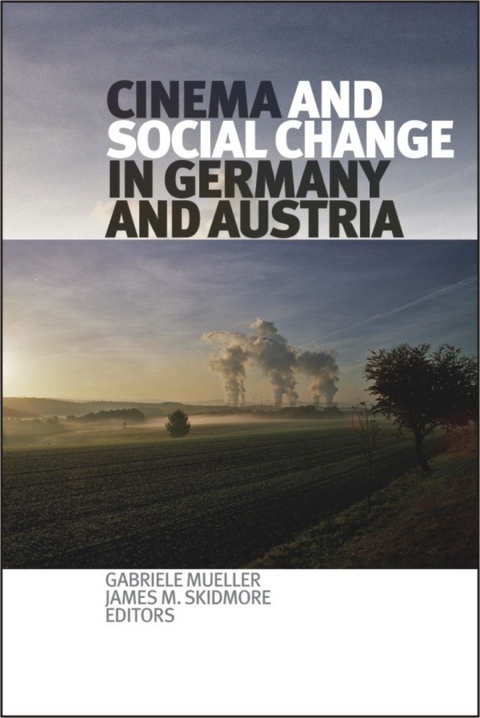
Cinema and Social Change in Germany and Austria (eBook)
314 Seiten
Wilfrid Laurier University (Verlag)
978-1-55458-138-2 (ISBN)
During the last decade, contemporary German and Austrian cinema has grappled with new social and economic realities. The cinema of consensus, a term coined to describe the popular and commercially oriented filmmaking of the 1990s, has given way to a more heterogeneous and critical cinema culture. Making the greatest artistic impact since the 1970s, contemporary cinema is responding to questions of globalization and the effects of societal and economic change on the individual. This book explores this trend by investigating different thematic and aesthetic strategies and alternative methods of film production and distribution. Functioning both as a product and as an agent of globalizing processes, this new cinema mediates and influences important political and social debates. The contributors illuminate these processes through their analyses of cinema s intervention in discourses on such concepts as national cinema, the effects of globalization on social mobility, and the emergence of a global culture. The essays illustrate the variety and inventiveness of contemporary Austrian and German filmmaking and highlight the complicated interdependencies between global developments and local specificities. They confirm a broader trend toward a more complex, critical, and formally diverse cinematic scene. This book offers insights into the strategies employed by German and Austrian filmmakers to position themselves between the commercial pressures of the film industry and the desire to mediate or even attempt to affect social change. It will be of interest to scholars in film studies, cultural studies, and European studies.
2
The Counter-Cinema of the Berlin School
Marco Abel
Abstract This chapter discusses the filmmaking movement known as the “Berlin School.” I argue that these films constitute a counter-cinema in the sense that they manage to critically engage the neo-liberalization of contemporary Germany because of, rather than despite, their particular aesthetics. These aesthetics, which I define as “a-representational realism,” allow these films both to foreground critically the issue of mobility as one of the central socio-cultural aspects affecting contemporary German political discourse and to afford their viewers a chance to become affected by a (utopian) sensation of mobility that is currently absent in their actual existing, neo-liberal social spaces.
After a quarter century of neglect, German cinema has rekindled international interest in its productions. The many awards and recognitions German films have recently garnered—I’m thinking here of films such as Caroline Link’s Nirgendwo in Afrika (Nowhere in Africa, 2001), Wolfgang Becker’s Good Bye, Lenin! (2003), Fatih Akin’s Gegen die Wand (Head-On, 2004), Hans Weingartner’s Die fetten Jahre sind vorbei (The Edukators, 2004), Oliver Hirschbiegel’s Der Untergang (Downfall, 2004), Marc Rothemund’s Sophie Scholl—Die letzten Tage (Sophie Scholl—The Final Days, 2005), and Florian Henckel von Donnersmarck’s Das Leben der Anderen (The Lives of Others, 2006)—evidence this renaissance of German film culture. Only too predictably, the German press and the country’s film industry representatives jumped on the opportunity to appropriate the recent success stories of German films, as if to declare that “we’re somebody again.” This nationalistic rhetoric eagerly espouses the belief in a German film resurgence—a convenient myth that via a synecdochical logic allowed more nationalistically minded journalists and bureaucrats to dream of the long hoped-for fulfillment of their desire to see the country itself resurge out of the long shadows cast by its totalitarian history (and post-unification economic woes) and emerge, at long last, as a “normal” country. As appealing as this view of German film history may be, it simply draws an incorrect picture, as one of Germany’s leading film critics, Katja Nicodemus, asserts in response to this new-found nationalist feeling about German film productions. The mainstream press and film industry representatives, who now celebrate the success of Der Untergang or Das Leben der Anderen as ingenious entrepreneurial endeavours that almost single-handedly pulled German films into the limelight of international film culture, have always obsessively focused their attention on how well the country’s film productions fare at the box office. They have rarely paid attention to developing a healthy film-cultural infrastructure capable of nurturing and sustaining a broad range of homemade productions—including artistically innovative small-scale films that usually do not rake in big returns at the box office, but that are, aesthetically, considerably more challenging than the nation’s best-known productions. And yet, as Nicodemus argues, it is precisely these small films that constitute the proper “we” at the heart of German film culture, rather than the few internationally renowned mainstream successes opportunistically celebrated by the country’s culture industry.
Accounting for the recent developments in German film culture, French film critics coined the phrase nouvelle vague Allemande (Knörer). Pleased with this positive reception across the Rhine, the German film industry un-self-critically appropriated this assessment into their own self-satisfied nationalist sentiments, all the while ignoring that for the French this term encompasses not merely films such as Good Bye, Lenin! but also Henner Winckler’s Klassenfahrt (School Trip, 2002), Ulrich Köhler’s Bungalow (2002), Christoph Hochhäusler’s Milchwald (This Very Moment, 2003), or Angela Schanelec’s Marseille (2004). It is films such as these—persistently ignored at home—that cumulatively demonstrate the emergence of a new film language in German cinema and constitute, according to Nicodemus, the true core of contemporary German film culture. Yet, what appeared to Cahiers du cinéma and Le Monde as a “new” wave of creatively innovative German films are, in fact, only more recent examples of a subterranean genealogy of German filmmaking that hearkens back to the first half of the 1990s. Consequently, what appears to many as a resurgence of German cinema is much better thought of as a continuation of an ongoing filmmaking process since unification—one that has predominantly taken place below the radar of the country’s self-appointed cultural guardians.
This, if you will, counter-cinema, has become known in Germany as the Berlin School. The films associated with this school distinguish themselves from other post-wall German films primarily in that they constitute the first significant (collective) attempt at advancing the aesthetics of cinema within German narrative filmmaking since the New German Cinema of Rainer Werner Fassbinder, Werner Herzog, Wim Wenders, Alexander Kluge, Klaus Lemke, Margarethe von Trotta, Jean-Marie Straub, and Danièle Huillet, and others. So who or what is the Berlin School? The label was coined by German film critic Merthen Worthmann in a review of Schanelec’s film Mein langsames Leben (Passing Summer, 2001), but was subsequently used by critics to refer to films by what is now known as the first generation of the Berlin School: Schanelec, Christian Petzold, and Thomas Arslan. All three attended and graduated in the early 1990s from the Deutsche Film und Fernsehakademie Berlin (DFFB), arguably the country’s most intellectual film school, and were taught by avant-garde and documentary filmmakers Harun Farocki and Hartmut Bitomsky. As others have observed, however, the Berlin School label is somewhat misleading when its scope is widened to a second generation of filmmakers such as Köhler and Henner Winckler, graduates of the Hochschule für bildende Künste Hamburg; Hochhäusler, Benjamin Heisenberg, and Maren Ade, graduates of the Hochschule für Fernsehen und Film München; Maria Speth, who honed her skills at the HFF “Konrad Wolf” in Potsdam-Babelsberg; Valeska Grisebach, who studied film in Vienna; or Aysum Bademsoy, who studied theatre at the Freie Universität Berlin and is, like Arslan, a child of Turkish immigrants who came to Germany in the 1960s.
In short, many so-called Berlin School directors neither hail from nor learned their filmmaking skills in Berlin (even though most of them have moved there by now). Nor, I hasten to add, are many Berlin School films about, or even set in, Berlin; in fact, one of the more interesting aspects of these films is their willingness to encounter spaces outside of Germany’s urban centres. Still, the label has unquestionably become part of the daily vocabulary of German film critics—so much so that discussions of the merits of individual films are often subordinated to considerations of them as examples of this school. That this de-singularization is something neither filmmakers nor more adventurous film critics are particularly fond of is understandable. Symptomatically, Olaf Möller claims in his program notes for “A German Cinema,” a side series he curated for the 2007 Indie Lisboa Film Festival, that he did not include certain directors usually associated with the Berlin School at least partially, because he did not want to perpetuate already existing prejudices. He points out the danger involved in pigeonholing these directors, citing the reception of films by Arslan, Schanelec, and Petzold (Ferien [Vacation, 2007], Nachmittag [Afternoon, 2007], and Yella [2007], respectively), which were often discussed upon their premiere at the Berlin Film Festival (Berlinale) in 2007 only in relation to each other rather than based on their own individual merits.
Agreeing with Möller’s concerns, I still think the label remains useful, because it enables the description and even advocacy of a cinema that otherwise finds itself ignored by a mainstream press more concerned with the latest box office numbers than with challenging its readers to seek out films that actively try to re-envision what German cinema could be(come). So what are these films like? Oskar Roehler, one of Germany’s foremost directors of the post-wall era who decidedly does not belong to the Berlin School, characterizes these films as recalcitrant and stern. According to him, nothing much happens in films such as Arslan’s Mach die Musik leiser (1994), Schanelec’s Plätze in den Städten (Places in Cities, 1998), Petzold’s Die innere Sicherheit (The State I Am In, 2000), Grisebach’s Mein Stern (Be My Star, 2001), Hochhäusler’s Falscher Bekenner (Low Profile a.k.a. I’m Guilty, 2005), or Köhler’s Montag kommen die Fenster (Windows on Monday, 2006). To Roehler, these films are slow and dreary, feature hardly any dialogue, are admired...
| Erscheint lt. Verlag | 30.8.2012 |
|---|---|
| Sprache | englisch |
| Themenwelt | Kunst / Musik / Theater ► Film / TV |
| Sozialwissenschaften ► Kommunikation / Medien ► Medienwissenschaft | |
| ISBN-10 | 1-55458-138-9 / 1554581389 |
| ISBN-13 | 978-1-55458-138-2 / 9781554581382 |
| Informationen gemäß Produktsicherheitsverordnung (GPSR) | |
| Haben Sie eine Frage zum Produkt? |
 EPUB (Adobe DRM)
Kopierschutz: Adobe-DRM
Adobe-DRM ist ein Kopierschutz, der das eBook vor Mißbrauch schützen soll. Dabei wird das eBook bereits beim Download auf Ihre persönliche Adobe-ID autorisiert. Lesen können Sie das eBook dann nur auf den Geräten, welche ebenfalls auf Ihre Adobe-ID registriert sind.
Details zum Adobe-DRM
Dateiformat: EPUB (Electronic Publication)
EPUB ist ein offener Standard für eBooks und eignet sich besonders zur Darstellung von Belletristik und Sachbüchern. Der Fließtext wird dynamisch an die Display- und Schriftgröße angepasst. Auch für mobile Lesegeräte ist EPUB daher gut geeignet.
Systemvoraussetzungen:
PC/Mac: Mit einem PC oder Mac können Sie dieses eBook lesen. Sie benötigen eine
eReader: Dieses eBook kann mit (fast) allen eBook-Readern gelesen werden. Mit dem amazon-Kindle ist es aber nicht kompatibel.
Smartphone/Tablet: Egal ob Apple oder Android, dieses eBook können Sie lesen. Sie benötigen eine
Geräteliste und zusätzliche Hinweise
Buying eBooks from abroad
For tax law reasons we can sell eBooks just within Germany and Switzerland. Regrettably we cannot fulfill eBook-orders from other countries.
aus dem Bereich