Bilingual English-Spanish Assessment™ (BESA™): Set
Brookes Publishing Co
978-1-68125-279-7 (ISBN)
When a young bilingual child experiences language difficulties, it can be hard to tell if those challenges are due to a disorder or just limited exposure to the English language. That's a critical distinction—because while limited language exposure will fix itself over time, a language impairment is a clinical issue that will cause the child difficulties in school without timely and effective intervention.
Now there's a valid reliable assessment that specifically responds to the needs of young Spanish-English bilingual children. For use with children ages 4 through 6 years who have varying degrees of bilingualism, the Bilingual English-Spanish Assessment (BESA) was developed to:
identify phonological and/or language impairment in bilingual children and English language learners using a standardized protocol
differentiate between a delay in English language acquisition and a true language disorder
document children's speech and language strengths and needs
monitor children's progress in both languages and use the information to make decisions about intervention
Through a combination of subtests for students and surveys for teachers and parents, BESA reveals the big picture of a young bilingual child's language development. Comprehensive assessment with BESA includes:
3 subtests (in both English and Spanish). These three standardized, norm-referenced subtests address the key domains of morphosyntax, semantics, and phonology. The subtests are administered with children one-on-one in a quiet, well-lit, well-ventilated room free of distractions.
2 questionnaires. The SLP gathers more information by interviewing both parents and teachers.
Bilingual Input-Output Survey (BIOS): determines Spanish and English use at home and school and pinpoints which language(s) need testing
Inventory to Assess Language Knowledge (ITALK): identifies the parent's and teacher's perception of the child's performance in each language and highlights areas of possible concern
Pragmatic activity: This 5- to 10-minute warmup activity, in which children are asked to “help wrap a present” with the examiner, is used to establish rapport with the child and give clinicians an idea of how collaborative and interactive the child will be during the rest of the assessment.
BESA Benefits:
Valid and reliable. There are very few assessment tools for bilingual children, and even fewer that are valid and reliable. BESA answers the call for a bilingual assessment backed up with solid evidence of validity and reliability.
Culturally and linguistically appropriate. BESA subtests are different for each language; the Spanish subtest isn't just a translation of the English one. Dialects were taken into consideration—the norming sample included 17 Spanish dialects and 7 regional dialects for English—and items were developed for each language based on the markers, structure, and culture of that language.
Uncovers the full picture of a child's language development.Not only does BESA identify language impairments, it also helps you gauge progress in both languages and document a child's dominant language across different domains of speech and language. This critical information will help you plan interventions and educational programming for bilingual children.
Flexible and convenient. You can use each BESA component independently or combine them as part of an assessment battery. Choose which component you want to give—you're not required to administer both the English and Spanish subtests. BESA can also be given over multiple sessions, so you can easily fit it into your schedule.
What's in the kit?
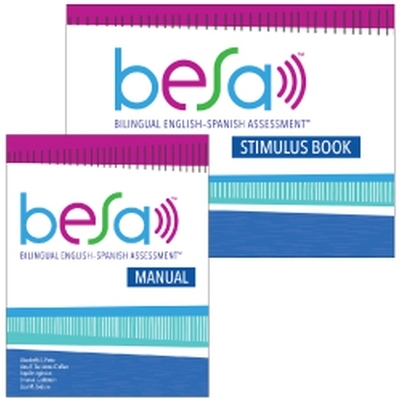
1 BESA Test Manual
1 BESA Stimulus Book
20 BESA Protocol English Forms
20 BESA Protocol Spanish Forms
20 BIOS Forms
20 ITALK forms
Elizabeth Peña PhD, CCC-SLP, is George Christian Centennial Professor in Communication at The University of Texas as Austin. Her research focuses on bilingualism and language impairment. Her work on test development for bilinguals addresses assessment skills that differentiate among children with and without language impairment that allow responses that reflect cultural knowledge. In the area of intervention, she is interested in how children from diverse linguistic backgrounds learn new language skills and how they transfer knowledge between two language. Aquiles Iglesias PhD is Professor and Founding Director of the Speech-Language Pathology Program at the University of Delaware. He was formerly a professor at Temple University and held various administrative positions. His major area of research is cultural and linguistic diversity, with a concentration on language acquisition in bilingual children. He developed the BESA (Bilingual English/Spanish Assessmentƞ and has numerous publications. He is a Fellow of the American Speech-Language-Hearing Association (ASHA) and received its highest award, Honors of the Association. Brian A. Goldstein, Ph.D., CCC-SLP, is Provost & VP for Academic Affairs and Professor at the Department of Communication Sciences and Disorders at La Salle University in Philadelphia, PA. He received a masters and doctorate in speech-language pathology from Temple University and a bachelors in Linguistics and Cognitive Science from Brandeis University. He is well-published in the area of speech sound development and disorders in bilingual populations. His focus is on phonological development and disorders in monolingual Spanish-speaking and Spanish-English bilingual children. He is a fellow of the American Speech-Language-Hearing Association (ASHA) and received ASHA's Certificate of Recognition for Special Contribution in Multicultural Affairs. Lisa M. Bedore, Ph.D., is Professor of Communication Sciences and Disorders at The University of Texas at Austin. Dr. Bedore's research interests focus on assessment and intervention for Spanish- English bilingual children with language impairment. Some of her work focuses on the ways that children's language experience and language ability interact in determining their language outcomes.
| Erscheint lt. Verlag | 30.7.2018 |
|---|---|
| Verlagsort | Baltimore |
| Sprache | spanisch |
| Maße | 292 x 304 mm |
| Gewicht | 5682 g |
| Themenwelt | Sozialwissenschaften ► Pädagogik ► Sonder-, Heil- und Förderpädagogik |
| ISBN-10 | 1-68125-279-1 / 1681252791 |
| ISBN-13 | 978-1-68125-279-7 / 9781681252797 |
| Zustand | Neuware |
| Informationen gemäß Produktsicherheitsverordnung (GPSR) | |
| Haben Sie eine Frage zum Produkt? |
aus dem Bereich