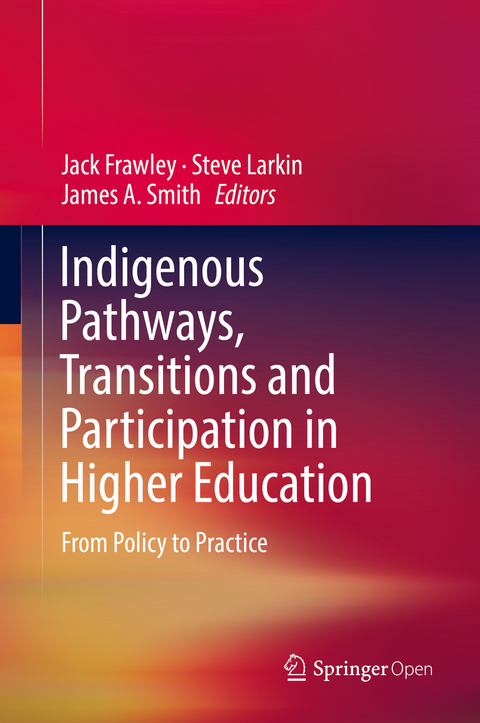
Indigenous Pathways, Transitions and Participation in Higher Education (eBook)
XXI, 287 Seiten
Springer Singapore (Verlag)
9789811040627 (ISBN)
Jack Frawley is as researcher and writer in the areas of intercultural studies, leadership, and evaluation evidenced by his extensive experience in important research and professional projects, national and international consultancies, books, edited books, book chapters, refereed articles, and other publications. He has presented at several national and international conferences and continues to publish on, and participate in, intercultural leadership-related research projects and evaluations. Jack holds adjunct appointments at the University of Canberra and the Batchelor Institute.Steven Larkin is a Kungarakany from Darwin in the Northern Territory. He is Pro Vice-Chancellor of Indigenous Education and Research at the University of Newcastle. Professor Larkin has served on numerous national advisory committees on Indigenous affairs. He has chaired the Aboriginal and Torres Strait Islander Higher Education Advisory Council or Indigenous HEAC (then Indigenous Higher Education Advisory Council) for three years (2009-2012), and the Northern Territory Board of Studies for two years (2010-2012), and continues to provide invaluable input as a member of several respected professional affiliations.James Smith is the program manager for the HEPPP-WCE initiative at the Office of the Pro Vice-Chancellor for Indigenous Leadership at Charles Darwin University. Prior to his current appointment, James worked in a variety of executive and senior management roles in the Northern Territory in both health and education sectors. He has a strong background in health promotion and community development, and is a fellow of the Australian Health Promotion Association and associate editor of the Health Promotion Journal of Australia and the International Journal of Men’s Health. He is also an adjunct research fellow at the Collaboration for Evidence, Research and Impact in Public Health (CERIPH) at Curtin University.
Introduction.- Chapter 1 Indigenous pathways and transitions into Higher Education: An Introduction.- Policy and Policy Issues.- Chapter 2 Understanding the nexus between equity and Indigenous higher education policy agendas in Australia.- Chapter 3 What do we know about community engagement in Indigenous education contexts and how might this impact on pathways into higher education?.- Chapter 4 A design and evaluation framework for Indigenisation of Australian Universities.- Chapter 5 Indigenous Knowledges, Graduate Attributes and Recognition of Prior Learning for Advanced Standing: Tensions within the academy.- Practice, Programs and Future Directions.- Chapter 6 You've got to put your stamp on things: A rippling story of success.- Chapter 7 Canada's Indigenous peoples' access to post-secondary education: The spirit of the 'New Buffalo'.- Chapter 8 Perspectives on enabling education for Indigenous students at three comprehensive universities in regional Australia.- Chapter 9 How we do business: Setting the agenda for cultural competence at the University of Sydney.- Chapter 10 Grandmothers' pedagogy: Lessons for supporting Native students' attendance at universities.- Chapter 11 Tackling Indigenous incarceration through promoting engagement with Higher Education.- Chapter 12 Digital literacy and other factors influencing the success of online courses in remote Indigenous communities.- Chapter 13 Promoting engagement and success at university through strengthening the online learning experiences of Indigenous students living and studying in remote communities.- Chapter 14 The impact of enabling programs on Indigenous participation, success and retention in Australian higher education.- Chapter 15 'Red dirt' schools and pathways into higher education.- Conclusion.- Chapter 16 From policy to practice in higher education: cross-cutting issues in Indigenous pathways, transition and participation.
| Erscheint lt. Verlag | 31.5.2017 |
|---|---|
| Zusatzinfo | XXI, 287 p. 6 illus. |
| Verlagsort | Singapore |
| Sprache | englisch |
| Themenwelt | Sozialwissenschaften ► Pädagogik ► Erwachsenenbildung |
| Schlagworte | Australian education • Australian indigenous education • community engagement • cultural interfaces • disadvantaged equity groups • Higher education policy • Indigenous higher education • Indigenous research • Interculturalism • open access • Student Equity • student transitions • University participation |
| ISBN-13 | 9789811040627 / 9789811040627 |
| Informationen gemäß Produktsicherheitsverordnung (GPSR) | |
| Haben Sie eine Frage zum Produkt? |
 EPUB (Adobe DRM)
Kopierschutz: Adobe-DRM
Adobe-DRM ist ein Kopierschutz, der das eBook vor Mißbrauch schützen soll. Dabei wird das eBook bereits beim Download auf Ihre persönliche Adobe-ID autorisiert. Lesen können Sie das eBook dann nur auf den Geräten, welche ebenfalls auf Ihre Adobe-ID registriert sind.
Details zum Adobe-DRM
Dateiformat: EPUB (Electronic Publication)
EPUB ist ein offener Standard für eBooks und eignet sich besonders zur Darstellung von Belletristik und Sachbüchern. Der Fließtext wird dynamisch an die Display- und Schriftgröße angepasst. Auch für mobile Lesegeräte ist EPUB daher gut geeignet.
Systemvoraussetzungen:
PC/Mac: Mit einem PC oder Mac können Sie dieses eBook lesen. Sie benötigen eine
eReader: Dieses eBook kann mit (fast) allen eBook-Readern gelesen werden. Mit dem amazon-Kindle ist es aber nicht kompatibel.
Smartphone/Tablet: Egal ob Apple oder Android, dieses eBook können Sie lesen. Sie benötigen eine
Geräteliste und zusätzliche Hinweise
Buying eBooks from abroad
For tax law reasons we can sell eBooks just within Germany and Switzerland. Regrettably we cannot fulfill eBook-orders from other countries.
aus dem Bereich