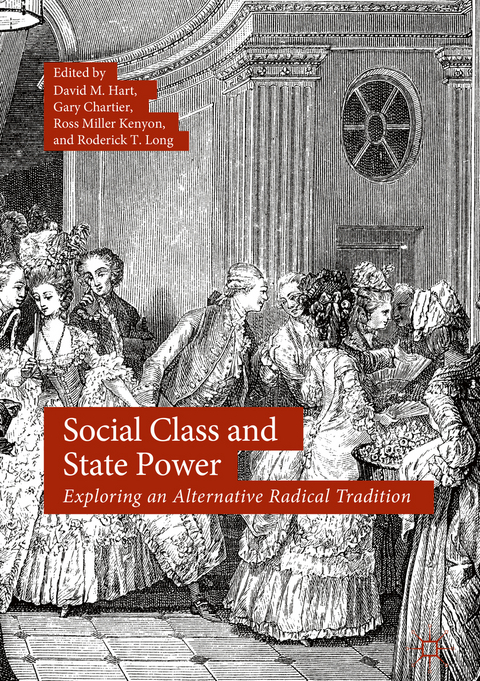
Social Class and State Power (eBook)
XXVI, 345 Seiten
Springer International Publishing (Verlag)
978-3-319-64894-1 (ISBN)
This book explores the idea of social class in the liberal tradition. It collects classical and contemporary texts illustrating and examining the liberal origins of class analysis-often associated with Marxism but actually rooted in the work of liberal theorists. Liberal class analysis emphasizes the constitutive connection between state power and class position. Social Class and State Power documents the rich tradition of liberal class theory, its rediscovery in the twentieth century, and the possibilities it opens up for research in the new millenium.
David M. Hart, Director, Online Library of Liberty, Liberty Fund, Indianapolis, USA
Gary Chartier, Distinguished Professor of Law and Business Ethics, La Sierra University, USA
Ross Miller Kenyon, independent scholar and video producer, Los Angeles, USARoderick T. Long, Professor of Philosophy, Auburn University, USA
David M. Hart, Director, Online Library of Liberty, Liberty Fund, Indianapolis, USA Gary Chartier, Distinguished Professor of Law and Business Ethics, La Sierra University, USA Ross Miller Kenyon, independent scholar and video producer, Los Angeles, USA Roderick T. Long, Professor of Philosophy, Auburn University, USA
Classic Works of Classical Liberal Class Analysis 1 Richard Overton, “Monopolists as Frogs and Vermin” (1641) 2 Adam Smith, “On Conspiracies, Monopolies, and Unproductive Labour” (1776) 3 Thomas Paine, “On Governments, Placemen, and Pensioners” (1792) 4 William Godwin, “Of Courts, Subjects, and Pensions” (1793) 5 Jeremy Bentham, “On Mischiefs and the Sinister Interests” (1817, 1824) 6 Thomas Hodgskin, “On Obedience as the Object of Legislation” (1832) . 7 William Leggett , “The Lordlings of the Paper Dynasty” (1834) 8 James Mill, “On Those Who Pillage and Those Who Are Pillaged” (1835) 9 John Wade, “The Aristocracy and the Oligarchy” (1835) 10 Adolphe Blanqui, “The Class Which Does Not Kill or Pillage” (1837) 11 Richard Cobden, “England is a perfect Paradise for the Aristocracy” (1845-49) 12 Frédéric Bastiat, “On the English Oligarchy and Legal Plunder” (1845, 1847) 13 John C. Calhoun, “Tax Payers versus Tax Receivers” (1849) 14 Charles Renouard, “Robbers as Parasites” (1852) 15 Gustave de Molinari, “The Nobility as Conquering Plunderers” (1852) 16 Augustin Thierry, “The Emancipation of the Bourgeoisie” (1853) 17 Herbert Spencer, “On Class Bias and the Militant Type of Society” (1873, 1882) 18 Lysander Spooner, “On Government as a Band of Robbers and Murderers” (1870, 1882) 19 William Graham Sumner, “On Forgotten Men and Plutocrats” (1883) 20 Benjamin R. Tucker, “The Four Monopolies: Money, Land, Tariffs, and Patents” (1888) 21 Vifredo Pareto, “The Decline and Rise of Elites” (1900) 22 Franz Oppenheimer, “The Economic versus the Political Means of Acquiring Wealth” (1908) 23 Albert J. Nock, Our Enemy, the State (1935) 24 Ludwig von Mises, “On Castes, Classes, and Group Interests” (1945) Contemporary Interpretations of Classical Liberal Class Analysis 25 Murray N. Rothbard, “The Anatomy of the State” (1965) 26 Roy A. Childs, “Big Business and the Rise of American Statism” (1969, 1971) 27 Walter E. Grinder and John Hagel, “Toward a Theory of State Capitalism: Ultimate Decision-Making and Class Structure” (1974) 28 Hans-Hermann Hoppe, “Marxist and Austrian Class Analysis” (1990) 29 Roderick T. Long, “Toward a Libertarian Theory of Class” (1998)
| Erscheint lt. Verlag | 29.11.2017 |
|---|---|
| Zusatzinfo | XXVI, 345 p. |
| Verlagsort | Cham |
| Sprache | englisch |
| Themenwelt | Sozialwissenschaften ► Soziologie ► Spezielle Soziologien |
| Schlagworte | activism • Anarchy • Class theory • Marxism • Social Class • Social Inquiry |
| ISBN-10 | 3-319-64894-2 / 3319648942 |
| ISBN-13 | 978-3-319-64894-1 / 9783319648941 |
| Informationen gemäß Produktsicherheitsverordnung (GPSR) | |
| Haben Sie eine Frage zum Produkt? |
 PDF (Wasserzeichen)
DRM: Digitales Wasserzeichen
Dieses eBook enthält ein digitales Wasserzeichen und ist damit für Sie personalisiert. Bei einer missbräuchlichen Weitergabe des eBooks an Dritte ist eine Rückverfolgung an die Quelle möglich.
Dateiformat: PDF (Portable Document Format)
Mit einem festen Seitenlayout eignet sich die PDF besonders für Fachbücher mit Spalten, Tabellen und Abbildungen. Eine PDF kann auf fast allen Geräten angezeigt werden, ist aber für kleine Displays (Smartphone, eReader) nur eingeschränkt geeignet.
Systemvoraussetzungen:
PC/Mac: Mit einem PC oder Mac können Sie dieses eBook lesen. Sie benötigen dafür einen PDF-Viewer - z.B. den Adobe Reader oder Adobe Digital Editions.
eReader: Dieses eBook kann mit (fast) allen eBook-Readern gelesen werden. Mit dem amazon-Kindle ist es aber nicht kompatibel.
Smartphone/Tablet: Egal ob Apple oder Android, dieses eBook können Sie lesen. Sie benötigen dafür einen PDF-Viewer - z.B. die kostenlose Adobe Digital Editions-App.
Buying eBooks from abroad
For tax law reasons we can sell eBooks just within Germany and Switzerland. Regrettably we cannot fulfill eBook-orders from other countries.
aus dem Bereich