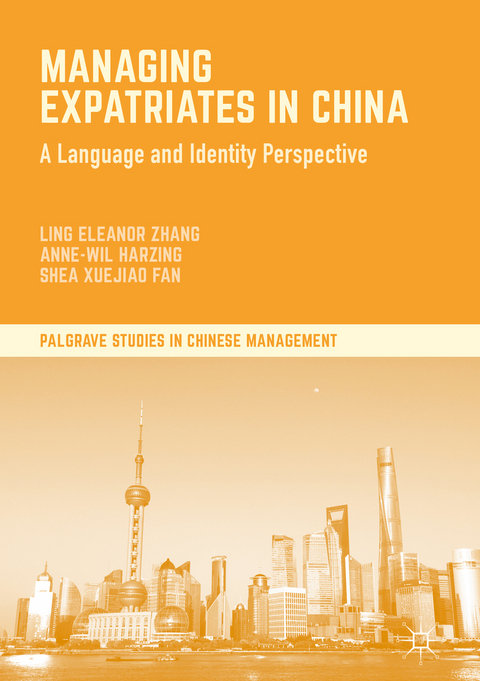
Managing Expatriates in China (eBook)
XV, 225 Seiten
Palgrave Macmillan UK (Verlag)
978-1-137-48909-8 (ISBN)
Providing fresh perspectives on managing expatriates in the changing host country of China, this book investigates expatriate management from a language and identity angle. The authors' multilingual and multicultural backgrounds allow them to offer a solid view on the best practices towards managing diverse groups of expatriates, including Western, Indian, and ethnic Chinese employees. With carefully considered analysis which incorporates micro and macro perspectives, together with indigenous Chinese and Western viewpoints, this book explores topics that include the importance of the host country language, expatriate adjustment, ethnic identity confirmation, acceptance and identity. The book presents a longitudinal yet contemporary snapshot of the language, culture, and identity realities that multinational corporation subsidiary employees are facing in China in the present decade (2006-2016). It will thus be an invaluable resource for International Management scholars, those involved in HRM and other practitioners, as well as business school lecturers and students with a strong interest in China.
Ling Eleanor Zhang is Lecturer of International Management at the School of Management, Royal Holloway, University of London, UK. Her research centres on interaction across boundaries. She examines the boundary spanning of multicultural employees, social categorisation and conflict management between expatriates and host country employees, and the language challenges employees face in subsidiaries of multinational corporations.
Anne-Wil Harzing is Professor of International Management at Middlesex University, UK. Prior to that she was Associate Dean Research at the University of Melbourne, Australia. Her research has been published in the field's leading journals and has received numerous awards. She currently plays a major role as research mentor and provides extensive academic resources on www.harzing.com.
Shea Xuejiao Fan is Lecturer in International Business at the Royal Melbourne Institute of Technology, Australia, and has also studied and worked in China, the Netherlands, and the USA. She specialises in expatriate management, cross-cultural management and identity in international management.
Providing fresh perspectives on managing expatriates in the changing host country of China, this book investigates expatriate management from a language and identity angle. The authors' multilingual and multicultural backgrounds allow them to offer a solid view on the best practices towards managing diverse groups of expatriates, including Western, Indian, and ethnic Chinese employees. With carefully considered analysis which incorporates micro and macro perspectives, together with indigenous Chinese and Western viewpoints, this book explores topics that include the importance of the host country language, expatriate adjustment, ethnic identity confirmation, acceptance and identity. The book presents a longitudinal yet contemporary snapshot of the language, culture, and identity realities that multinational corporation subsidiary employees are facing in China in the present decade (2006-2016). It will thus be an invaluable resource for International Management scholars, those involved in HRM and other practitioners, as well as business school lecturers and students with a strong interest in China.
Ling Eleanor Zhang is Lecturer of International Management at the School of Management, Royal Holloway, University of London, UK. Her research centres on interaction across boundaries. She examines the boundary spanning of multicultural employees, social categorisation and conflict management between expatriates and host country employees, and the language challenges employees face in subsidiaries of multinational corporations.Anne-Wil Harzing is Professor of International Management at Middlesex University, UK. Prior to that she was Associate Dean Research at the University of Melbourne, Australia. Her research has been published in the field’s leading journals and has received numerous awards. She currently plays a major role as research mentor and provides extensive academic resources on www.harzing.com.Shea Xuejiao Fan is Lecturer in International Business at the Royal Melbourne Institute of Technology, Australia, and has also studied and worked in China, the Netherlands, and the USA. She specialises in expatriate management, cross-cultural management and identity in international management.
Preface 6
Acknowledgements 8
Contents 9
About the Authors 11
List of Figures 13
List of Tables 15
1: Introduction 16
1.1 Background 16
1.2 Multinationals and Language Dilemmas 17
1.3 Language, Cross-Cultural Adjustment, Acceptance and Social Identity 20
1.4 Expatriate Diversity: Employment Type and Ethnic Origins 22
1.5 Local Employees 25
1.6 China as the Host Country 27
1.7 Fieldwork and Authors’ Reflexive Notes 30
1.8 Overview of the Book 37
Bibliography 40
2: Setting the Scene: Expatriates, Language and Culture in China 48
2.1 Introduction 48
2.2 A Helicopter View Using Large-Scale Survey Research 50
2.3 The Dominance of Expatriates in China 52
2.4 Why Are Expatriates Needed? 56
2.5 Factors Which Cause Barriers Between HQ and Subsidiary Managers 59
2.6 Corporate Language Policies 62
2.7 Subsidiary Performance in China: Problems in HR Management? 64
2.8 Conclusion 66
Bibliography 67
3: Host Country Language: Why It Matters, and Why Expatriates Need to Learn It 69
3.1 Introduction: Behind the English-Speaking Scenes in Subsidiaries in China 69
3.2 The Role of the Host Country Language in China 71
3.3 Why the Host Country Language Matters 74
3.3.1 Can “Think Globally and Act Locally” Succeed Without Speaking Locally? 74
3.3.2 Lost in Translation: A Dangerous, But Accepted Status Quo 75
3.3.3 Does Anyone Speak Really Good English? 78
3.3.4 Fatigue as a Result of “Diluted” Communication 82
3.4 Do I Really Need to Learn It? Yes! 84
3.4.1 Individual Challenges? 84
3.4.2 Organisational Constraints? 88
3.4.3 A Question of Linguistic Nationalism at the Country Level? 92
3.5 How to Tackle Facing Such a “Difficult” Host Country Language 93
3.5.1 Giving the Host Country Language a Proper Identity 94
3.5.2 Encouraging Language Boundary Spanners 96
3.5.3 Fostering Tolerance and Perseverance 97
3.6 Conclusion 99
Bibliography 101
4: The Impact of Host Country Language Skills on Expatriate Adjustment and the Expatriate-Local Relationship 104
4.1 Introduction 104
4.2 Cross-Cultural Adjustment 105
4.3 Why the Host Country Language Is Relevant for Expatriate Adjustment 107
4.3.1 Interaction with Locals at Work 108
4.3.2 Interaction with Locals Outside Work 111
4.3.3 Support from Colleagues at Work 112
4.3.4 Support from Colleagues Outside Work 114
4.3.5 Social Networks at Work 115
4.3.6 Social Networks Outside Work 116
4.4 The Impact of Language Skills on Relationships in the Workplace 118
4.4.1 Harmonious Relationships 119
4.4.2 Distant Relationships 122
4.4.3 Segregated Relationships 125
4.5 Towards Harmonious Relationships Between Expatriates and Locals 127
4.6 Conclusion 129
Bibliography 131
5: Gaining Acceptance from Local Colleagues: Evidence from Indian Expatriates in China 133
5.1 Introduction 133
5.2 What Do We Know About Acceptance? 134
5.3 Why Focus on Indian Expatriates? 136
5.3.1 Historical and Political Factors 136
5.3.2 Cultural Factors 137
5.3.3 Psychological Factors 138
5.4 Data Collection and Analysis 139
5.5 Introducing the Three-Level Model of Acceptance 140
5.6 Illustration of the Model Through the Daily Interactions Between Indian Expatriates and Chinese Employees 143
5.6.1 Outer-Level Acceptance 144
5.6.2 Intermediate-Level Acceptance 148
5.6.3 Inner-Level Acceptance 152
5.7 Three Levels of Acceptance: So What? 155
5.7.1 Suggestions for Expatriates 156
5.7.2 Suggestions for MNCs 158
5.8 Conclusion 160
Bibliography 161
6: The Double-Edged Sword of Ethnic Similarity 164
6.1 Introduction 164
6.2 Identity: What Is It and How Does It Affect Us? 169
6.3 Ethnic Identity Confirmation: Why Is It Important and How Difficult Is It to Achieve? 170
6.3.1 Overseas Chinese Expatriates’ Ethnic Identity: Local Employees’ View 172
6.3.2 Overseas Chinese Expatriates’ View of Their Own Ethnic Identity 174
6.4 How Ethnic Identity Confirmation Affects Interactions Between Overseas Chinese Expatriates and Local Chinese 176
6.4.1 Does Ethnic Identity Confirmation Affect Different Expatriates Differently? 177
6.4.2 How Does Ethnic Identity Confirmation Affect Local Employees? 180
6.5 Is Employing Ethnically Similar Expatriates a Useful Strategy? 183
6.5.1 Ethnic Similarity: A Double-Edged Sword 184
6.5.2 Suggestions for Ethnically Similar Expatriates: Be Prepared for Identity Pitfalls 185
6.5.3 Suggestions for MNCs: Offer Tailored Expatriate Training and Support 186
6.5.4 Suggestions for MNCs: Strategically Manage Expatriates’ Ethnic Identity 187
6.6 Conclusion 188
Bibliography 189
7: Conclusion: Expatriate Language and Identity Challenges and Recommendations for Expatriate Management 192
7.1 Summary of Key Findings 192
7.2 The Changing Concept of Expatriation in a Rapidly Changing China 195
7.3 Changing Identities and Negotiating Acceptance 197
7.4 Recommendations for MNCs, Expatriates and Local Employees 201
7.4.1 Recommendations for MNCs: Allow Employee Diversity to Take Centre Stage 201
7.4.2 Recommendations for Expatriates and Local Employees: “Dancing with Diversity” 206
7.4.3 Recommendations for Ethnic Chinese Expatriates 213
7.5 Conclusion 215
Bibliography 216
Bibliography 218
Index 232
| Erscheint lt. Verlag | 28.11.2017 |
|---|---|
| Reihe/Serie | Palgrave Studies in Chinese Management | Palgrave Studies in Chinese Management |
| Zusatzinfo | XV, 225 p. 8 illus., 7 illus. in color. |
| Verlagsort | London |
| Sprache | englisch |
| Themenwelt | Sozialwissenschaften ► Soziologie ► Spezielle Soziologien |
| Wirtschaft ► Betriebswirtschaft / Management ► Personalwesen | |
| Wirtschaft ► Betriebswirtschaft / Management ► Unternehmensführung / Management | |
| Schlagworte | changing china • Chinese business • cultural adjustment • Diversity • host country • Managing Diversity • MNC • MNC subsidiary employees • multicultural backgrounds |
| ISBN-10 | 1-137-48909-X / 113748909X |
| ISBN-13 | 978-1-137-48909-8 / 9781137489098 |
| Informationen gemäß Produktsicherheitsverordnung (GPSR) | |
| Haben Sie eine Frage zum Produkt? |
 PDF (Wasserzeichen)
DRM: Digitales Wasserzeichen
Dieses eBook enthält ein digitales Wasserzeichen und ist damit für Sie personalisiert. Bei einer missbräuchlichen Weitergabe des eBooks an Dritte ist eine Rückverfolgung an die Quelle möglich.
Dateiformat: PDF (Portable Document Format)
Mit einem festen Seitenlayout eignet sich die PDF besonders für Fachbücher mit Spalten, Tabellen und Abbildungen. Eine PDF kann auf fast allen Geräten angezeigt werden, ist aber für kleine Displays (Smartphone, eReader) nur eingeschränkt geeignet.
Systemvoraussetzungen:
PC/Mac: Mit einem PC oder Mac können Sie dieses eBook lesen. Sie benötigen dafür einen PDF-Viewer - z.B. den Adobe Reader oder Adobe Digital Editions.
eReader: Dieses eBook kann mit (fast) allen eBook-Readern gelesen werden. Mit dem amazon-Kindle ist es aber nicht kompatibel.
Smartphone/Tablet: Egal ob Apple oder Android, dieses eBook können Sie lesen. Sie benötigen dafür einen PDF-Viewer - z.B. die kostenlose Adobe Digital Editions-App.
Buying eBooks from abroad
For tax law reasons we can sell eBooks just within Germany and Switzerland. Regrettably we cannot fulfill eBook-orders from other countries.
aus dem Bereich