


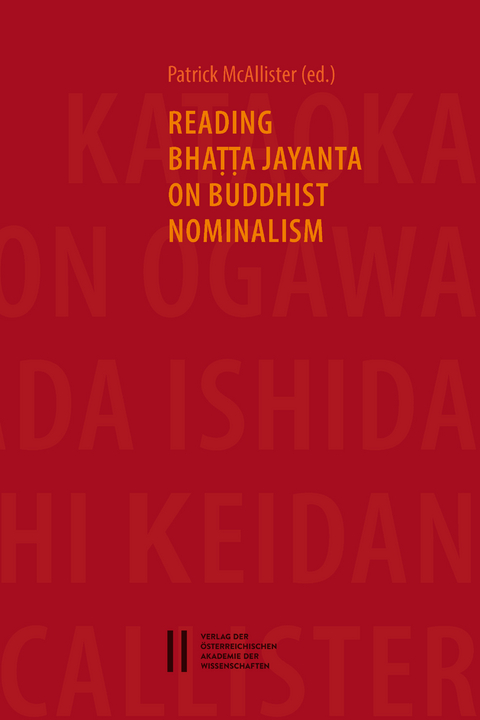
Reading Bhaṭṭa Jayanta on Buddhist Nominalism
Seiten
2017
|
2. Auflage
Verlag der österreichischen Akademie der Wissenschaften
978-3-7001-7974-0 (ISBN)
Verlag der österreichischen Akademie der Wissenschaften
978-3-7001-7974-0 (ISBN)
- Titel nicht im Sortiment
- Artikel merken
Reading Bhaṭṭa Jayanta on Buddhist Nominalism engages with an ancient Indian philosophical theory, called the “exclusion theory” (apoha), which was developed by Indian Buddhists from the fifth century of the common era onward. This theory attempts to explain what universals really are and how they are known, yet without accepting that any two real things are identical with each other, or even similar to each other, in any substantial sense. The manifold philosophical problems arising from this seemingly self-contradictory position, and the Buddhist’s ingenious solution to it, exercised most schools of Indian thought for more than seven centuries and caused the Buddhists to continuously refine their theory.
The book bases its investigation of the apoha theory on the succinct and accessible discussion of it found in the Nyāyamañjarī, a text by the accomplished author and Nyāya philosopher Bhaṭṭa Jayanta who flourished late in the ninth century of the common era. In its first part, the book presents a careful edition of the original Sanskrit text of this section of the Nyāyamañjarī, along with a clear and annotated English translation of this text, and thus enables the reader to gain a first-hand experience of the topic in a concrete historical form.
The second part of this book contains seven articles that discuss important issues that the Buddhist theory of universals had to deal with, including ontological, epistemological and linguistic conundrums, all of which are discussed in Jayanta’s text. These contributions try to answer these questions with different methods, ranging from a critical-historical analysis to the speculative philosophical approach, and often combining them for best results. These articles are arranged according to the date of their main subject matter, structurally following the presentation which Jayanta himself chose, and shine spotlights on stages of the apoha theory’s development from the fifth to eleventh century of the common era.
This combination of a complete primary text with scholarly articles exploring several of its topics in more depth is intended to allow the informed reader to approach this important episode in the history of philosophy in an engaging and methodically sound manner, and to present new insights into the history of the apoha theory to the scholarly community.
The book bases its investigation of the apoha theory on the succinct and accessible discussion of it found in the Nyāyamañjarī, a text by the accomplished author and Nyāya philosopher Bhaṭṭa Jayanta who flourished late in the ninth century of the common era. In its first part, the book presents a careful edition of the original Sanskrit text of this section of the Nyāyamañjarī, along with a clear and annotated English translation of this text, and thus enables the reader to gain a first-hand experience of the topic in a concrete historical form.
The second part of this book contains seven articles that discuss important issues that the Buddhist theory of universals had to deal with, including ontological, epistemological and linguistic conundrums, all of which are discussed in Jayanta’s text. These contributions try to answer these questions with different methods, ranging from a critical-historical analysis to the speculative philosophical approach, and often combining them for best results. These articles are arranged according to the date of their main subject matter, structurally following the presentation which Jayanta himself chose, and shine spotlights on stages of the apoha theory’s development from the fifth to eleventh century of the common era.
This combination of a complete primary text with scholarly articles exploring several of its topics in more depth is intended to allow the informed reader to approach this important episode in the history of philosophy in an engaging and methodically sound manner, and to present new insights into the history of the apoha theory to the scholarly community.
is a Researcher at the Institute for the Cultural and Intellectual History of Asia at the Austrian Academy of Sciences
https://onix.oeaw.ac.at/Inhaltsverzeichnis/9783700179740_Inhaltsverzeichnis.pdf
https://onix.oeaw.ac.at/Leseprobe/9783700179740_Leseprobe.pdf
| Erscheinungsdatum | 27.11.2017 |
|---|---|
| Reihe/Serie | Beiträge zur Kultur- und Geistesgeschichte Asiens ; 95 |
| Verlagsort | Wien |
| Sprache | englisch |
| Maße | 150 x 225 mm |
| Gewicht | 519 g |
| Einbandart | Englisch Broschur |
| Themenwelt | Geschichte ► Teilgebiete der Geschichte ► Kulturgeschichte |
| Sozialwissenschaften | |
| Schlagworte | Asienforschung • Beiträge zur Kultur- und Geistesgeschichte Asiens • Buddhist Nomination • Reading Bhatta Jayanta |
| ISBN-10 | 3-7001-7974-X / 370017974X |
| ISBN-13 | 978-3-7001-7974-0 / 9783700179740 |
| Zustand | Neuware |
| Informationen gemäß Produktsicherheitsverordnung (GPSR) | |
| Haben Sie eine Frage zum Produkt? |
Mehr entdecken
aus dem Bereich



aus dem Bereich
Die Revolution des Gemeinen Mannes
Buch | Softcover (2024)
C.H.Beck (Verlag)
CHF 16,80
Eine Geschichte des Geschmacks
Buch | Hardcover (2025)
C.H.Beck (Verlag)
CHF 49,95
vom Mittelalter bis zur Gegenwart
Buch | Softcover (2024)
C.H.Beck (Verlag)
CHF 16,80


