


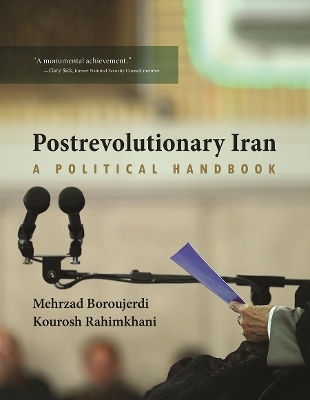
Postrevolutionary Iran
A Political Handbook
Seiten
2018
Syracuse University Press (Verlag)
978-0-8156-3574-1 (ISBN)
Syracuse University Press (Verlag)
978-0-8156-3574-1 (ISBN)
Provides a comprehensive collection of data on political life in post-revolutionary Iran, including coverage of 36 national elections, more than 400 legal and outlawed political organisations, and family ties among the elite. It provides biographical sketches of more than 2,300 political personalities.
The 1979 revolution fundamentally altered Iran’s political landscape as a generation of inexperienced clerics who did not hail from the ranks of the upper class—and were not tainted by association with the old regime—came to power. The actions and intentions of these truculent new leaders and their lay allies caused major international concern. Meanwhile, Iran’s domestic and foreign policy and its nuclear program have loomed large in daily news coverage. Despite global consternation, however, our knowledge about Iran’s political elite remains skeletal. Nearly four decades after the clergy became the state elite par excellence, there has been no empirical study of the recruitment, composition, and circulation of the Iranian ruling members after 1979.
Postrevolutionary Iran: A Political Handbook provides the most comprehensive collection of data on political life in postrevolutionary Iran, including coverage of 36 national elections, more than 400 legal and outlawed political organizations, and family ties among the elite. It provides biographical sketches of more than 2,300 political personalities ranging from cabinet ministers and parliament deputies to clerical, judicial, and military leaders, much of this information previously unavailable in English.
Providing a cartography of the complex structure of power in postrevolutionary Iran, this volume offers a window not only into the immediate years before and after the Iranian Revolution but also into what has happened during the last four turbulent decades. This volume and the data it contains will be invaluable to policymakers, researchers, and scholars of the Middle East alike.
The 1979 revolution fundamentally altered Iran’s political landscape as a generation of inexperienced clerics who did not hail from the ranks of the upper class—and were not tainted by association with the old regime—came to power. The actions and intentions of these truculent new leaders and their lay allies caused major international concern. Meanwhile, Iran’s domestic and foreign policy and its nuclear program have loomed large in daily news coverage. Despite global consternation, however, our knowledge about Iran’s political elite remains skeletal. Nearly four decades after the clergy became the state elite par excellence, there has been no empirical study of the recruitment, composition, and circulation of the Iranian ruling members after 1979.
Postrevolutionary Iran: A Political Handbook provides the most comprehensive collection of data on political life in postrevolutionary Iran, including coverage of 36 national elections, more than 400 legal and outlawed political organizations, and family ties among the elite. It provides biographical sketches of more than 2,300 political personalities ranging from cabinet ministers and parliament deputies to clerical, judicial, and military leaders, much of this information previously unavailable in English.
Providing a cartography of the complex structure of power in postrevolutionary Iran, this volume offers a window not only into the immediate years before and after the Iranian Revolution but also into what has happened during the last four turbulent decades. This volume and the data it contains will be invaluable to policymakers, researchers, and scholars of the Middle East alike.
Mehrzad Boroujerdi is O’Hanley Faculty Scholar and professor of political science at Syracuse University’s Maxwell School, and former president of the International Society for Iranian Studies. He is the author of Iranian Intellectuals and the West: The Tormented Triumph of Nativism and editor of Mirror for the Muslim Prince: Islam and the Theory of Statecraft. Kourosh Rahimkhani is a doctoral candidate in political science at Binghamton University. His research focuses on politics of ethnoreligious identities, nondemocratic elections, and authoritarian politics.
| Erscheinungsdatum | 12.06.2018 |
|---|---|
| Zusatzinfo | 22 figures |
| Verlagsort | New York |
| Sprache | englisch |
| Maße | 212 x 294 mm |
| Gewicht | 2270 g |
| Themenwelt | Sachbuch/Ratgeber ► Geschichte / Politik ► Allgemeines / Lexika |
| Geisteswissenschaften ► Geschichte ► Regional- / Ländergeschichte | |
| Sozialwissenschaften ► Politik / Verwaltung ► Europäische / Internationale Politik | |
| ISBN-10 | 0-8156-3574-5 / 0815635745 |
| ISBN-13 | 978-0-8156-3574-1 / 9780815635741 |
| Zustand | Neuware |
| Informationen gemäß Produktsicherheitsverordnung (GPSR) | |
| Haben Sie eine Frage zum Produkt? |
Mehr entdecken
aus dem Bereich

aus dem Bereich
Handbuch zum Lesen des Himmels
Buch | Hardcover (2025)
Harpercollins (Verlag)
CHF 30,80
historische Porträts von George Washington bis Donald Trump
Buch | Softcover (2025)
C.H.Beck (Verlag)
CHF 33,55
eine Erfindung der globalen Welt : 4000 Jahre Geschichte
Buch | Hardcover (2025)
Klett-Cotta (Verlag)
CHF 53,20


