


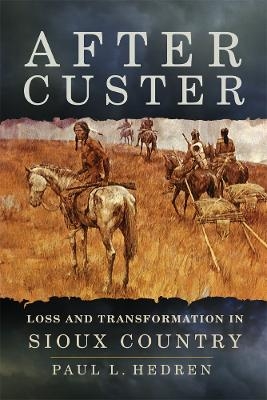
After Custer
Loss and Transformation in Sioux Country
Seiten
2018
University of Oklahoma Press (Verlag)
978-0-8061-6044-3 (ISBN)
University of Oklahoma Press (Verlag)
978-0-8061-6044-3 (ISBN)
After the defeat of Custer at the Little Big Horn, the US army responded by pouring fresh troops and resources into the war effort. In this study, Paul Hedren examines the war's effects on the culture, environment, and geography of the northern Great Plains, their Native inhabitants, and the Anglo-American invaders.
Between 1876 and 1877, the U.S. Army battled Lakota Sioux and Northern Cheyenne Indians in a series of vicious conflicts known today as the Great Sioux War. After the defeat of Custer at the Little Big Horn in June 1876, the army responded to its stunning loss by pouring fresh troops and resources into the war effort. In the end, the U.S. Army prevailed, but at a significant cost. In this unique contribution to American western history, Paul L. Hedren examines the war's effects on the culture, environment, and geography of the northern Great Plains, their Native inhabitants, and the Anglo-American invaders.As Hedren explains, U.S. military control of the northern plains following the Great Sioux War permitted the Northern Pacific Railroad to extend westward from the Missouri River. The new transcontinental line brought hide hunters who targeted the great northern buffalo herds and ultimately destroyed them. A de-buffaloed prairie lured cattlemen, who in turn spawned their own culture. Through forced surrender of their lands and lifeways, Lakotas and Northern Cheyennes now experienced even more stress and calamity than they had endured during the war itself. The victors, meanwhile, faced a different set of challenges, among them providing security for the railroad crews, hide hunters, and cattlemen.
Hedren is the first scholar to examine the events of 1876-77 and their aftermath as a whole, taking into account relationships among military leaders, the building of forts, and the army's efforts to memorialize the war and its victims. Woven into his narrative are the voices of those who witnessed such events as the burial of Custer, the laying of railroad track, or the sudden surround of a buffalo herd. Their personal testimonies lend both vibrancy and pathos to this story of irreversible change in Sioux Country.
Between 1876 and 1877, the U.S. Army battled Lakota Sioux and Northern Cheyenne Indians in a series of vicious conflicts known today as the Great Sioux War. After the defeat of Custer at the Little Big Horn in June 1876, the army responded to its stunning loss by pouring fresh troops and resources into the war effort. In the end, the U.S. Army prevailed, but at a significant cost. In this unique contribution to American western history, Paul L. Hedren examines the war's effects on the culture, environment, and geography of the northern Great Plains, their Native inhabitants, and the Anglo-American invaders.As Hedren explains, U.S. military control of the northern plains following the Great Sioux War permitted the Northern Pacific Railroad to extend westward from the Missouri River. The new transcontinental line brought hide hunters who targeted the great northern buffalo herds and ultimately destroyed them. A de-buffaloed prairie lured cattlemen, who in turn spawned their own culture. Through forced surrender of their lands and lifeways, Lakotas and Northern Cheyennes now experienced even more stress and calamity than they had endured during the war itself. The victors, meanwhile, faced a different set of challenges, among them providing security for the railroad crews, hide hunters, and cattlemen.
Hedren is the first scholar to examine the events of 1876-77 and their aftermath as a whole, taking into account relationships among military leaders, the building of forts, and the army's efforts to memorialize the war and its victims. Woven into his narrative are the voices of those who witnessed such events as the burial of Custer, the laying of railroad track, or the sudden surround of a buffalo herd. Their personal testimonies lend both vibrancy and pathos to this story of irreversible change in Sioux Country.
Paul L. Hedren is a retired National Park Service superintendent residing in Omaha, Nebraska. He is the author of Fort Laramie and the Great Sioux War and Great Sioux War Orders of Battle: How the United States Army Waged War on the Northern Plains, 1876-1877.
| Erscheinungsdatum | 10.07.2018 |
|---|---|
| Zusatzinfo | 2 maps |
| Verlagsort | Oklahoma |
| Sprache | englisch |
| Maße | 152 x 229 mm |
| Gewicht | 391 g |
| Themenwelt | Sachbuch/Ratgeber ► Geschichte / Politik ► Allgemeines / Lexika |
| Sachbuch/Ratgeber ► Geschichte / Politik ► Regional- / Landesgeschichte | |
| Geschichte ► Allgemeine Geschichte ► Neuzeit (bis 1918) | |
| Geisteswissenschaften ► Geschichte ► Regional- / Ländergeschichte | |
| Geschichte ► Teilgebiete der Geschichte ► Kulturgeschichte | |
| Geschichte ► Teilgebiete der Geschichte ► Militärgeschichte | |
| Sozialwissenschaften ► Soziologie | |
| ISBN-10 | 0-8061-6044-6 / 0806160446 |
| ISBN-13 | 978-0-8061-6044-3 / 9780806160443 |
| Zustand | Neuware |
| Informationen gemäß Produktsicherheitsverordnung (GPSR) | |
| Haben Sie eine Frage zum Produkt? |
Mehr entdecken
aus dem Bereich

aus dem Bereich
Geschichte einer wilden Handlung
Buch | Hardcover (2024)
C.H.Beck (Verlag)
CHF 47,60


