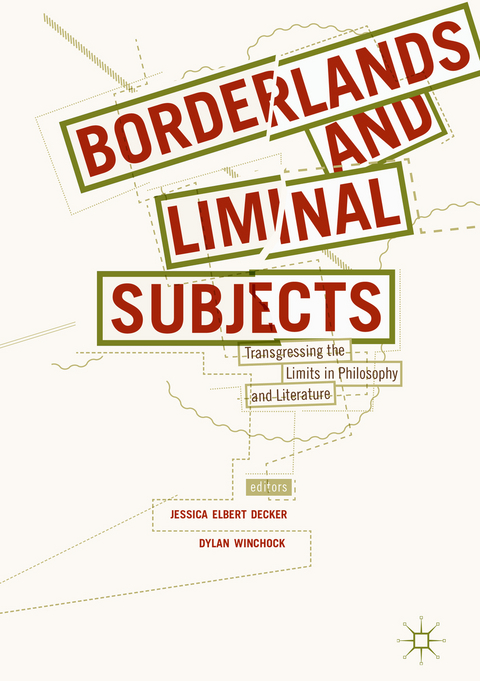
Borderlands and Liminal Subjects (eBook)
XIII, 281 Seiten
Springer International Publishing (Verlag)
978-3-319-67813-9 (ISBN)

Jessica Elbert Decker is Assistant Professor of Philosophy at California State University San Marcos, USA. Her current research investigates the symbolic structures of western patriarchy, especially as they appear in ancient philosophy, mythology, and psychoanalysis.
Dylan Winchock is a lecturer for the Literature & Writing and Liberal Studies programs at California State University San Marcos, USA. His scholarship focuses on contemporary literature and the emergence of borderlands as sites of hegemonic struggle in city space. His most recent project is a critique of utopian fantasies in literature.
Jessica Elbert Decker is Associate Professor of Philosophy at California State University San Marcos, USA. Her current research investigates the symbolic structures of western patriarchy, especially as they appear in ancient philosophy, mythology, and psychoanalysis. Dylan Winchock is a lecturer for the Literature & Writing and Liberal Studies programs at California State University San Marcos, USA. His scholarship focuses on contemporary literature and the emergence of borderlands as sites of hegemonic struggle in city space. His most recent project is a critique of utopian fantasies in literature.
Introduction: Borderlands and Liminality Across Philosophy and LiteratureEthics at the Border: Transmitting Migrant ExperiencesLand, Territory and Border: Liminality in Contemporary Israeli LiteratureZones of Maximal Translatability: Borderspace and Women’s TimeA Search for Colonial Histories: The Conquest by Yxta Maya MurrayTransforming Borders: Resistant Liminality in Beloved, Song of Solomon, and ParadiseGone Over on the Other Side:” Passing in Chesnutt’s The House Behind the CedarsQueering and Gendering Aztlán: Anzaldúa’s Feminist Reshaping of the Chicana/o Nation in the U.S Mexico BorderlandsAchilles and the (Sexual) History of Being Borderland Spaces of the Third Kind: Erotic Agency in Plato and Octavia ButlerAlice's Parallel Series: Carroll, Deleuze, and the ‘Stuttering Sense’ of the WorldCultural Liminality: Gender, Identity, and Margin in the Uncanny Stories of Elizabeth BowenCrossing the Utopian / Apocalyptic Border: The Anxiety of Forgetting in Paul Auster’s In the Country of Last Things.
| Erscheint lt. Verlag | 15.11.2017 |
|---|---|
| Zusatzinfo | XIII, 281 p. |
| Verlagsort | Cham |
| Sprache | englisch |
| Themenwelt | Geisteswissenschaften ► Philosophie |
| Geisteswissenschaften ► Psychologie ► Psychoanalyse / Tiefenpsychologie | |
| Sozialwissenschaften ► Soziologie | |
| Schlagworte | Achilles • Anzaldua • Ethnicity • Green Line • Race |
| ISBN-10 | 3-319-67813-2 / 3319678132 |
| ISBN-13 | 978-3-319-67813-9 / 9783319678139 |
| Informationen gemäß Produktsicherheitsverordnung (GPSR) | |
| Haben Sie eine Frage zum Produkt? |
 PDF (Wasserzeichen)
DRM: Digitales Wasserzeichen
Dieses eBook enthält ein digitales Wasserzeichen und ist damit für Sie personalisiert. Bei einer missbräuchlichen Weitergabe des eBooks an Dritte ist eine Rückverfolgung an die Quelle möglich.
Dateiformat: PDF (Portable Document Format)
Mit einem festen Seitenlayout eignet sich die PDF besonders für Fachbücher mit Spalten, Tabellen und Abbildungen. Eine PDF kann auf fast allen Geräten angezeigt werden, ist aber für kleine Displays (Smartphone, eReader) nur eingeschränkt geeignet.
Systemvoraussetzungen:
PC/Mac: Mit einem PC oder Mac können Sie dieses eBook lesen. Sie benötigen dafür einen PDF-Viewer - z.B. den Adobe Reader oder Adobe Digital Editions.
eReader: Dieses eBook kann mit (fast) allen eBook-Readern gelesen werden. Mit dem amazon-Kindle ist es aber nicht kompatibel.
Smartphone/Tablet: Egal ob Apple oder Android, dieses eBook können Sie lesen. Sie benötigen dafür einen PDF-Viewer - z.B. die kostenlose Adobe Digital Editions-App.
Buying eBooks from abroad
For tax law reasons we can sell eBooks just within Germany and Switzerland. Regrettably we cannot fulfill eBook-orders from other countries.
aus dem Bereich