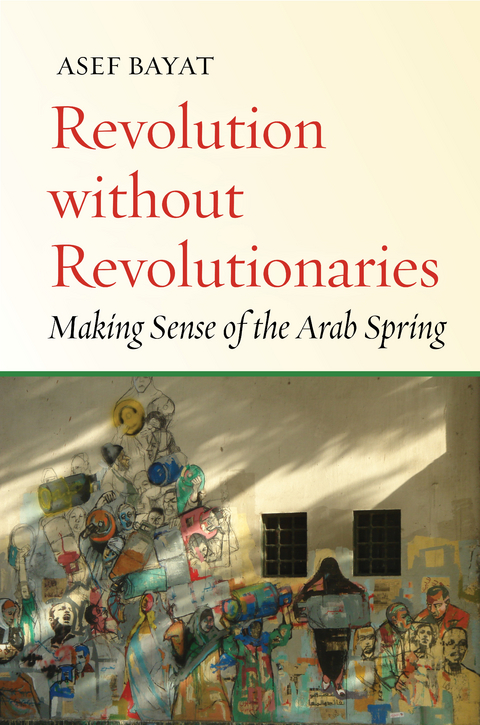
Revolution without Revolutionaries (eBook)
312 Seiten
Stanford University Press (Verlag)
978-1-5036-0307-3 (ISBN)
Asef Bayat is the Catherine and Bruce Bastian Professor of Global and Transnational Studies and Professor of Sociology at the University of Illinois, Urbana-Champaign. He is the author of Life as Politics: How Ordinary People Change the Middle East (Stanford, 2009, 2013) and Making Islam Democratic: Social Movements and the Post-Islamist Turn (Stanford, 2007).
Contents and Abstracts1Revolutions of Wrong Times chapter abstractChapter 1 sets the broad historical and conceptual framework for historically locating the revolutions of the new millennium, including the Arab Spring and the Occupy movements, by comparing them to the radical revolutions of the 1970s, notably those in Iran, Yemen, and Nicaragua. It suggests that the Arab uprisings and the Occupy movements came to fruition in a different historical time dominated by neoliberal norms that disparaged the very idea of revolution, collectivist ideals, and distributionist justice. The result was "refolution," or revolutions with a nonradical outcome.2Marx in the Islamic Revolution chapter abstractChapter 2 shows how the revolutions of the 1970s, unlike the Arab Spring, were informed by an intellectual component with socialist ideas as a major element. It focuses on the Iranian revolution of 1979 in which revolutionary ideas were articulated by Marxist and Islamic leftist guerrilla movements, as well as the "ideologue of the revolution," Ali Shariati. The revolution saw radical strategies and repertoires to which revolutionary ideas lent support.3Revolution in the Everyday chapter abstractChapter 3 elaborates on the revolutions' radical repertoires and strategies by examining the widespread shura (council) movements for grassroots democracy and self-rule in the neighborhoods, colleges, farms, and workplaces, focusing on the occupation of factories. With the fragmentation of labor and the end of existing socialism, radical ideas began to lose their clout.4Not a Theology of Liberation chapter abstractChapter 4 examines the deradicalization of political Islam, showing how the Islamist opposition evolved from its strong anti-imperialist and social justice propensity to embrace reformist politics and neoliberal economy. By the time the Arab uprisings occurred, most Islamists and secular counterparts had been conditioned by the neoliberal climate. The chapter shows that ISIS somehow represents Islamism of neoliberal times.5Cities of Dissent chapter abstractDespite the decline in revolutionary projects, popular dissent grew as neoliberalism transformed the Arab economies and shaped an increasingly contentious urbanity.6Square and Counter-Square chapter abstractChapter 6 examines how dissent found expression in the Arab cities' public spaces, in particular the Arab squares, during the uprisings. It addresses the question of what the urban locus of the uprisings tells us about their origin and dynamics and why certain spaces, such as squares, become the site of popular contention. It focuses on Cairo's Tahrir Square, Tunis's Bourguiba Boulevard, and Istanbul's Taksim Square as sites of street politics, exploring the regimes' "counter-square" strategies.7The Spring of Surprise chapter abstractAlthough it was not unexpected that the uprisings took place in urban areas, their sudden and fierce eruption surprised both observers and activists. Chapter 7 explores the way in which Arab subaltern groups were involved in discreet everyday struggles to enhance their life chances under the shadow of an authoritarian government and neoliberal economy. They had created their own opaque and illegible realities, "uncivil societies," under the radar of the state and scholars. Their struggles, often in the form of nonmovements, assumed a collective voice once the protests began and merged into what came to be known as the Arab uprisings. Surprise also lay in their ideological makeup and political trajectories.8Half Revolution, No Revolution chapter abstractChapter 8 examines the particular "refolutionary" character of the Arab Spring in Tunisia, Yemen, and Egypt, discussing their promise as well as their serious limitations in transforming into full-fledged revolutions. The chapter argues that what transpired in the Arab world were not revolutions in the sense of their twentieth-century counterparts but a mix of revolutionary mobilizations and reformist trajectories. To illustrate this, the chapter discusses the impact of neoliberal normativity on the thinking of the political class, both Islamists and non-Islamists.9Radical Impulses of the Social chapter abstractWhile there was little change in the structure of state power and the old elites, things were different at the societal level. Chapter 9 shows that the extraordinary acts of claim making by the poor, women, lower-class youth, and social minorities in pursuit of equality, inclusion, and recognition radicalized these otherwise nonradical revolutions.10The Agony of Transition chapter abstractChapter 10 discusses the contradictions of the postrevolutionary "transition." It demonstrates that the subaltern struggles discussed earlier made, in part, the postrevolutionary transition acutely contentious, reinforcing the painful and paradoxical postrevolutionary moments. The revolutions remained largely defenseless against the domestic and regional counterrevolution, which in turn had a devastating impact on efforts to achieve a just and free social order in Arab societies, feeding into the rising disenchantment with the experience and idea of revolution.11Revolution and Hope chapter abstractChapter 11 discusses the question of despair that came to afflict so many activists in postrevolutionary moments and concludes by exploring grounds for hope and the renewal of a revolutionary spirit in the postArab Spring Middle East.
| Erscheint lt. Verlag | 25.5.2023 |
|---|---|
| Reihe/Serie | Stanford Studies in Middle Eastern and Islamic Societies and Cultures | Stanford Studies in Middle Eastern and Islamic Societies and Cultures |
| Sprache | englisch |
| Themenwelt | Geschichte ► Allgemeine Geschichte ► Neuzeit (bis 1918) |
| Geschichte ► Allgemeine Geschichte ► Zeitgeschichte | |
| Geisteswissenschaften ► Geschichte ► Regional- / Ländergeschichte | |
| Sozialwissenschaften ► Ethnologie | |
| Sozialwissenschaften ► Politik / Verwaltung | |
| Sozialwissenschaften ► Soziologie | |
| Schlagworte | Arab revolution • arab spring • Egypt • Iranian Revolution • Neoliberalism • refo-lution • Tunisia • uprisings |
| ISBN-10 | 1-5036-0307-5 / 1503603075 |
| ISBN-13 | 978-1-5036-0307-3 / 9781503603073 |
| Informationen gemäß Produktsicherheitsverordnung (GPSR) | |
| Haben Sie eine Frage zum Produkt? |
 EPUB (Adobe DRM)
Kopierschutz: Adobe-DRM
Adobe-DRM ist ein Kopierschutz, der das eBook vor Mißbrauch schützen soll. Dabei wird das eBook bereits beim Download auf Ihre persönliche Adobe-ID autorisiert. Lesen können Sie das eBook dann nur auf den Geräten, welche ebenfalls auf Ihre Adobe-ID registriert sind.
Details zum Adobe-DRM
Dateiformat: EPUB (Electronic Publication)
EPUB ist ein offener Standard für eBooks und eignet sich besonders zur Darstellung von Belletristik und Sachbüchern. Der Fließtext wird dynamisch an die Display- und Schriftgröße angepasst. Auch für mobile Lesegeräte ist EPUB daher gut geeignet.
Systemvoraussetzungen:
PC/Mac: Mit einem PC oder Mac können Sie dieses eBook lesen. Sie benötigen eine
eReader: Dieses eBook kann mit (fast) allen eBook-Readern gelesen werden. Mit dem amazon-Kindle ist es aber nicht kompatibel.
Smartphone/Tablet: Egal ob Apple oder Android, dieses eBook können Sie lesen. Sie benötigen eine
Geräteliste und zusätzliche Hinweise
Buying eBooks from abroad
For tax law reasons we can sell eBooks just within Germany and Switzerland. Regrettably we cannot fulfill eBook-orders from other countries.
aus dem Bereich