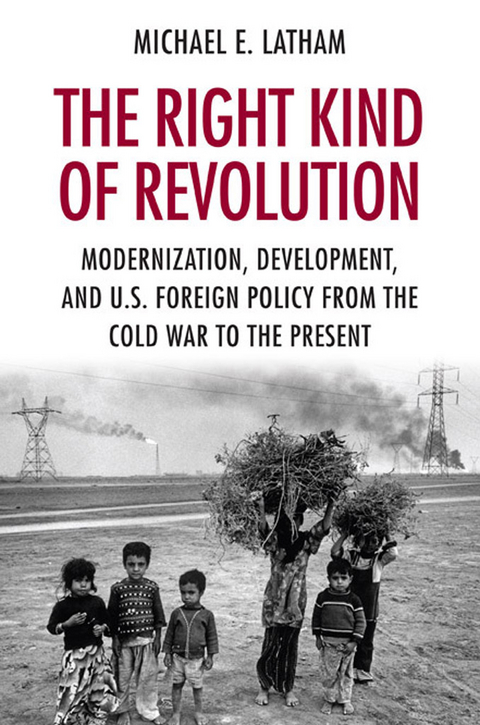
Right Kind of Revolution (eBook)
256 Seiten
Cornell University Press (Verlag)
978-0-8014-6056-2 (ISBN)
A critical history of modernization theory in American foreign policy.
Michael E. Latham has provided a very interesting and useful synthesis of the rise and decline (and eventual reappearance) of modernization theory in the United States, exploring both its intellectual roots and its deep connections to the country's foreign policy.- Michele Alacevich -Technology and Culture After World War II, a powerful conviction took hold among American intellectuals and policymakers: that the United States could profoundly accelerate and ultimately direct the development of the decolonizing world, serving as a modernizing force around the globe. By accelerating economic growth, promoting agricultural expansion, and encouraging the rise of enlightened elites, they hoped to link development with security, preventing revolutions and rapidly creating liberal, capitalist states. In The Right Kind of Revolution, Michael E. Latham explores the role of modernization and development in U.S. foreign policy from the early Cold War through the present. The modernization project rarely went as its architects anticipated. Nationalist leaders in postcolonial states such as India, Ghana, and Egypt pursued their own independent visions of development. Attempts to promote technological solutions to development problems also created unintended consequences by increasing inequality, damaging the environment, and supporting coercive social policies. In countries such as Guatemala, South Vietnam, and Iran, U.S. officials and policymakers turned to modernization as a means of counterinsurgency and control, ultimately shoring up dictatorial regimes and exacerbating the very revolutionary dangers they wished to resolve. Those failures contributed to a growing challenge to modernization theory in the late 1960s and 1970s. Since the end of the Cold War the faith in modernization as a panacea has reemerged. The idea of a global New Deal, however, has been replaced by a neoliberal emphasis on the power of markets to shape developing nations in benevolent ways. U.S. policymakers have continued to insist that history has a clear, universal direction, but events in Iraq and Afghanistan give the lie to modernization's false hopes and appealing promises.
Michael E. Latham is Professor of History at Fordham University and Dean of Fordham College at Rose Hill. He is the author of Modernization as Ideology: American Social Science and "Nation Building" in the Kennedy Era and coeditor of Staging Growth: Modernization, Development, and the Global Cold War and Knowledge and Postmodernism in Historical Perspective.
Introduction
1. Setting the Foundations: Imperial Ideals, Global War, and Decolonization
2. Take-Off: Modernization and Cold War America
3. Nationalist Encounters: Nehru's India, Nasser's Egypt,
and Nkrumah's Ghana
4. Technocratic Faith: From Birth Control to the Green Revolution
5. Counterinsurgency and Repression: Guatemala, South Vietnam, and Iran
6. Modernization under Fire: Alternative Paradigms, Sustainable Development, and the Neoliberal Turn
7. The Ghosts of Modernization: From Cold War Victory to Afghanistan and IraqBibliography
Index
| Erscheint lt. Verlag | 15.1.2011 |
|---|---|
| Verlagsort | Ithaca |
| Sprache | englisch |
| Maße | 160 x 160 mm |
| Themenwelt | Sachbuch/Ratgeber ► Geschichte / Politik ► 20. Jahrhundert bis 1945 |
| Geschichte ► Allgemeine Geschichte ► Neuzeit (bis 1918) | |
| Geschichte ► Allgemeine Geschichte ► Zeitgeschichte | |
| Geisteswissenschaften ► Geschichte ► Regional- / Ländergeschichte | |
| Geschichte ► Teilgebiete der Geschichte ► Kulturgeschichte | |
| Geschichte ► Teilgebiete der Geschichte ► Wirtschaftsgeschichte | |
| Sozialwissenschaften ► Politik / Verwaltung ► Europäische / Internationale Politik | |
| Sozialwissenschaften ► Politik / Verwaltung ► Staat / Verwaltung | |
| Schlagworte | 20th Century American History • American foreign affairs during the twentieth century • American foreign relations • American History • american military history • American modernization and development policies • creating NATO • Decolonization • foreign policy • foreign policy cold war • Foreign Relations • Foreign relations 1945-1989 • foriegn policy • harry truman's foreign policy • History • independent visions for development, technological solutions to development problems, social policies, global New Deal, failures of modernization • modern foreign policy • North Atlantic Treaty Organization • Political Science • present foreign policy • The Marshall Plan • U.S. Foreign Policy |
| ISBN-10 | 0-8014-6056-5 / 0801460565 |
| ISBN-13 | 978-0-8014-6056-2 / 9780801460562 |
| Informationen gemäß Produktsicherheitsverordnung (GPSR) | |
| Haben Sie eine Frage zum Produkt? |
 EPUB (Adobe DRM)
Kopierschutz: Adobe-DRM
Adobe-DRM ist ein Kopierschutz, der das eBook vor Mißbrauch schützen soll. Dabei wird das eBook bereits beim Download auf Ihre persönliche Adobe-ID autorisiert. Lesen können Sie das eBook dann nur auf den Geräten, welche ebenfalls auf Ihre Adobe-ID registriert sind.
Details zum Adobe-DRM
Dateiformat: EPUB (Electronic Publication)
EPUB ist ein offener Standard für eBooks und eignet sich besonders zur Darstellung von Belletristik und Sachbüchern. Der Fließtext wird dynamisch an die Display- und Schriftgröße angepasst. Auch für mobile Lesegeräte ist EPUB daher gut geeignet.
Systemvoraussetzungen:
PC/Mac: Mit einem PC oder Mac können Sie dieses eBook lesen. Sie benötigen eine
eReader: Dieses eBook kann mit (fast) allen eBook-Readern gelesen werden. Mit dem amazon-Kindle ist es aber nicht kompatibel.
Smartphone/Tablet: Egal ob Apple oder Android, dieses eBook können Sie lesen. Sie benötigen eine
Geräteliste und zusätzliche Hinweise
Buying eBooks from abroad
For tax law reasons we can sell eBooks just within Germany and Switzerland. Regrettably we cannot fulfill eBook-orders from other countries.
aus dem Bereich