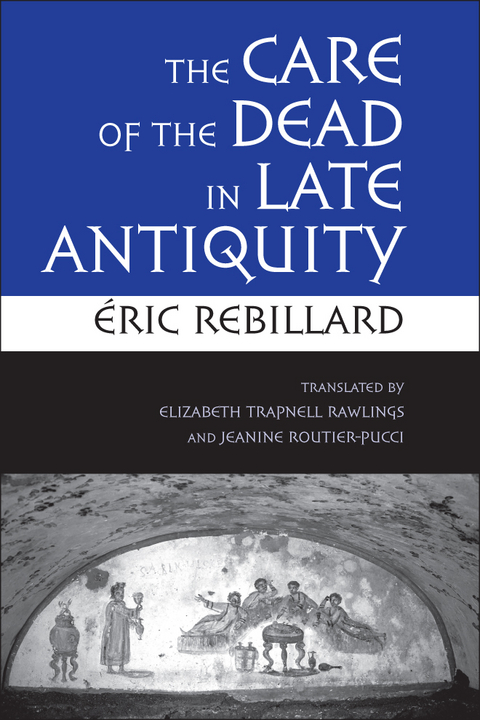
The Care of the Dead in Late Antiquity (eBook)
240 Seiten
Cornell University Press (Verlag)
978-0-8014-5792-0 (ISBN)
In this provocative book Éric Rebillard challenges many long-held assumptions about early Christian burial customs. For decades scholars of early Christianity have argued that the Church owned and operated burial grounds for Christians as early as the...
In this provocative book Éric Rebillard challenges many long-held assumptions about early Christian burial customs. For decades scholars of early Christianity have argued that the Church owned and operated burial grounds for Christians as early as the third century. Through a careful reading of primary sources including legal codes, theological works, epigraphical inscriptions, and sermons, Rebillard shows that there is little evidence to suggest that Christians occupied exclusive or isolated burial grounds in this early period. In fact, as late as the fourth and fifth centuries the Church did not impose on the faithful specific rituals for laying the dead to rest. In the preparation of Christians for burial, it was usually next of kin and not representatives of the Church who were responsible for what form of rite would be celebrated, and evidence from inscriptions and tombstones shows that for the most part Christians didn't separate themselves from non-Christians when burying their dead. According to Rebillard it would not be until the early Middle Ages that the Church gained control over burial practices and that "Christian cemeteries" became common.
In this translation of Religion et Sépulture: L'église, les vivants et les morts dans l'Antiquité tardive, Rebillard fundamentally changes our understanding of early Christianity. The Care of the Dead in Late Antiquity will force scholars of the period to rethink their assumptions about early Christians as separate from their pagan contemporaries in daily life and ritual practice.
In this provocative book Éric Rebillard challenges many long-held assumptions about early Christian burial customs. For decades scholars of early Christianity have argued that the Church owned and operated burial grounds for Christians as early as the third century. Through a careful reading of primary sources including legal codes, theological works, epigraphical inscriptions, and sermons, Rebillard shows that there is little evidence to suggest that Christians occupied exclusive or isolated burial grounds in this early period.
In fact, as late as the fourth and fifth centuries the Church did not impose on the faithful specific rituals for laying the dead to rest. In the preparation of Christians for burial, it was usually next of kin and not representatives of the Church who were responsible for what form of rite would be celebrated, and evidence from inscriptions and tombstones shows that for the most part Christians didn't separate themselves from non-Christians when burying their dead. According to Rebillard it would not be until the early Middle Ages that the Church gained control over burial practices and that "Christian cemeteries" became common.
In this translation of Religion et Sépulture: L'église, les vivants et les morts dans l'Antiquité tardive, Rebillard fundamentally changes our understanding of early Christianity. The Care of the Dead in Late Antiquity will force scholars of the period to rethink their assumptions about early Christians as separate from their pagan contemporaries in daily life and ritual practice.
Eric Rebillard is Professor of Classics and History at Cornell University. He is the author of In hora mortis and editor of L'Année philologique on the Internet. Elizabeth Trapnell Rawlings is an independent translator. Jeanine Routier-Pucci is Senior Lecturer of Spanish Language at Cornell University.
| Erscheint lt. Verlag | 6.4.2012 |
|---|---|
| Reihe/Serie | Cornell Studies in Classical Philology | Cornell Studies in Classical Philology |
| Übersetzer | Elizabeth Trapnell Rawlings, Jeanine Routier-Pucci |
| Verlagsort | Ithaca |
| Sprache | englisch |
| Maße | 160 x 160 mm |
| Themenwelt | Sachbuch/Ratgeber ► Geschichte / Politik ► Vor- und Frühgeschichte / Antike |
| Geschichte ► Allgemeine Geschichte ► Vor- und Frühgeschichte | |
| Geschichte ► Allgemeine Geschichte ► Altertum / Antike | |
| Religion / Theologie ► Christentum ► Kirchengeschichte | |
| Religion / Theologie ► Christentum ► Liturgik / Homiletik | |
| Geisteswissenschaften ► Sprach- / Literaturwissenschaft ► Anglistik / Amerikanistik | |
| Geisteswissenschaften ► Sprach- / Literaturwissenschaft ► Literaturwissenschaft | |
| Sozialwissenschaften ► Soziologie ► Mikrosoziologie | |
| Schlagworte | commemoration of the dead, church and death, sociology of death, european religious history, christian burial customs, christianity and death |
| ISBN-10 | 0-8014-5792-0 / 0801457920 |
| ISBN-13 | 978-0-8014-5792-0 / 9780801457920 |
| Informationen gemäß Produktsicherheitsverordnung (GPSR) | |
| Haben Sie eine Frage zum Produkt? |
 EPUB (Adobe DRM)
Kopierschutz: Adobe-DRM
Adobe-DRM ist ein Kopierschutz, der das eBook vor Mißbrauch schützen soll. Dabei wird das eBook bereits beim Download auf Ihre persönliche Adobe-ID autorisiert. Lesen können Sie das eBook dann nur auf den Geräten, welche ebenfalls auf Ihre Adobe-ID registriert sind.
Details zum Adobe-DRM
Dateiformat: EPUB (Electronic Publication)
EPUB ist ein offener Standard für eBooks und eignet sich besonders zur Darstellung von Belletristik und Sachbüchern. Der Fließtext wird dynamisch an die Display- und Schriftgröße angepasst. Auch für mobile Lesegeräte ist EPUB daher gut geeignet.
Systemvoraussetzungen:
PC/Mac: Mit einem PC oder Mac können Sie dieses eBook lesen. Sie benötigen eine
eReader: Dieses eBook kann mit (fast) allen eBook-Readern gelesen werden. Mit dem amazon-Kindle ist es aber nicht kompatibel.
Smartphone/Tablet: Egal ob Apple oder Android, dieses eBook können Sie lesen. Sie benötigen eine
Geräteliste und zusätzliche Hinweise
Buying eBooks from abroad
For tax law reasons we can sell eBooks just within Germany and Switzerland. Regrettably we cannot fulfill eBook-orders from other countries.
aus dem Bereich