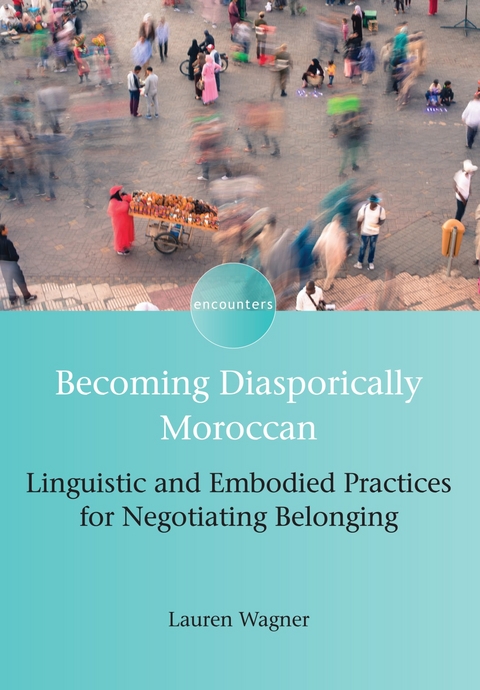
Becoming Diasporically Moroccan (eBook)
Channel View Publications (Verlag)
978-1-78309-837-8 (ISBN)
Questions persist about post-migrant generations and their sense of belonging in one homeland or another. In the setting of Morocco, where trajectories to and from Europe have colored several centuries of history, this book provides a framework to explore how migration and return become incorporated into contemporary ‘Moroccanness’.
Questions persist about post-migrant generations and their sense of belonging in one homeland or another. As descendants of migrants, 'second' and further generations often struggle to establish an unproblematic belonging in/to a resident homeland, as the place where they live and work but are often categorized as 'outsiders'. Simultaneously, because of improving access to travel, they can also maintain a physical presence in an ancestral homeland. However, their encounters there may also problematize their sense of belonging. During their summertime visits to Morocco, the European-Moroccan participants in this ethnography repeatedly find themselves negotiating a sense of belonging in the 'homeland'. This book analyzes how these negotiations take place in order to investigate how the categories of 'diasporic' and 'Moroccan' become shaped by the interactional encounters observed. In the setting of Morocco, where trajectories to and from Europe have colored several centuries of history, this book provides a framework to explore how migration and return become incorporated into contemporary 'Moroccanness'.
lt;p>Lauren Wagner is Assistant Professor in Globalisation and Development, Maastricht University, The Netherlands. She is co-convener of the Anthropology of Mobilities network, European Association of Social Anthropologists. Her research focuses on embodied practices and diasporic mobilities.
Acknowledgements
Transcription Conventions
Introduction
Chapter 1: Pathways and Backgrounds
Chapter 2: Integrating Theory and Method
Chapter 3: Defining the Category ‘Moroccan’: Embodied Misrecognitions and Dynamics of Passing
Chapter 4: Bargaining for ‘Moroccanness’: Categorial Work on the Market
Chapter 5: A New Category? Becoming ‘Diasporically-Moroccan’
Conclusion: Assembling Diasporicness
Bibliography
| Erscheint lt. Verlag | 14.8.2017 |
|---|---|
| Reihe/Serie | Encounters | Encounters |
| Verlagsort | Bristol |
| Sprache | englisch |
| Themenwelt | Geisteswissenschaften ► Sprach- / Literaturwissenschaft ► Sprachwissenschaft |
| Sozialwissenschaften ► Ethnologie | |
| Sozialwissenschaften ► Soziologie | |
| Schlagworte | Anthropology • Assemblage • belonging • Categorization • Diaspora • Immigration • Membership Categorization Analysis • Morocco |
| ISBN-10 | 1-78309-837-6 / 1783098376 |
| ISBN-13 | 978-1-78309-837-8 / 9781783098378 |
| Informationen gemäß Produktsicherheitsverordnung (GPSR) | |
| Haben Sie eine Frage zum Produkt? |
 EPUB (Adobe DRM)
Kopierschutz: Adobe-DRM
Adobe-DRM ist ein Kopierschutz, der das eBook vor Mißbrauch schützen soll. Dabei wird das eBook bereits beim Download auf Ihre persönliche Adobe-ID autorisiert. Lesen können Sie das eBook dann nur auf den Geräten, welche ebenfalls auf Ihre Adobe-ID registriert sind.
Details zum Adobe-DRM
Dateiformat: EPUB (Electronic Publication)
EPUB ist ein offener Standard für eBooks und eignet sich besonders zur Darstellung von Belletristik und Sachbüchern. Der Fließtext wird dynamisch an die Display- und Schriftgröße angepasst. Auch für mobile Lesegeräte ist EPUB daher gut geeignet.
Systemvoraussetzungen:
PC/Mac: Mit einem PC oder Mac können Sie dieses eBook lesen. Sie benötigen eine
eReader: Dieses eBook kann mit (fast) allen eBook-Readern gelesen werden. Mit dem amazon-Kindle ist es aber nicht kompatibel.
Smartphone/Tablet: Egal ob Apple oder Android, dieses eBook können Sie lesen. Sie benötigen eine
Geräteliste und zusätzliche Hinweise
Buying eBooks from abroad
For tax law reasons we can sell eBooks just within Germany and Switzerland. Regrettably we cannot fulfill eBook-orders from other countries.
aus dem Bereich