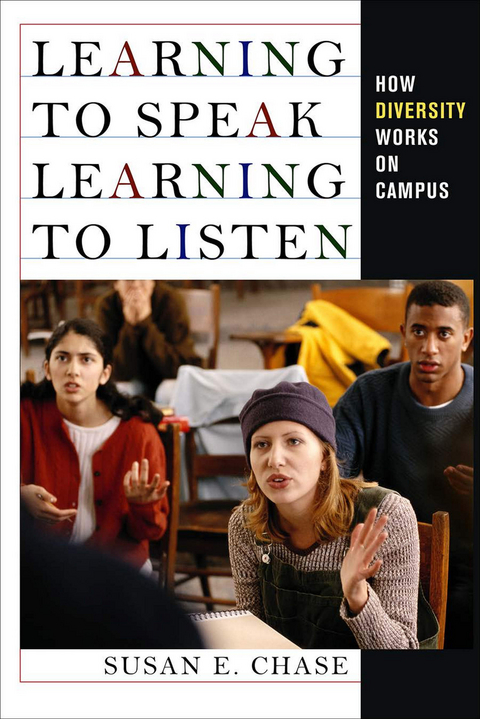
Learning to Speak, Learning to Listen (eBook)
304 Seiten
Cornell University Press (Verlag)
978-0-8014-6031-9 (ISBN)
"This book about diversity offers a fresh perspective and is an important reminder to all that context matters, and what we say and do (our narrative practices) shape and are shaped by it."—Susan Murphy, Cornell University
Over the past three decades, colleges and universities have committed to encouraging, embracing, and supporting diversity as a core principle of their mission. But how are goals for achieving and maintaining diversity actually met? What is the role of students in this mission? When a university is committed to diversity, what is campus culture like?In Learning to Speak, Learning to Listen, Susan E. Chase portrays how undergraduates at a predominantly white urban institution, which she calls "City University" (a pseudonym), learn to speak and listen to each other across social differences. Chase interviewed a wide range of students and conducted content analyses of the student newspaper, student government minutes, curricula, and website to document diversity debates at this university. Amid various controversies, she identifies a defining moment in the campus culture: a protest organized by students of color to highlight the university's failure to live up to its diversity commitments. Some white students dismissed the protest, some were hostile to it, and some fully engaged their peers of color.In a book that will be useful to students and educators on campuses undergoing diversity initiatives, Chase finds that both students' willingness to share personal stories about their diverse experiences and collaboration among student organizations, student affairs offices, and academic programs encourage speaking and listening across differences and help incorporate diversity as part of the overall mission of the university.
Over the past three decades, colleges and universities have committed to encouraging, embracing, and supporting diversity as a core principle of their mission. But how are goals for achieving and maintaining diversity actually met? What is the role of students in this mission? When a university is committed to diversity, what is campus culture like? In Learning to Speak, Learning to Listen, Susan E. Chase portrays how undergraduates at a predominantly white urban institution, which she calls "City University" (a pseudonym), learn to speak and listen to each other across social differences.
Chase interviewed a wide range of students and conducted content analyses of the student newspaper, student government minutes, curricula, and website to document diversity debates at this university. Amid various controversies, she identifies a defining moment in the campus culture: a protest organized by students of color to highlight the university's failure to live up to its diversity commitments. Some white students dismissed the protest, some were hostile to it, and some fully engaged their peers of color.
In a book that will be useful to students and educators on campuses undergoing diversity initiatives, Chase finds that both students' willingness to share personal stories about their diverse experiences and collaboration among student organizations, student affairs offices, and academic programs encourage speaking and listening across differences and help incorporate diversity as part of the overall mission of the university.
Susan E. Chase is Associate Professor of Sociology at the University of Tulsa. She is author of Ambiguous Empowerment: The Work Narratives of Women School Superintendents and coauthor of Mothers and Children: Feminist Analyses and Personal Narratives.
Preface
IntroductionPart I. City University's Narrative Landscape
1 Diversity at City University
2 Conflicting Discourses
3 Race in CU’s Narrative LandscapePart II. Students’ Personal Narratives
4 Learning to Speak
5 Learning to ListenPart III. Students’ Protest and Response
6 Creating a Voice of Protest
7 Walking on Eggshells (And Other Responses)
8 Doing the Work of AlliesReflections
EpilogueAppendixes
A Note to People at CU
B Methodological Issues
C Interviewees and Interview Guides
D Detailed Tables and Methods of Content AnalysisNotes
Selected References
Index
| Verlagsort | Ithaca |
|---|---|
| Sprache | englisch |
| Maße | 160 x 160 mm |
| Themenwelt | Schulbuch / Wörterbuch ► Lernhilfen ► Sekundarstufe I |
| Sozialwissenschaften ► Pädagogik ► Erwachsenenbildung | |
| Schlagworte | Overcoming social divides, university's commitments to diversity, protests on college campuses, antiracist activism in colleges, inclusive campus culture |
| ISBN-10 | 0-8014-6031-X / 080146031X |
| ISBN-13 | 978-0-8014-6031-9 / 9780801460319 |
| Informationen gemäß Produktsicherheitsverordnung (GPSR) | |
| Haben Sie eine Frage zum Produkt? |
 PDF (Adobe DRM)
Kopierschutz: Adobe-DRM
Adobe-DRM ist ein Kopierschutz, der das eBook vor Mißbrauch schützen soll. Dabei wird das eBook bereits beim Download auf Ihre persönliche Adobe-ID autorisiert. Lesen können Sie das eBook dann nur auf den Geräten, welche ebenfalls auf Ihre Adobe-ID registriert sind.
Details zum Adobe-DRM
Dateiformat: PDF (Portable Document Format)
Mit einem festen Seitenlayout eignet sich die PDF besonders für Fachbücher mit Spalten, Tabellen und Abbildungen. Eine PDF kann auf fast allen Geräten angezeigt werden, ist aber für kleine Displays (Smartphone, eReader) nur eingeschränkt geeignet.
Systemvoraussetzungen:
PC/Mac: Mit einem PC oder Mac können Sie dieses eBook lesen. Sie benötigen eine
eReader: Dieses eBook kann mit (fast) allen eBook-Readern gelesen werden. Mit dem amazon-Kindle ist es aber nicht kompatibel.
Smartphone/Tablet: Egal ob Apple oder Android, dieses eBook können Sie lesen. Sie benötigen eine
Geräteliste und zusätzliche Hinweise
Buying eBooks from abroad
For tax law reasons we can sell eBooks just within Germany and Switzerland. Regrettably we cannot fulfill eBook-orders from other countries.
aus dem Bereich