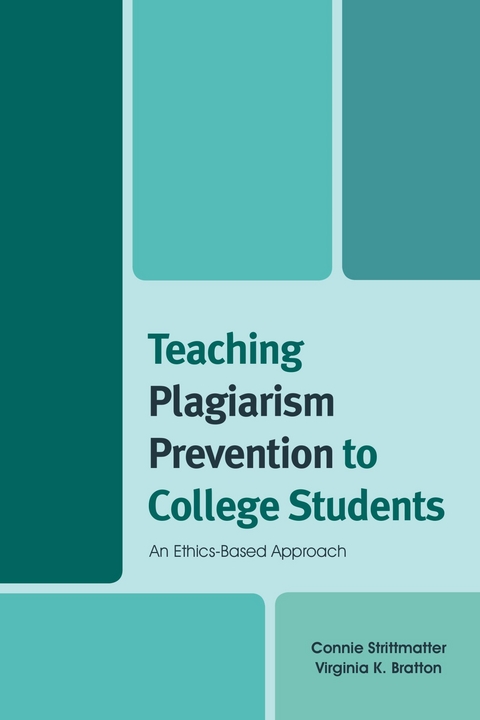
Teaching Plagiarism Prevention to College Students (eBook)
158 Seiten
Rowman & Littlefield Publishers (Verlag)
978-1-4422-6442-7 (ISBN)
Connie Strittmatter is the Head Librarian for Access Services at Boston College. Prior to her position at Boston College, she was the Team Leader for Access Services and Associate Professor at Montana State University Library. She received her MLS from Kent State University in 2000 and her Masters in Business Administration from the W.P. Carey School of Business at Arizona State University in 2004. Connie’s research focus has been on pedagogical design for library instruction. She has published in College & Research Libraries, Journal of Business and Finance Librarianship, and Ethics & Behavior. While at Montana State University, Connie worked with Business faculty to incorporate a library instruction module (with an ethics component) into a core business class. She expanded her plagiarism and ethics instruction into engineering and international student orientation. Virginia K. Bratton is an Associate Professor of Management in the Jake Jabs College of Business and Entrepreneurship at Montana State University in Bozeman, MT. She received her Ph.D. in Business Administration from Florida State University in 2004, where she completed her dissertation on the topic of ethical decision-making on a student population. Dr. Bratton teaches courses in organizational behavior, human resource management, and leadership. Her research focus is on business ethics, impression management, and performance appraisals, and she has published in Journal of Organizational Behavior,Journal of Vocational Behavior, and Leadership and Organization Development Journal. Dr. Bratton has delivered ethics instruction to a broad array of populations including undergraduate business and engineering students at Montana State University, doctoral management students at the University of Melbourne in Melbourne, Australia, and human resource management practitioners from Montana and its surrounding states.
List of FiguresList of TablesAcknowledgmentsPrefacePart 1 Plagiarism: An Ethical Issue1 Plagiarism Prevention Instruction: Where Did We Come from? Where Are We Going?2 Thinking Through the Ethics of Plagiarism: A Crash Course Part II Introducing Plagiarism and Ethics Awareness Training (PEAT)3 Getting Started: Choosing Your Teaching Strategy for PEAT 4 Designing Your Content: The Curricular Building Blocks of PEATAppendix A5 Putting it into Action: Implementing PEAT in the ClassroomPart III Assessing the Effectiveness of Your PEAT Program6 Did They Like it? Did They learn? Assessing Student Reactions and Knowledge 7 Did Training Make a Difference? Assessing Student Behaviors and Organizational Outcomes8 Sharing the News: Communicating Your Training Results9 Where do we from here?: A holistic model for plagiarism preventionAbout the AuthorsIndex
| Erscheint lt. Verlag | 25.8.2016 |
|---|---|
| Sprache | englisch |
| Themenwelt | Geisteswissenschaften ► Sprach- / Literaturwissenschaft ► Literaturwissenschaft |
| Geisteswissenschaften ► Sprach- / Literaturwissenschaft ► Sprachwissenschaft | |
| Sozialwissenschaften ► Kommunikation / Medien ► Buchhandel / Bibliothekswesen | |
| Sozialwissenschaften ► Pädagogik ► Erwachsenenbildung | |
| Schlagworte | Library Instruction |
| ISBN-10 | 1-4422-6442-X / 144226442X |
| ISBN-13 | 978-1-4422-6442-7 / 9781442264427 |
| Informationen gemäß Produktsicherheitsverordnung (GPSR) | |
| Haben Sie eine Frage zum Produkt? |
 EPUB (Adobe DRM)
Kopierschutz: Adobe-DRM
Adobe-DRM ist ein Kopierschutz, der das eBook vor Mißbrauch schützen soll. Dabei wird das eBook bereits beim Download auf Ihre persönliche Adobe-ID autorisiert. Lesen können Sie das eBook dann nur auf den Geräten, welche ebenfalls auf Ihre Adobe-ID registriert sind.
Details zum Adobe-DRM
Dateiformat: EPUB (Electronic Publication)
EPUB ist ein offener Standard für eBooks und eignet sich besonders zur Darstellung von Belletristik und Sachbüchern. Der Fließtext wird dynamisch an die Display- und Schriftgröße angepasst. Auch für mobile Lesegeräte ist EPUB daher gut geeignet.
Systemvoraussetzungen:
PC/Mac: Mit einem PC oder Mac können Sie dieses eBook lesen. Sie benötigen eine
eReader: Dieses eBook kann mit (fast) allen eBook-Readern gelesen werden. Mit dem amazon-Kindle ist es aber nicht kompatibel.
Smartphone/Tablet: Egal ob Apple oder Android, dieses eBook können Sie lesen. Sie benötigen eine
Geräteliste und zusätzliche Hinweise
Buying eBooks from abroad
For tax law reasons we can sell eBooks just within Germany and Switzerland. Regrettably we cannot fulfill eBook-orders from other countries.
aus dem Bereich