Culturally Affirming Literacy Practices for Urban Elementary Students (eBook)
210 Seiten
Rowman & Littlefield Publishers (Verlag)
978-1-4758-2644-9 (ISBN)
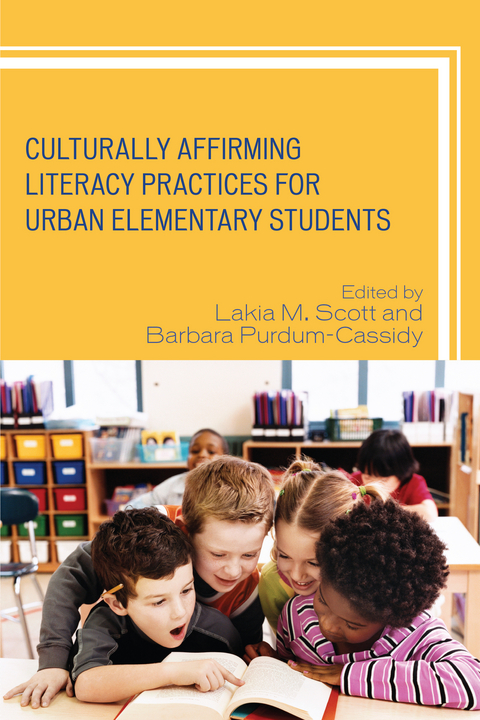
The nation's demographic of public schools are more ethnically, racially, and linguistically diverse than ever before (Strauss, 2014). However, there are still educational policies and practices that call to question whether traditionally marginalized students receive an equitable education. This is demonstrated in national achievement trends, which highlight disproportionality ratings among minoritized student groups. Also when examining school discipline policies, expulsion ratings, special education services, and school choice movements, all seem to handicap educational opportunity for low-income Black and Brown students. As American schools become more and more diverse, it is imperative that the literacy practices used to teach young students of color reflect the nation's changing demographic. This book provides practical insights guided by conceptual and contextual knowledge in understanding how to teach urban African American and Hispanic/Latino(a) students by discussing issues associated with critical pedagogies, literacy, and culturally appropriate instructional strategies that have demonstrated success for traditionally marginalized student populations. This book examines culturally affirming literacy practices from three main components: (1) scholarship, (2) the field of practice, and (3) teacher education models. Each of these three are significant in understanding how to teach minoritized populations. As such, chapters have been organized into three main sections that address scholarship and research, trends in the field, and implications for teacher education models - all in order to advance the literacy achievement of African American and Hispanic/Latino(a) students.
Dr. Lakia M. Scott is an Assistant Professor in the School of Education at Baylor University. She currently teaches an elementary and middle grades reading methods course to pre-service teachers and has over ten years of combined experiences at the elementary, secondary, undergraduate, and graduate teaching levels. Dr. Barbara Purdum-Cassidy is a Clinical Assistant Professor in the School of Education at Baylor University. With over twenty-five years of combined teaching experiences, Dr. Purdum-Cassidy currently teaches elementary language arts methods and advanced methods of teaching writing.
AcknowledgmentsForewordNancy GallavanChapter 1: Introduction: The Continued Era of Language Discrimination for Minoritized Students: Implications for Culturally Affirming Literacy Practices in Urban Elementary SchoolsLakia Scott, Baylor UniversityChapter 2: A Framework for Critical Social Justice Literacy in Urban Elementary SchoolsDana Stachowiak, University of Louisiana at LafayetteChapter 3: Reauthorizing Excellence in Literacy Teaching for African American LearnersMelanie Acosta, University of AlabamaChapter 4: Harambee!: Successful, Culturally-Centered Literacy Instruction for Struggling Readers through the Children Defense Fund’s Freedom School ModelMarcia Watson, Towson UniversityChapter 5: Beyond Basic Instruction: Effective Civic Literacy Instruction in Urban School Settings Barbara Purdum-Cassidy, Baylor University, and Karon LeCompte, Baylor UniversityChapter 6: Affirming the Identities of English Learners through Purposeful, Project-Based Literacy Instruction Catherine Reischl, University of Michigan, and Debi Khasnabis, University of MichiganChapter 7: Critical Pedagogies for Increasing English Language Learners’ Reading and Writing AchievementCherese Childers-McKee, University of North Carolina at Greensboro, Libra Boyd, University of North Carolina at Greensboro, and Corliss Brown Thompson, Northeastern UniversityChapter 8: How Does your Garden Grow? Using Nature to Bridge the Language Gap with Young English Language Learners Elena King, Greensboro College, and Michelle Plaisance, Greensboro CollegeChapter 9: Culturally Relevant Texts and Urban English Language LearnersJessica Meehan, Tarleton State UniversityChapter 10: Moving Beyond Apartheid Schooling and “Adequate Education”: Empowering the Minoritized through Critical Media LiteracyElena Venegas, Baylor UniversityChapter 11: “Started from the Bottom Now We Here”: Helping Educators to Empower Urban Students about their Futures by Liberating them from Cultural PastLakia M. Scott, Baylor University and Marcia Watson, Towson UniversityChapter12: Teaching with the Technology: Apps, Software, and Social Media Explored for the Urban Literacy ClassroomJason Trumble, University of Central Arkansas, and Michael Mills, University of Central ArkansasChapter 13: Preparing Pre-Service and In-Service Educators to Use Instructional Technology as a Differentiation Tool in English Language Arts and ReadingLeanne Howell, Baylor University, and Brent Merritt, Midway Independent School DistrictChapter 14: Professional Development and Classroom Resources for the Elementary Literacy EducatorSherry McElhannon, Literacy Fusions,andJessica Rogers, Literacy FusionsAbout the EditorsAbout the ContributorsIndex
| Erscheint lt. Verlag | 17.8.2016 |
|---|---|
| Sprache | englisch |
| Themenwelt | Schulbuch / Wörterbuch ► Schulbuch / Allgemeinbildende Schulen |
| Sozialwissenschaften ► Pädagogik ► Didaktik | |
| ISBN-10 | 1-4758-2644-3 / 1475826443 |
| ISBN-13 | 978-1-4758-2644-9 / 9781475826449 |
| Informationen gemäß Produktsicherheitsverordnung (GPSR) | |
| Haben Sie eine Frage zum Produkt? |
 EPUB (Adobe DRM)
Kopierschutz: Adobe-DRM
Adobe-DRM ist ein Kopierschutz, der das eBook vor Mißbrauch schützen soll. Dabei wird das eBook bereits beim Download auf Ihre persönliche Adobe-ID autorisiert. Lesen können Sie das eBook dann nur auf den Geräten, welche ebenfalls auf Ihre Adobe-ID registriert sind.
Details zum Adobe-DRM
Dateiformat: EPUB (Electronic Publication)
EPUB ist ein offener Standard für eBooks und eignet sich besonders zur Darstellung von Belletristik und Sachbüchern. Der Fließtext wird dynamisch an die Display- und Schriftgröße angepasst. Auch für mobile Lesegeräte ist EPUB daher gut geeignet.
Systemvoraussetzungen:
PC/Mac: Mit einem PC oder Mac können Sie dieses eBook lesen. Sie benötigen eine
eReader: Dieses eBook kann mit (fast) allen eBook-Readern gelesen werden. Mit dem amazon-Kindle ist es aber nicht kompatibel.
Smartphone/Tablet: Egal ob Apple oder Android, dieses eBook können Sie lesen. Sie benötigen eine
Geräteliste und zusätzliche Hinweise
Buying eBooks from abroad
For tax law reasons we can sell eBooks just within Germany and Switzerland. Regrettably we cannot fulfill eBook-orders from other countries.
aus dem Bereich