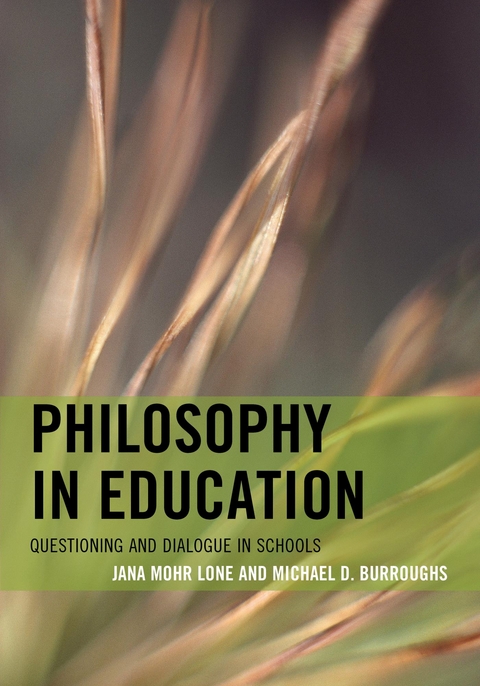
Philosophy in Education (eBook)
240 Seiten
Rowman & Littlefield Publishers (Verlag)
978-1-4422-3479-6 (ISBN)
Jana Mohr Lone is the founder and director of the University of Washington Center for Philosophy for Children. Since 1995 she has taught philosophy in classrooms from preschool to college, as well as taught college students, K-12 teachers, parents and others about ways to bring philosophy into the lives of young people. She is the author of The Philosophical Child, which explores ways that parents, grandparents, and other adults can stimulate philosophical conversations about children's questions, Philosophy and Education: Introducing Philosophy to Young People, (co-editor with Roberta Israeloff), which examines various issues involved in teaching philosophy to young people, and many articles about K-12 philosophy. She writes the blog Wondering Aloud: Philosophy with Young People. A frequent speaker about pre-college philosophy, Jana is the president of PLATO (Philosophy Learning and Teaching Organization), chair of the American Philosophical Association Committee on Pre-College Instruction in Philosophy, and the founding editor-in-chief of the journal Questions: Philosophy for Young People. Michael D. Burroughs is Assistant Director of the Rock Ethics Institute and Senior Lecturer in Philosophy at the Pennsylvania State University. For over a decade, he has been working to provide greater access to pre-college philosophy in the United States. Michael has taught philosophy at numerous academic levels, including K-12 and college classes, as well as workshops for pre-college teachers and university professors. In 2008, Michael co-founded Philosophical Horizons, a pre-college philosophy program dedicated to introducing the history and practice of philosophy to children in Memphis city schools (K-12). Michael also served as Outreach Coordinator for the Philosophy Department at the University of North Carolina at Chapel Hill. During his tenure at UNC-Chapel Hill, he taught university courses on pre-college philosophy and collaborated with local educators and philosophy and education graduate students to begin numerous elementary, middle, and high school philosophy programs. Michael serves on the PLATO (Philosophy Learning and Teaching Organization) board of directors and has presented and written extensively on issues in pre-college philosophy, including chapters in Philosophy in Schools: An Introduction for Philosophers and Teachers (Routledge, 2013) and Ethics in Youth Sport: Policy and Pedagogical Applications (Routledge, 2013).
PrefaceSection IWhy introduce philosophy to young people?Chapter 1 – Philosophy Beyond the University Chapter 2 – Wonder, Questioning and Reflection Section IIMaking Space for Questioning and Dialogue Chapter 3 – Learner-Centered Education and the Dialogical Model Chapter 4 – Philosophical SensitivityChapter 5 – The Community of Philosophical InquirySection IIIIn the Classroom Chapter 6 – Philosophy in Elementary School A Question BoardCreating Our Own Philosophical StoryThe Three Questions by Jon MuthStuart Little chapter 12 by E.B. WhiteBig Questions and How We Answer ThemWhy? by Lindsay Camp and Tony RossKeep the Question GoingWhat’s Your Reason?Good News, Bad NewsHorton Hears A Who by Dr. SeussHarry Potter and the Sorcerer’s Stone chapter 12 by J.K. RowlingSilent discussion: The Hole by Øyvind TorseterLet’s Do Nothing by Tony FucileThe Big Orange Splot by Daniel Manus PinkwaterAn Angel for Solomon Singer by Cynthia RylantA Shelter in Our Car by Monica GunningFour Feet, Two Sandals by Karen Lynn Williams and Khadra Mohammed Amazing Grace by Mary HoffmanPaperbag Princess by Robert MunschThe Other Side by Jacqueline WoodsonFreedom Summer by Deborah WilesBird by Zetta ElliottThe Conductor by Laetitia DevernayWhat is Music? Silence and SoundThe Art Lesson by Tomie de PaolaWhat is art?The Coat by Julie Hunt and Ron BrooksChapter 7 – Philosophy in Middle SchoolFreedomFair or Equal?Justice and Fairness in SchoolsStereotypingFollowing the LeaderOn FriendshipHuman Nature and the Ring of GygesDrawing a Good LifeShallow Pond and CharityPhilosophical Inquiry and Teaching The Book Thief by Marcus ZusakLEGOs of TheseusSocial Media and Free WillConvince Your Teacher/PrincipalLogic CharadesChapter 8 – Philosophy in High SchoolArguments and Philosophical ReasoningDrop the BallWhat Do We Find Beautiful?Affirmative Action in University Admissions (1)Affirmative Action in University Admissions (2)I Lost My CoolSocial Contract Theory: Creating a Cooperative Learning EnvironmentApplied Ethics – Genetic EnhancementJustice and UtopiaThe Case of Kitty Genovese: Moral Responsibility and the Bystander EffectThe Words We Live ByThe Ethics of “Stop Snitching”Socratic SeminarIn-Class Ethics BowlSection IVIdentity, Social Inequality and Philosophical PracticeChapter 9 – Philosophical Recognition and Identity: Recognizing the Child Chapter 10 – Children’s Philosophical Encounters: Taking Seriously the Role of Privilege in ClassroomsChapter 11 – Philosophy and Transforming K-12 Education AppendixBibliographyAbout the Authors
| Erscheint lt. Verlag | 11.2.2016 |
|---|---|
| Sprache | englisch |
| Themenwelt | Schulbuch / Wörterbuch ► Schulbuch / Allgemeinbildende Schulen |
| Sozialwissenschaften ► Pädagogik ► Allgemeines / Lexika | |
| Sozialwissenschaften ► Pädagogik ► Bildungstheorie | |
| ISBN-10 | 1-4422-3479-2 / 1442234792 |
| ISBN-13 | 978-1-4422-3479-6 / 9781442234796 |
| Informationen gemäß Produktsicherheitsverordnung (GPSR) | |
| Haben Sie eine Frage zum Produkt? |
 EPUB (Adobe DRM)
Kopierschutz: Adobe-DRM
Adobe-DRM ist ein Kopierschutz, der das eBook vor Mißbrauch schützen soll. Dabei wird das eBook bereits beim Download auf Ihre persönliche Adobe-ID autorisiert. Lesen können Sie das eBook dann nur auf den Geräten, welche ebenfalls auf Ihre Adobe-ID registriert sind.
Details zum Adobe-DRM
Dateiformat: EPUB (Electronic Publication)
EPUB ist ein offener Standard für eBooks und eignet sich besonders zur Darstellung von Belletristik und Sachbüchern. Der Fließtext wird dynamisch an die Display- und Schriftgröße angepasst. Auch für mobile Lesegeräte ist EPUB daher gut geeignet.
Systemvoraussetzungen:
PC/Mac: Mit einem PC oder Mac können Sie dieses eBook lesen. Sie benötigen eine
eReader: Dieses eBook kann mit (fast) allen eBook-Readern gelesen werden. Mit dem amazon-Kindle ist es aber nicht kompatibel.
Smartphone/Tablet: Egal ob Apple oder Android, dieses eBook können Sie lesen. Sie benötigen eine
Geräteliste und zusätzliche Hinweise
Buying eBooks from abroad
For tax law reasons we can sell eBooks just within Germany and Switzerland. Regrettably we cannot fulfill eBook-orders from other countries.
aus dem Bereich