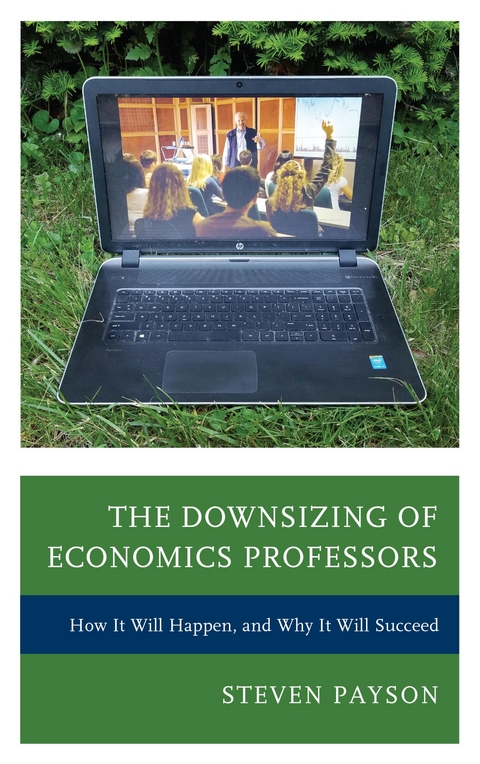
Downsizing of Economics Professors (eBook)
182 Seiten
Lexington Books (Verlag)
978-1-4985-6261-4 (ISBN)

The number of economics professors now teaching at universities will decline substantially over the next couple of decades. This will happen for one main reason-the advent of distance learning, especially in the form of Massive Open Online Courses (MOOCs), which enable a single professor to lecture to tens of thousands of students. Other academic fields will undoubtedly encounter similar reductions in their numbers of professors. However, as this book argues at several levels, academic economics is the one profession that is most qualified to study and address the topic. In this sense it is the one profession that should best recognize the economic benefits of this transition, which this book describes, and take responsibility for leading the transition among all academic fields.Unfortunately, the position espoused by several academic economists has been against this inevitable transition-a position that politically upholds their employment and the status of their institutions. They have asserted that MOOCs lower the quality of education and threaten the financial viability of traditional universities. Based on extensive evidence and analysis, however, this book argues that their position untenable. Their position is hypocritical as well, given the fact that economics professors, more than anyone else, have upheld the idea that jobs should be lost, and new ones should be gained, in response to technological changes that promote economic efficiency. There is also irony in the fact that the high tuitions required to maintain traditional classrooms effectively deny a college education to those who cannot afford it. Thus, unsound arguments that traditional lectures are needed to preserve the quality of education actually do not improve the quality of education but have the only real effect of denying education to many people who would otherwise be able to receive it.To address this topic comprehensively, the book goes deep into fundamental questions about what economics professors really do with their time and energy, and what they should be doing in the best interests of their students and of society. These are areas that the profession has needed to address for a long time, but has failed to do so.
Steven Payson has been a consultant at ICF Incorporated and the Inter-American Development Bank; a senior economist at the National Science Foundation and the Departments of Agriculture and Interior; and a branch chief at the Bureau of Economic Analysis. He received his doctorate in economics from Columbia University. He has taught at Columbia University, American University, Georgetown, and Virginia Tech. Since 2006, Dr. Payson has been executive director of the Association for Integrity and Responsible Leadership in Economics, and in 2009–2010 he was president of Society of Government Economists. He is author of four other economics books.
Chapter 4: The Profession’s Propaganda against MOOCsChapter 8: Product and Labor EvolutionConclusionBibliography
| Zusatzinfo | 9 Illustrations including: - 2 Black & White Illustrations; - 7 Tables. |
|---|---|
| Sprache | englisch |
| Themenwelt | Sozialwissenschaften ► Pädagogik ► Erwachsenenbildung |
| Wirtschaft ► Allgemeines / Lexika | |
| Wirtschaft ► Betriebswirtschaft / Management ► Allgemeines / Lexika | |
| Wirtschaft ► Volkswirtschaftslehre | |
| Schlagworte | Distance Learning • economics classes • economics education • economics lectures • economics profession • economics professors • integrity in economics • leadership in economics • Moocs • Online courses |
| ISBN-10 | 1-4985-6261-2 / 1498562612 |
| ISBN-13 | 978-1-4985-6261-4 / 9781498562614 |
| Informationen gemäß Produktsicherheitsverordnung (GPSR) | |
| Haben Sie eine Frage zum Produkt? |
 EPUB (Adobe DRM)
Kopierschutz: Adobe-DRM
Adobe-DRM ist ein Kopierschutz, der das eBook vor Mißbrauch schützen soll. Dabei wird das eBook bereits beim Download auf Ihre persönliche Adobe-ID autorisiert. Lesen können Sie das eBook dann nur auf den Geräten, welche ebenfalls auf Ihre Adobe-ID registriert sind.
Details zum Adobe-DRM
Dateiformat: EPUB (Electronic Publication)
EPUB ist ein offener Standard für eBooks und eignet sich besonders zur Darstellung von Belletristik und Sachbüchern. Der Fließtext wird dynamisch an die Display- und Schriftgröße angepasst. Auch für mobile Lesegeräte ist EPUB daher gut geeignet.
Systemvoraussetzungen:
PC/Mac: Mit einem PC oder Mac können Sie dieses eBook lesen. Sie benötigen eine
eReader: Dieses eBook kann mit (fast) allen eBook-Readern gelesen werden. Mit dem amazon-Kindle ist es aber nicht kompatibel.
Smartphone/Tablet: Egal ob Apple oder Android, dieses eBook können Sie lesen. Sie benötigen eine
Geräteliste und zusätzliche Hinweise
Buying eBooks from abroad
For tax law reasons we can sell eBooks just within Germany and Switzerland. Regrettably we cannot fulfill eBook-orders from other countries.
aus dem Bereich