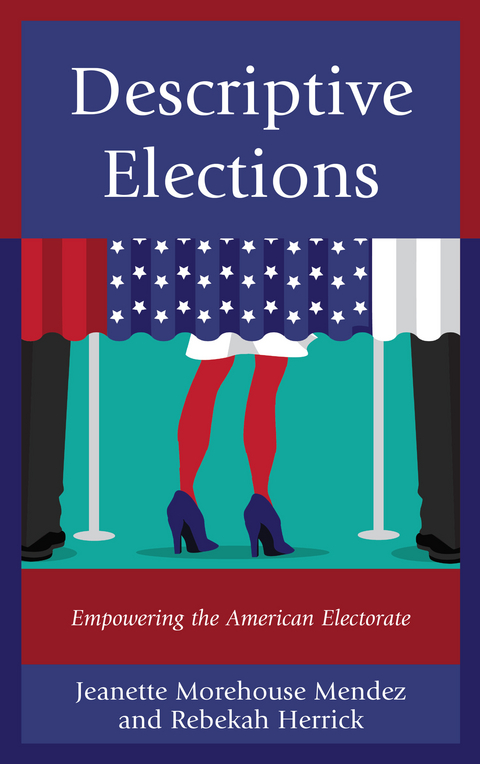
Descriptive Elections (eBook)
156 Seiten
Lexington Books (Verlag)
978-1-4985-3030-9 (ISBN)
Elections are in trouble with general low levels of interest and turnout; Jeanette Morehouse Mendez and Rebekah Herrick suggest that if candidates looked more like America does, these problems would decrease. They call these elections where candidates differ in key social demographic traits descriptive elections. They predict that races that have candidates of different race and/or gender will see higher voter turnout out, because voters will be more interested in these races and will have less alienation and indifference. In addition, they predict that voters' stereotypes/gender preferences, as well as elite behavior, can contribute to greater voter engagement. They also predict that campaigns in these elections will discuss a wider variety of issues, and the media will do likewise. They test their expectations by examining the gender mix of candidates in gubernatorial, congressional, and state legislative races. The results suggest that voters in mixed-gender and women-only elections have less alienation, less indifference, and greater interest. They also are more likely to vote. The results offer more modest evidence that campaigns and media coverage differ in these races. Thus the authors conclude that voters' gender stereotypes and preferences have a larger effect on voters' engagements in descriptive elections.
Jeanette Morehouse Mendez is professor and head of the Political Science Department at Oklahoma State University.Rebekah Herrick is professor of political science at Oklahoma State University.
PrefaceChapter 1: The Theory of Descriptive ElectionsChapter 2: The Effects of Descriptive Elections on Turnout Chapter 3: Effects of Descriptive Elections on Voter EngagementChapter 4: Descriptive Elections and Campaign AdsChapter 5: Descriptive Elections, Issues and Media CoverageChapter 6: Descriptive Elections in State Legislative RacesChapter 7: ConclusionAppendix 1: Survey script for scenarios used with student surveyAppendix 2: Survey script for scenarios used with MTurk surveyAppendix 3: List of RacesAppendix 4: List of Issues CodedAppendix 5: List of Traits Coded
| Erscheint lt. Verlag | 23.6.2016 |
|---|---|
| Zusatzinfo | 23 Illustrations including: - 23 Tables. |
| Sprache | englisch |
| Themenwelt | Sozialwissenschaften ► Politik / Verwaltung ► Staat / Verwaltung |
| Sozialwissenschaften ► Soziologie ► Gender Studies | |
| Schlagworte | campaigns • descriptive representation • Election studies • Gender Studies • Media and politics • political communication • Voter engagement • Voter turnout • women in politics |
| ISBN-10 | 1-4985-3030-3 / 1498530303 |
| ISBN-13 | 978-1-4985-3030-9 / 9781498530309 |
| Informationen gemäß Produktsicherheitsverordnung (GPSR) | |
| Haben Sie eine Frage zum Produkt? |
 EPUB (Adobe DRM)
Kopierschutz: Adobe-DRM
Adobe-DRM ist ein Kopierschutz, der das eBook vor Mißbrauch schützen soll. Dabei wird das eBook bereits beim Download auf Ihre persönliche Adobe-ID autorisiert. Lesen können Sie das eBook dann nur auf den Geräten, welche ebenfalls auf Ihre Adobe-ID registriert sind.
Details zum Adobe-DRM
Dateiformat: EPUB (Electronic Publication)
EPUB ist ein offener Standard für eBooks und eignet sich besonders zur Darstellung von Belletristik und Sachbüchern. Der Fließtext wird dynamisch an die Display- und Schriftgröße angepasst. Auch für mobile Lesegeräte ist EPUB daher gut geeignet.
Systemvoraussetzungen:
PC/Mac: Mit einem PC oder Mac können Sie dieses eBook lesen. Sie benötigen eine
eReader: Dieses eBook kann mit (fast) allen eBook-Readern gelesen werden. Mit dem amazon-Kindle ist es aber nicht kompatibel.
Smartphone/Tablet: Egal ob Apple oder Android, dieses eBook können Sie lesen. Sie benötigen eine
Geräteliste und zusätzliche Hinweise
Buying eBooks from abroad
For tax law reasons we can sell eBooks just within Germany and Switzerland. Regrettably we cannot fulfill eBook-orders from other countries.
aus dem Bereich