


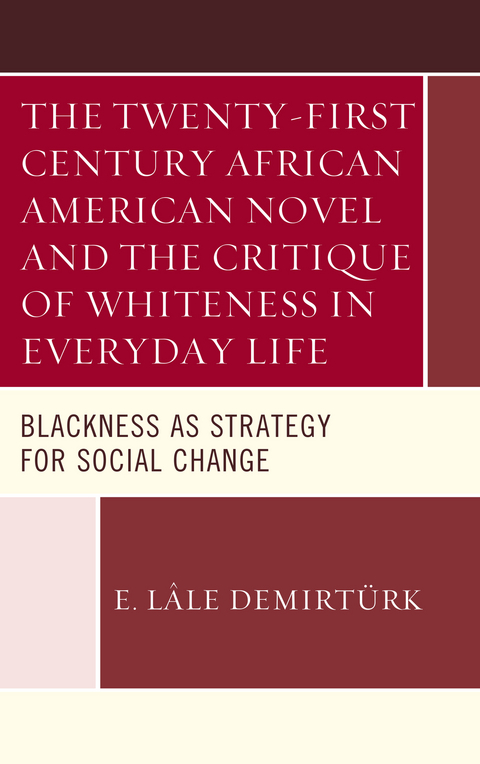
Twenty-first Century African American Novel and the Critique of Whiteness in Everyday Life (eBook)
314 Seiten
Lexington Books (Verlag)
978-1-4985-3483-3 (ISBN)
This book examines the post-9/11 African American novels, developing a new critical discourse on everyday discursive practices of whiteness. The critique of everyday life in the racial context of post-9/11 American society is important in considering diverse forms of the lived experiences and subjectivities of black people in the novels. They help us see that African American representations of the city have political significance in that the "e;neo-urban novel"e; explores the possibility of a black dialogic communication to build a transformative social change. Since the real power of Whiteness lies in its discursive power, the book reveals the urgency to understand not only how whiteness works in everyday life in American society. But it also explores how to cultivate new possibilities of configuring and performing Blackness differently, as a response to the post-9/11 configurations of the culture of fear, to produce new ways of interactional social relations that can eventually open up the space of critical awareness for white people to work against rather than reinforce discursive practices of White supremacy in everyday life. This book explores how the multiple subjectivities and transformative acts of blackness can offer ways of subverting the discursive power of the white embodied practices. What defines post-9/11 America as a nation that is consumed by the fear of racialized terrorists is its roots in the fear of ('uncontrollable') Blackness as excess and ominous threat in the domestic terrain through which the ideology of White supremacy has constructed for governing through Whiteness. African-American urban novels published in the twenty-first century respond to the discursive power of normative Whiteness that regulates black bodies, selves and lives. This book demonstrates how black people contest white dominant social spaces as sites of black criminality and exclusion in an attempt to re-signify them as the sites of black transformative change through personal and grassroots activism through their performativity of Blackness as an agential identity formation in their interpersonal urban social encounters with white people. Hence, the vulnerable spaces of Whiteness in interracial urban encounters, as it pervasively addresses those moments of transformative change, enacted by Black characters, in the face of the discursive practices of whiteness in the everyday life. These novels celebrate multifarious representations of black individuals, who are capable of using their agency to subvert White discursive power, in finding ways in their personal and grassroots activism to transform the culture of fear that locates Blackness as such in an attempt to make a difference in the American society at large.
E. Lâle Demirtürk is professor of American literature in the Department of American Culture and Literature at Bilkent University.
Introduction - The 21st Century and the Invention of “Post-Racial(ized)” Blackness: Discrepant Engagements in the African American “Neo-Urban” Novel Chapter One - The Contemporary African American Novel as Strategic Intervention in Post-9/11: Re-inscriptions of Emmett Till by Olympia Vernon, Daniel Black and Bernice L. McFadden Chapter Two - The “Politics of Small Things” as Transformative Change: Living “Thought in Action” in Walter Mosley’s The Right MistakeChapter Three - Hybrid Spatialities in ‘Gentrified’ Discursive Terrain: Undoing the Walls of Whitely Modes of Being in Nathan McCall’s Them Chapter Four - Navigating Interiority in the Interstices of ‘Black(Police)Man’ as Resistance: Transformative Politics of Mourning in Marita Golden’s AfterChapter Five - (Dis)Articulations of Racial Scripts in the Black Performative: Savage Junctures of (Neo)Colonial Whiteness inWalter Mosley’s The Man in my BasementAfterword - Transgressive Performativity of Blackness as Blueprint for Change: Deconstructing the Everyday Whiteness of Postraciality
| Erscheint lt. Verlag | 25.5.2016 |
|---|---|
| Sprache | englisch |
| Themenwelt | Literatur ► Essays / Feuilleton |
| Geisteswissenschaften ► Sprach- / Literaturwissenschaft ► Anglistik / Amerikanistik | |
| Geisteswissenschaften ► Sprach- / Literaturwissenschaft ► Literaturwissenschaft | |
| Sozialwissenschaften ► Ethnologie | |
| Sozialwissenschaften ► Soziologie ► Makrosoziologie | |
| Schlagworte | African American literature • African American Novel • African American Resistance • black bodies • Black Everyday Life • black literature • Blackness • Contemporary literature • Transformative change • Twenty-First Century Literature • whiteness |
| ISBN-10 | 1-4985-3483-X / 149853483X |
| ISBN-13 | 978-1-4985-3483-3 / 9781498534833 |
| Informationen gemäß Produktsicherheitsverordnung (GPSR) | |
| Haben Sie eine Frage zum Produkt? |
 EPUB (Adobe DRM)
Kopierschutz: Adobe-DRM
Adobe-DRM ist ein Kopierschutz, der das eBook vor Mißbrauch schützen soll. Dabei wird das eBook bereits beim Download auf Ihre persönliche Adobe-ID autorisiert. Lesen können Sie das eBook dann nur auf den Geräten, welche ebenfalls auf Ihre Adobe-ID registriert sind.
Details zum Adobe-DRM
Dateiformat: EPUB (Electronic Publication)
EPUB ist ein offener Standard für eBooks und eignet sich besonders zur Darstellung von Belletristik und Sachbüchern. Der Fließtext wird dynamisch an die Display- und Schriftgröße angepasst. Auch für mobile Lesegeräte ist EPUB daher gut geeignet.
Systemvoraussetzungen:
PC/Mac: Mit einem PC oder Mac können Sie dieses eBook lesen. Sie benötigen eine
eReader: Dieses eBook kann mit (fast) allen eBook-Readern gelesen werden. Mit dem amazon-Kindle ist es aber nicht kompatibel.
Smartphone/Tablet: Egal ob Apple oder Android, dieses eBook können Sie lesen. Sie benötigen eine
Geräteliste und zusätzliche Hinweise
Buying eBooks from abroad
For tax law reasons we can sell eBooks just within Germany and Switzerland. Regrettably we cannot fulfill eBook-orders from other countries.
aus dem Bereich


