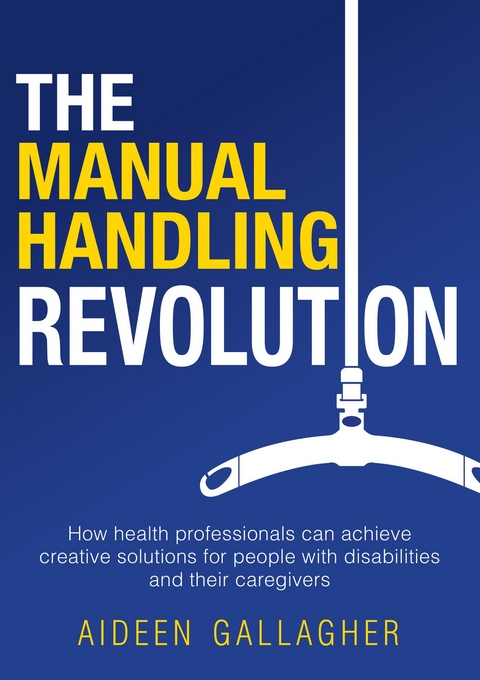
Manual Handling Revolution (eBook)
188 Seiten
Aideen Gallagher (Verlag)
978-1-925648-27-0 (ISBN)
Are you a health professional who wants to feel confident about the manual handling solutions you offer people with disabilities and their caregivers? At long last there is a book that provides a framework for health professionals in solving complex manual handling problems. The Manual Handling Revolution offers simple yet powerful insights into how we think about manual handling and guides you through a process of changing that thinking to achieve some creative solutions for people with disabilities and their caregivers. You will discover:- how to objectively evaluate equipment solutions to find the best option to a problem- how to get the best out of equipment solutions you already use to eliminate manual handling- how to achieve a win win outcome for the person with disabilities and their caregivers- A method for you to feel confident as a professional in the solutions you recommend- A systematic framework for understanding the manual handling assessment process If you want to aspire for excellence in manual handling and make a huge impact on the lives of people with disabilities and their caregivers, then this book is for you.
Introduction
About 12 years ago, I had to assess a client I will never forget. I was working within the Workplace Health and Safety (WHS) department of a care agency as a manual handling advisor. My role was to ensure the agency’s care workers were safe when assisting people with disabilities with personal care tasks.
The client I had to assess was 27. He had cerebral palsy and his family was looking for help with his personal care. I noticed straightaway when I looked at the file that this client was born the same day as me. We both started our lives on the same day but, because of his cerebral palsy, his life and the lives of his parents were very different from my life and my parents’ lives. How unfair was that.
At the assessment that day, I really wanted to give this family all the help they needed and deserved. However, as part of my role, I had to give the family some news they did not want to hear. The agency was not able to manually lift their son. This resulted in the client’s father asking me to leave their home. While I needed to give that message, because of the way I had delivered it I felt I had let them down at a time that they probably needed me most, and I was devastated.
How did this happen, when every bone in my body wanted to make this situation better for this family? I decided that day that I never wanted that to happen again; there must be another way. Manual handling involves moving a person from one position to another, but it is so much more than this. This experience sent me on a path of learning that would change the way I looked at manual handling and how I solved manual handling problems.
Seeing patterns and connections
In the 12 years since that incident, my career has meandered between mental health and manual handling, with a stint in academia along the way. This has allowed me to gain insight into some of the intricacies of the manual handling industry, while also giving me the ability to see the wood from the trees when I stepped out of the industry. I was able to view the situation from an academic perspective when I worked as a lecturer on an undergraduate occupational therapy program, and from a clinical perspective in my various clinical roles. In addition, I have also had the opportunity to work with some really clever professionals, both care workers and health professionals, who have taught me things that have really made a difference to my practice.
Throughout my 15 years in the industry, I have identified certain patterns in the way some allied health professionals address manual handling concerns. These patterns are limiting the extent to which many health professionals can achieve superior outcomes for the client and the care workers who support them, and limiting how confident they feel about the advice they are able to give.
Differing philosophies
I noticed some overarching philosophies in the WHS world that were very different from my practice in mental health. Risk assessment is a process used in both disciplines, yet in mental health it was used more creatively than in manual handling. I studied the literature to see if it was possible to take some lessons from the mental health area and apply them to manual handling. Could we be creative while still having safety as the overarching philosophy?
Focus on people first, then equipment
Allied health professionals I worked with seemed to have the philosophy of using people first and then equipment. I noticed many health professionals were still doing manual transfers when they didn’t need to. Equipment was available that completely eliminated the need for manual transfers, and this equipment was easy to use. While many of these resources did cost money, they could be applied to a huge variety of manual handling problems if the clinician was willing to put on their creative hat. The cost of that equipment could eventually be dwarfed by the savings achieved by using the equipment to its fullest potential.
No systematic framework for equipment prescription
Seeing clients in the community with physical disabilities where health professionals were already involved, I started to see patterns in the mistakes some health professionals were making when prescribing equipment. These professionals were lacking a systematic framework, which made mistakes hard to avoid. These mistakes were not resulting in problems with safety, but they were making the carer work harder than they should have had to. In many instances, a second care worker was put in when they were not needed. Watching the way in which the equipment was being used was akin to watching a Ferrari being driven in third gear. With a few minor adjustments to equipment, I knew I would be able to get them up to top gear – with all the benefits for efficiency that had to offer.
I saw that many health professionals weren’t confident with equipment. They didn’t seem to know what was available and what made one item of equipment different from the other, and what made it most suitable in solving a manual handling problem. Once they had an item of equipment to work with, many didn’t know how to make it work for them. While manual handling innovators were coming up with solutions to solve problems, health professionals were becoming overwhelmed with choice.
Increased anxiety
Manual handling was not taught extensively in undergraduate programs, yet health professionals were coming out of university with the expectation that they would be experts in manual handling. Even if a health professional wanted to learn manual handling skills, few postgraduate training options were available to assist them with this upskilling. While improved equipment provided a significant opportunity to eliminate manual handling, no training was available in how to systematically prescribe equipment and ensure the most was made of what it had to offer.
As I started offering manual handling workshops, I noticed an air of anxiety among the health professionals I taught. Many health professionals disliked manual handling and were often fearful about making a wrong decision. Health professionals also felt they were responsible for the actions of a care worker they taught a manual handling routine to – so if a care worker was not following directions, they were to blame.
A manual handling routine aims to control the risk as far as reasonably practicable. The outcome of all risk assessment is that a certain part of the risk remains, no matter what control measures you put in place. Health professionals were becoming anxious about this remaining level of risk when they could not possibly be able to control all the risk, no matter how many skills or resources they had.
Lack of creative thinking
As a lecturer on an undergraduate occupational therapy program, I was aware of the massive emphasis on creative problem-solving in the education of health professionals. Experts in this area recognised this kind of problem-solving was needed for health professionals to be able to adapt to the growing health demands of contemporary practice. While I was confident health professionals had these skills, something appeared to happen when manual handling entered the mix. Some health professionals appeared paralysed and lacked the confidence to apply their demonstrated creative problem-solving skills in a manual handling setting.
Socially and emotionally challenging
As well as being challenging from a physical perspective, manual handling was also socially and emotionally challenging. So many people were involved in the manual handling process – including the client, the care worker and the family. Along with this, the needs for independence and autonomy for the client, and safety for the care worker were sometimes at odds with one another.
In terms of the client, I found that my mental health experience was invaluable to me in my role as a manual handling advisor. This experience gave me the skills to recognise the significant grief many people with disabilities were experiencing when manual handling was involved. Manual handling always involved some kind of loss, where someone was unable to do something they might have been able to do before. I was able to identify this grief and, more importantly, I had the skills to be able to do something about it.
In terms of the care worker, in solving physical problems, I realised very quickly that a manual handling risk can very easily be replaced with a stress risk for the care worker if the way I dealt with the manual handling risk was insensitive towards the client. Care workers were in the client’s home and they had to go into that home daily – unlike me, who came in once. I had to ensure my intervention did not add to the stress side of their job through damaging their relationship with their client.
For these reasons, some health professionals were finding manual handling interventions exceptionally challenging. They were the assessments that would take a long time and would involve some kind of conflict. Health professionals would have to manage the needs of multiple parties, without the advantage of some kind of framework for ensuring all needs were met.
The unfortunate result
Allied health professionals were telling me they dreaded the manual handling assessment because they didn’t know how to achieve a solution where the client was happy, the care worker was safe and they themselves were confident that they had recommended the best routine possible to meet the needs of all parties.
Health professionals were finding themselves avoiding cases that involved manual handling...
| Erscheint lt. Verlag | 25.10.2017 |
|---|---|
| Sprache | englisch |
| Themenwelt | Schulbuch / Wörterbuch ► Schulbuch / Allgemeinbildende Schulen |
| Medizin / Pharmazie ► Pflege | |
| Sozialwissenschaften ► Pädagogik ► Sonder-, Heil- und Förderpädagogik | |
| Schlagworte | Moving and handling • occupational therapy • People with Disability • worker safety |
| ISBN-10 | 1-925648-27-3 / 1925648273 |
| ISBN-13 | 978-1-925648-27-0 / 9781925648270 |
| Informationen gemäß Produktsicherheitsverordnung (GPSR) | |
| Haben Sie eine Frage zum Produkt? |
 EPUB (Adobe DRM)
Kopierschutz: Adobe-DRM
Adobe-DRM ist ein Kopierschutz, der das eBook vor Mißbrauch schützen soll. Dabei wird das eBook bereits beim Download auf Ihre persönliche Adobe-ID autorisiert. Lesen können Sie das eBook dann nur auf den Geräten, welche ebenfalls auf Ihre Adobe-ID registriert sind.
Details zum Adobe-DRM
Dateiformat: EPUB (Electronic Publication)
EPUB ist ein offener Standard für eBooks und eignet sich besonders zur Darstellung von Belletristik und Sachbüchern. Der Fließtext wird dynamisch an die Display- und Schriftgröße angepasst. Auch für mobile Lesegeräte ist EPUB daher gut geeignet.
Systemvoraussetzungen:
PC/Mac: Mit einem PC oder Mac können Sie dieses eBook lesen. Sie benötigen eine
eReader: Dieses eBook kann mit (fast) allen eBook-Readern gelesen werden. Mit dem amazon-Kindle ist es aber nicht kompatibel.
Smartphone/Tablet: Egal ob Apple oder Android, dieses eBook können Sie lesen. Sie benötigen eine
Geräteliste und zusätzliche Hinweise
Buying eBooks from abroad
For tax law reasons we can sell eBooks just within Germany and Switzerland. Regrettably we cannot fulfill eBook-orders from other countries.
aus dem Bereich