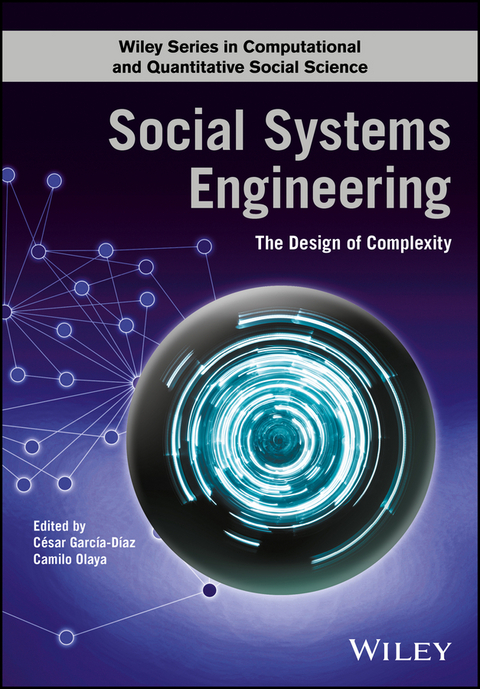
Social Systems Engineering (eBook)
John Wiley & Sons (Verlag)
978-1-118-97443-8 (ISBN)

Uniquely reflects an engineering view to social systems in a wide variety of contexts of application
Social Systems Engineering: The Design of Complexity brings together a wide variety of application approaches to social systems from an engineering viewpoint. The book defines a social system as any complex system formed by human beings. Focus is given to the importance of systems intervention design for specific and singular settings, the possibilities of engineering thinking and methods, the use of computational models in particular contexts, and the development of portfolios of solutions. Furthermore, this book considers both technical, human and social perspectives, which are crucial to solving complex problems.
Social Systems Engineering: The Design of Complexity provides modelling examples to explore the design aspect of social systems. Various applications are explored in a variety of areas, such as urban systems, health care systems, socio-economic systems, and environmental systems. It covers important topics such as organizational design, modelling and intervention in socio-economic systems, participatory and/or community-based modelling, application of systems engineering tools to social problems, applications of computational behavioral modeling, computational modelling and management of complexity, and more.
- Highlights an engineering view to social systems (as opposed to a 'scientific' view) that stresses the importance of systems intervention design for specific and singular settings
- Divulges works where the design, re-design, and transformation of social systems constitute the main aim, and where joint considerations of both technical and social perspectives are deemed important in solving social problems
- Features an array of applied cases that illustrate the application of social systems engineering in different domains
Social Systems Engineering: The Design of Complexity is an excellent text for academics and graduate students in engineering and social science-specifically, economists, political scientists, anthropologists, and management scientists with an interest in finding systematic ways to intervene and improve social systems.
César García-Díaz, PhD, is an Assistant Professor in the Department of Industrial Engineering, Universidad de los Andes, Bogotá, Colombia. César's expertise is in the field of agent-based social simulation.
Camilo Olaya, PhD, is an Associate Professor in the Department of Industrial Engineering, Universidad de los Andes, Bogotá, Colombia. Camilo is a researcher in model-based engineering of private and public systems with more than 15 years of experience in this field.
Uniquely reflects an engineering view to social systems in a wide variety of contexts of application Social Systems Engineering: The Design of Complexity brings together a wide variety of application approaches to social systems from an engineering viewpoint. The book defines a social system as any complex system formed by human beings. Focus is given to the importance of systems intervention design for specific and singular settings, the possibilities of engineering thinking and methods, the use of computational models in particular contexts, and the development of portfolios of solutions. Furthermore, this book considers both technical, human and social perspectives, which are crucial to solving complex problems. Social Systems Engineering: The Design of Complexity provides modelling examples to explore the design aspect of social systems. Various applications are explored in a variety of areas, such as urban systems, health care systems, socio-economic systems, and environmental systems. It covers important topics such as organizational design, modelling and intervention in socio-economic systems, participatory and/or community-based modelling, application of systems engineering tools to social problems, applications of computational behavioral modeling, computational modelling and management of complexity, and more. Highlights an engineering view to social systems (as opposed to a scientific view) that stresses the importance of systems intervention design for specific and singular settings Divulges works where the design, re-design, and transformation of social systems constitute the main aim, and where joint considerations of both technical and social perspectives are deemed important in solving social problems Features an array of applied cases that illustrate the application of social systems engineering in different domains Social Systems Engineering: The Design of Complexity is an excellent text for academics and graduate students in engineering and social science specifically, economists, political scientists, anthropologists, and management scientists with an interest in finding systematic ways to intervene and improve social systems.
César García-Díaz, PhD, is an Assistant Professor in the Department of Industrial Engineering, Universidad de los Andes, Bogotá, Colombia. César's expertise is in the field of agent-based social simulation. Camilo Olaya, PhD, is an Associate Professor in the Department of Industrial Engineering, Universidad de los Andes, Bogotá, Colombia. Camilo is a researcher in model-based engineering of private and public systems with more than 15 years of experience in this field.
Title Page 5
Copyright Page 6
Contents 7
List of Contributors 13
Preface 15
Introduction: The Why, What and How of Social Systems Engineering 17
The Very Idea 17
Epistemic Notions on the Engineering of Social Systems 19
Using Engineering Methods 22
Into Real-World Applications 24
References 24
Part 1Social Systems Engineering: The Very Idea 27
Chapter 1 Compromised Exactness and the Rationality of Engineering 29
1.1 Introduction 29
1.2 The Historical Context 30
1.3 Science and Engineering: Distinctive Rationalities 36
1.4 ‘Compromised Exactness’: Design in Engineering 39
1.5 Engineering Social Systems? 42
References 45
Chapter 2 Uncertainty in the Design and Maintenance of Social Systems 47
2.1 Introduction 47
2.2 Uncertainties in Simple and Complicated Engineered Systems 49
2.3 Control Volume and Uncertainty 51
2.4 Engineering Analysis and Uncertainty in Complex Systems 53
2.5 Uncertainty in Social Systems Engineering 55
2.6 Conclusions 58
References 58
Chapter 3 System Farming 61
3.1 Introduction 61
3.2 Uncertainty, Complexity and Emergence 62
3.2.1 The Double Complexity of CSS 64
3.3 Science and Engineering Approaches 65
3.3.1 The Impossibility of a Purely Design-Based Engineering Approach to CSS 67
3.3.2 Design vs. Adaptation 68
3.3.3 The Necessity of Strongly Validated Foundations for Design-Based Approaches 69
3.4 Responses to CSS Complexity 70
3.4.1 Formal Methods 70
3.4.2 Statistical Approaches 71
3.4.3 Self-adaptive and Adaptive Systems 73
3.4.4 Participatory Approaches and Rapid Prototyping 73
3.5 Towards Farming Systems 74
3.5.1 Reliability from Experience Rather Than Control of Construction 74
3.5.2 Post-Construction Care Rather Than Prior Effort 74
3.5.3 Continual Tinkering Rather Than One-Off Effort 75
3.5.4 Multiple Fallible Mechanisms Rather Than One Reliable Mechanism 75
3.5.5 Monitoring Rather Than Prediction 75
3.5.6 Disaster Aversion Rather Than Optimizing Performance 75
3.5.7 Partial Rather Than Full Understanding 75
3.5.8 Specific Rather Than Abstract Modelling 76
3.5.9 Many Models Rather Than One 76
3.5.10 A Community Rather Than Individual Effort 76
3.6 Conclusion 76
References 77
Chapter 4 Policy between Evolution and Engineering 81
4.1 Introduction: Individual and Social System 81
4.2 Policy – Concept and Process 83
4.3 Human Actors: Perception, Policy and Action 86
4.4 Artefacts 89
4.5 Engineering and Evolution: From External to Internal Selection 92
4.6 Policy between Cultural Evolution and Engineering 95
4.7 Conclusions and Outlook 98
Appendix: Brief Overview of the Policy Literature 99
References 102
Chapter 5 ‘Friend’ versus ‘Electronic Friend’ 107
References 115
Part II Methodologies and Tools 117
Chapter 6 Interactive Visualizations for Supporting Decision-Making in Complex Socio-technical Systems 119
6.1 Introduction 119
6.2 Policy Flight Simulators 120
6.2.1 Background 120
6.2.2 Multi-level Modelling 121
6.2.3 People’s Use of Simulators 122
6.3 Application 1 – Hospital Consolidation 124
6.3.1 Model Overview 126
6.3.2 Results and Conclusions 133
6.4 Application 2 – Enterprise Diagnostics 134
6.4.1 Automobile Industry Application 135
6.4.2 Interactive Visualization 138
6.4.3 Experimental Evaluation 141
6.4.4 Results and Discussion 141
6.4.5 Implications 144
6.5 Conclusions 144
References 145
Chapter 7 Developing Agent-Based Simulation Models for Social Systems Engineering Studies: A Novel Framework and its Application to Modelling Peacebuilding Activities 149
7.1 Introduction 149
7.2 Background 150
7.2.1 Simulation 150
7.2.2 Peacebuilding 151
7.3 Framework 153
7.3.1 Toolkit Design 154
7.3.2 Application Design 158
7.4 Illustrative Example of Applying the Framework 159
7.4.1 Peacebuilding Toolkit Design 159
7.4.2 Peacebuilding Application Design 165
7.4.3 Engineering Actions and Interventions in a Peacebuilding Context 169
7.5 Conclusions 171
References 171
Chapter 8 Using Actor-Network Theory in Agent-Based Modelling 173
8.1 Introduction 173
8.2 Agent-Based Modelling 174
8.2.1 ABM Approaches 175
8.2.2 Agent Interactions 176
8.3 Actor-Network Theory 176
8.4 Towards an ANT-Based Approach to ABM 178
8.4.1 ANT Concepts Related to ABM 178
8.5 Design Guidelines 179
8.6 The Case of WEEE Management 182
8.6.1 Contextualizing the Case Study 183
8.6.2 ANT Applied to WEEE Management in Colombia 184
8.6.3 ANT–ABM Translation Based on the Case Study 188
8.6.4 Open Issues and Reflections 189
8.7 Conclusions 190
References 191
Chapter 9 Engineering the Process of Institutional Innovation in Contested Territory 195
9.1 Introduction 195
9.2 Can Cyber Security and Risk be Quantified? 197
9.2.1 Schools of Thought 197
9.3 Social Processes of Innovation in Pre?paradigmatic Fields 199
9.3.1 Epistemic and Ontological Rivalry 199
9.3.2 Knowledge Artefacts 200
9.3.3 Implications of Theory 200
9.4 A Computational Model of Innovation 202
9.4.1 Base Model: Innovation as Percolation 202
9.4.2 Full Model: Innovation with Knowledge Artefacts 206
9.4.3 Experiment 206
9.5 Discussion 210
Acknowledgements 210
References 211
Part III Cases and Applications 213
Chapter 10 Agent-Based Explorations of Environmental Consumption in Segregated Networks 215
10.1 Introduction 215
10.1.1 Micro-drivers of Technology Adoption 217
10.1.2 The Problem of Network Segregation 218
10.2 Model Overview 219
10.2.1 Synopsis of Model Parameters 220
10.2.2 Agent Selection by Firms 221
10.2.3 Agent Adoption Decisions 222
10.3 Results 222
10.3.1 Influence of Firm Strategy on Saturation Times 223
10.3.2 Characterizing Adoption Dynamics 224
10.3.3 Incentivizing Different Strategies 226
10.4 Conclusion 228
Acknowledgements 228
References 229
Chapter 11 Modelling in the ‘Muddled Middle’: A Case Study of Water Service Delivery in Post-Apartheid South Africa 231
11.1 Introduction 231
11.2 The Case Study 232
11.3 Contextualizing Modelling in the ‘Muddled Middle’ in the Water Sector 233
11.4 Methods 235
11.5 Results 236
11.6 Discussion 244
Acknowledgements 246
References 247
Chapter 12 Holistic System Design: The Oncology Carinthia Study 251
12.1 The Challenge: Holistic System Design 251
12.2 Methodology 252
12.3 Introduction to the Case Study: Oncology Carinthia 254
12.3.1 Setting the Stage 254
12.3.2 Framing: Purpose and Overall Goals (F) 255
12.3.3 Mapping the System at the Outset (M) 256
12.3.4 A First Model (M) and Assessment (A) 258
12.3.5 The Challenge Ahead 261
12.3.6 A First Take on Design (D): Ascertaining Levers 262
12.3.7 From Design (D) to Change (C) 264
12.3.8 Progress in Organizational Design (D) 265
12.3.9 The Evolution of Oncology Carinthia (C) 274
12.3.10 Results 275
12.4 Insights, Teachings and Implications 277
Acknowledgements 279
Appendix: Mathematical Representations for Figures 12.5, 12.6 and 12.7 279
A1: VSM, for any System-in-Focus (one level of recursion ref. Figure 12.5)
A2: Recursive Structure of the VSM (ref. Figure 12.6) 280
A3: Virtual Teams (ref. Figure 12.7) 280
References 281
Chapter 13 Reinforcing the Social in Social Systems Engineering – Lessons Learnt from Smart City Projects in the United Kingdom 283
13.1 Introduction 283
13.1.1 Cities as Testbeds 284
13.1.2 Smart Cities as Artificial Systems 284
13.1.3 Chapter Structure 285
13.2 Methodology 286
13.3 Case Studies 287
13.3.1 Glasgow 287
13.3.2 London 290
13.3.3 Bristol 293
13.3.4 Peterborough 295
13.4 Discussion 299
13.4.1 Push/Pull Adoption Model 299
13.4.2 Civic Engagement 300
13.4.3 Solutions and Problems 301
13.4.4 Metrics, Quantification and Optimization 301
13.4.5 Project Scope and Lifecycles 302
13.4.6 Collaboration and Multidisciplinarity 302
13.4.7 Knowledge-Sharing 303
13.5 Conclusion 303
References 304
Index 307
EULA 311
| Erscheint lt. Verlag | 13.10.2017 |
|---|---|
| Reihe/Serie | Wiley Series in Computational and Quantitative Social Science | Wiley Series in Computational and Quantitative Social Science |
| Sprache | englisch |
| Themenwelt | Mathematik / Informatik ► Mathematik ► Angewandte Mathematik |
| Mathematik / Informatik ► Mathematik ► Statistik | |
| Mathematik / Informatik ► Mathematik ► Wahrscheinlichkeit / Kombinatorik | |
| Sozialwissenschaften | |
| Technik ► Elektrotechnik / Energietechnik | |
| Schlagworte | agent-based modelling • agent-based simulation • artificial societies and social simulation • Betriebswirtschaft u. Operationsforschung • Business & Management • computational organization theory • Computational Social Science • computational social systems • Design • dynamical systems modelling • Electrical & Electronics Engineering • Elektrotechnik u. Elektronik • Engineering • engineering thinking • Environmental Systems • Health Care Systems • Institutions • Management Science/Operational Research • mathematical organization theory • Modelling • non-equilibrium approaches to economic systems • Organizations • quantitative social science • Social Science • social science computing • Social Systems • social systems engineering • Social Systems Engineering: The Design of Complexity • Societies • socio-economic systems • Statistics • Statistics for Social Sciences • Statistik • Statistik in den Sozialwissenschaften • System Dynamics • Systems Dynamics • Systems Engineering & Management • systems thinking • systems thinking in organizations • Systemtechnik • Systemtechnik u. -management • Urban Systems • Wirtschaft u. Management |
| ISBN-10 | 1-118-97443-3 / 1118974433 |
| ISBN-13 | 978-1-118-97443-8 / 9781118974438 |
| Informationen gemäß Produktsicherheitsverordnung (GPSR) | |
| Haben Sie eine Frage zum Produkt? |
 PDF (Adobe DRM)
Kopierschutz: Adobe-DRM
Adobe-DRM ist ein Kopierschutz, der das eBook vor Mißbrauch schützen soll. Dabei wird das eBook bereits beim Download auf Ihre persönliche Adobe-ID autorisiert. Lesen können Sie das eBook dann nur auf den Geräten, welche ebenfalls auf Ihre Adobe-ID registriert sind.
Details zum Adobe-DRM
Dateiformat: PDF (Portable Document Format)
Mit einem festen Seitenlayout eignet sich die PDF besonders für Fachbücher mit Spalten, Tabellen und Abbildungen. Eine PDF kann auf fast allen Geräten angezeigt werden, ist aber für kleine Displays (Smartphone, eReader) nur eingeschränkt geeignet.
Systemvoraussetzungen:
PC/Mac: Mit einem PC oder Mac können Sie dieses eBook lesen. Sie benötigen eine
eReader: Dieses eBook kann mit (fast) allen eBook-Readern gelesen werden. Mit dem amazon-Kindle ist es aber nicht kompatibel.
Smartphone/Tablet: Egal ob Apple oder Android, dieses eBook können Sie lesen. Sie benötigen eine
Geräteliste und zusätzliche Hinweise
Buying eBooks from abroad
For tax law reasons we can sell eBooks just within Germany and Switzerland. Regrettably we cannot fulfill eBook-orders from other countries.
aus dem Bereich