


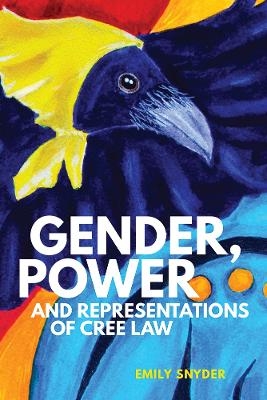
Gender, Power, and Representations of Cree Law
Seiten
2018
University of British Columbia Press (Verlag)
978-0-7748-3568-8 (ISBN)
University of British Columbia Press (Verlag)
978-0-7748-3568-8 (ISBN)
Drawing on the insights of Indigenous feminist legal theory, Emily Snyder examines representations of Cree law and gender in books, videos, graphic novels, educational websites, online lectures, and a video game. Although these resources promote the revitalization of Cree law and the principle of miyo-wîcêhtowin (good relations), Snyder argues that they do not capture the complexities of gendered power dynamics.
The majority of the resources either erase women's legal authority by not mentioning them, or they diminish women's agency by portraying them primarily as mothers and nurturers. Although these latter roles are celebrated, Snyder argues that Cree laws and gender roles are represented in inflexible, aesthetically pleasing ways that overlook power imbalances and difficult questions regarding interpretations of tradition.
What happens when good relations are represented in ways that are oppressive? Grappling with this question, Snyder makes the case that educators need to critically engage with issues of gender and power in order to create inclusive resources that meaningfully address the everyday messiness of law. As with all legal orders, gendered oppression can be perpetuated through Cree law, but Cree law is also a dynamic resource for challenging gendered oppression.
The majority of the resources either erase women's legal authority by not mentioning them, or they diminish women's agency by portraying them primarily as mothers and nurturers. Although these latter roles are celebrated, Snyder argues that Cree laws and gender roles are represented in inflexible, aesthetically pleasing ways that overlook power imbalances and difficult questions regarding interpretations of tradition.
What happens when good relations are represented in ways that are oppressive? Grappling with this question, Snyder makes the case that educators need to critically engage with issues of gender and power in order to create inclusive resources that meaningfully address the everyday messiness of law. As with all legal orders, gendered oppression can be perpetuated through Cree law, but Cree law is also a dynamic resource for challenging gendered oppression.
Emily Snyder is an assistant professor in the Department of Indigenous Studies and the Women's and Gender Studies Program at the University of Saskatchewan. She is a white settler committed to ongoing reflection about anticolonial feminist legal scholarship and teaching.
Introduction
1 Frameworks
2 Representations
3 Absences
4 Roles
5 Complexities
6 Troublemakers
Conclusion
Appendix
Notes; Bibliography; Index
| Erscheinungsdatum | 07.01.2018 |
|---|---|
| Verlagsort | Vancouver |
| Sprache | englisch |
| Maße | 152 x 229 mm |
| Gewicht | 480 g |
| Themenwelt | Recht / Steuern ► Allgemeines / Lexika |
| Recht / Steuern ► EU / Internationales Recht | |
| Sozialwissenschaften ► Ethnologie | |
| Sozialwissenschaften ► Soziologie ► Gender Studies | |
| ISBN-10 | 0-7748-3568-0 / 0774835680 |
| ISBN-13 | 978-0-7748-3568-8 / 9780774835688 |
| Zustand | Neuware |
| Informationen gemäß Produktsicherheitsverordnung (GPSR) | |
| Haben Sie eine Frage zum Produkt? |
Mehr entdecken
aus dem Bereich


aus dem Bereich
eine kritische Theorie in 99 Fragmenten
Buch | Softcover (2023)
Campus (Verlag)
CHF 55,95


