World War I (eBook)
John Wiley & Sons (Verlag)
978-1-118-95191-0 (ISBN)
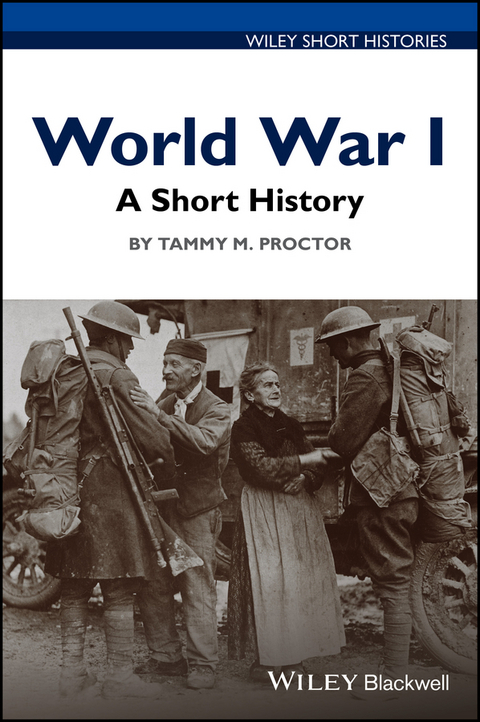
A lively, engaging history of The Great War written for a new generation of readers
In recent years, scholarship on World War I has turned from a fairly narrow focus on military tactics, weaponry, and diplomacy to incorporate considerations of empire, globalism, and social and cultural history. This concise history of the first modern, global war helps to further broaden the focus typically provided in World War I surveys by challenging popular myths and stereotypes to provide a new, engaging account of The Great War.
The conventional World War I narrative that has evolved over the past century is that of an inevitable but useless war, where men were needlessly slaughtered due to poor decisions by hidebound officers. This characterization developed out of a narrow focus on the Western Front promulgated mainly by British historians. In this book, Professor Proctor provides a broader, more multifaceted historical narrative including perspectives from other fronts and spheres of interest and a wider range of participants. She also draws on recent scholarship to consider the gendered aspect of war and the ways in which social class, religion, and cultural factors shaped experiences and memories of the war.
- Structured chronologically to help convey a sense of how the conflict evolved
- Each chapter considers a key interpretive question, encouraging readers to examine the extent to which the war was total, modern, and global
- Challenges outdated stereotypes created through a focus on the Western Front
- Considers the war in light of recent scholarship on empire, global history, gender, and culture
- Explores ways in which the war and the terms of peace shaped the course of the 20th century
World War I: A Short History is sure to become required reading in undergraduate survey courses on WWI, as well as courses in military history, the 20th century world, or the era of the World Wars.
Tammy Proctor, has a bachelor's degree in journalism and history from the University of Missouri and a PhD from Rutgers University, is Professor of History and Department Head at Utah State University. In addition to teaching and writing history, Tammy is addicted to travel, running and biking, and mystery novels. She is originally from Kansas City, Missouri.
A lively, engaging history of The Great War written for a new generation of readers In recent years, scholarship on World War I has turned from a fairly narrow focus on military tactics, weaponry, and diplomacy to incorporate considerations of empire, globalism, and social and cultural history. This concise history of the first modern, global war helps to further broaden the focus typically provided in World War I surveys by challenging popular myths and stereotypes to provide a new, engaging account of The Great War. The conventional World War I narrative that has evolved over the past century is that of an inevitable but useless war, where men were needlessly slaughtered due to poor decisions by hidebound officers. This characterization developed out of a narrow focus on the Western Front promulgated mainly by British historians. In this book, Professor Proctor provides a broader, more multifaceted historical narrative including perspectives from other fronts and spheres of interest and a wider range of participants. She also draws on recent scholarship to consider the gendered aspect of war and the ways in which social class, religion, and cultural factors shaped experiences and memories of the war. Structured chronologically to help convey a sense of how the conflict evolved Each chapter considers a key interpretive question, encouraging readers to examine the extent to which the war was total, modern, and global Challenges outdated stereotypes created through a focus on the Western Front Considers the war in light of recent scholarship on empire, global history, gender, and culture Explores ways in which the war and the terms of peace shaped the course of the 20th century World War I: A Short History is sure to become required reading in undergraduate survey courses on WWI, as well as courses in military history, the 20th century world, or the era of the World Wars.
Tammy Proctor, has a bachelor's degree in journalism and history from the University of Missouri and a PhD from Rutgers University, is Professor of History and Department Head at Utah State University. In addition to teaching and writing history, Tammy is addicted to travel, running and biking, and mystery novels. She is originally from Kansas City, Missouri.
Title Page 5
Copyright Page 6
Contents 7
List of Illustrations 9
Preface 11
Acknowledgments 21
Chapter 1 Why and How Did War Break Out in Summer 1914? 23
Who Started the War? 24
A Grand Tour of 1914 25
United Kingdom 25
French Republic 27
German Empire 28
Habsburg Empire 29
Ottoman Empire 30
Other Empires 30
Russian Empire 32
United States and Canada 32
Tensions in 1914 33
Nationalism 34
Eastern Question 35
Industrialization 35
Militarization 36
Technology 37
Alliances 38
Prior Conflicts 38
The Journey to War in 1914 39
Conclusion 43
Citations 44
Select Bibliography 44
Appendix 1.1: Important States in 1914 45
Appendix 1.2: Timeline from June to August 1914 46
Chapter 2 1914. Was This War a Total War? 47
The War in 1914 48
Western Front 49
Eastern Front 52
African Fronts 53
Pacific and Australasia 54
Ottoman Fronts 55
Defining Total War and Its Debates 56
Total War: Mobilization of Men and Resources 59
Total War: War Aims 61
Total War: Methods of War 65
Conclusion 66
Citations 67
Select Bibliography 68
Appendix 2.1: Timeline from July to December 1914 70
Chapter 3 1915. How and Where Was the War Fought? 71
1915 and the Problem of Stalemate 72
War “Fronts” or Zones of Conflict 76
Combat Zones 76
Occupation Zones 81
Transitional Zones 82
Home Zones 85
Conclusion 87
Citations 88
Select Bibliography 88
Appendix 3.1: Timeline for 1915 90
Chapter 4 1916. Who Participated in the War and How? 91
1916. Trial by Fire 93
1. February—The Germans and the Battle of Verdun 94
2. March—The Italians and the Fifth Battle of the Isonzo 95
3. May—The Austro?Hungarians and the Battle of Asiago 95
4. June—The Russians and the Brusilov Offensive 96
5. July—The British and the Battle of the Somme 96
6. Elsewhere 97
Technological Advances 98
Varieties of Experience 99
Men at War 99
Women at War 102
Too Old or Too Young for War? 105
Conclusion 107
Citations 108
Select Bibliography 108
Appendix 4.1: Timeline for 1916 110
Chapter 5 1917. How Did War Affect the Societies and People Who Participated? 111
Battles of Support 1917 112
Fighting the War at Home 117
Behind Barbed Wire 121
Under Foreign Occupation 123
The Impact of the United States 126
Warnings of Discontent 128
Conclusion 129
Citations 130
Select Bibliography 131
Appendix 5.1: Timeline for 1917 133
Chapter 6 1918. What Circumstances Led to the End of the War? 135
The Impact of Russia’s Revolution 138
The Western Front in 1918 140
Other Battlefronts by 1918 144
Assessing the Damage 147
Conclusion 149
Citations 150
Select Bibliography 151
Appendix 6.1: Timeline for 1918 154
Chapter 7 1919. How Did the Peace Treaties Shape the Postwar World? 155
Making Peace: Treaties and the League of Nations 157
Borders 158
Disarmament and Demilitarization 159
War Guilt and Reparations 159
League of Nations 160
Other Treaties 161
Big Questions—Crises of the Immediate Postwar 163
Minority Questions 164
Economic and Political Challenges 166
Conclusion 168
Citations 169
Select Bibliography 170
Appendix 7.1: Timeline for 1919–1923 172
Chapter 8 Postwar. How Was the War Remembered and Commemorated? 173
Commemoration in Stone 175
Known and Marked 178
Missing in Action 179
Unknown and Eternal 180
Memorials as Dissent 180
Personal Grief and Memory 181
Cultural Memory of War 184
Conclusion 185
Citations 186
Select Bibliography 187
Appendix 8.1: Timeline for 1917–1938 Showing War Memorial Related Events 188
Chapter 9 Postscript: World War I in Context 189
Citations 193
Select Bibliography 193
Index 195
EULA 200
| Erscheint lt. Verlag | 9.10.2017 |
|---|---|
| Reihe/Serie | Wiley Blackwell Short Histories |
| Wiley Blackwell Short Histories | Wiley Short Histories |
| Sprache | englisch |
| Themenwelt | Geschichte ► Allgemeine Geschichte ► Neuzeit (bis 1918) |
| Geschichte ► Allgemeine Geschichte ► 1918 bis 1945 | |
| Geschichte ► Teilgebiete der Geschichte ► Militärgeschichte | |
| Sozialwissenschaften ► Politik / Verwaltung | |
| Schlagworte | 20th century european history • aerial bombing in world war i • alsace Lorraine • Archduke Ferdinand • Austria-Hungary • Eastern Front • gender and war</p> • Geschichte • Geschichte u. Zeitgeschichte des 20./21. Jahrhunderts • global war • History • history of chemical warfare • history of the tank in warfare • history of warfare • Kaiser Wilhelm • <p>world war 1 • military history • Military Technology • Mustard Gas • Plan XVII • schleiffen plan • social history of world war i • tank warfare • The Great War • the Western Front • the zimmerman telegram • Total War • trench warfare • Twentieth Century & Contemporary History • united states in world war I • Women and war • world war i air battles • world war i artillery • world war i combatants • world war i fighter planes • world war i sea battles • world war I technology |
| ISBN-10 | 1-118-95191-3 / 1118951913 |
| ISBN-13 | 978-1-118-95191-0 / 9781118951910 |
| Informationen gemäß Produktsicherheitsverordnung (GPSR) | |
| Haben Sie eine Frage zum Produkt? |
 PDF (Adobe DRM)
Kopierschutz: Adobe-DRM
Adobe-DRM ist ein Kopierschutz, der das eBook vor Mißbrauch schützen soll. Dabei wird das eBook bereits beim Download auf Ihre persönliche Adobe-ID autorisiert. Lesen können Sie das eBook dann nur auf den Geräten, welche ebenfalls auf Ihre Adobe-ID registriert sind.
Details zum Adobe-DRM
Dateiformat: PDF (Portable Document Format)
Mit einem festen Seitenlayout eignet sich die PDF besonders für Fachbücher mit Spalten, Tabellen und Abbildungen. Eine PDF kann auf fast allen Geräten angezeigt werden, ist aber für kleine Displays (Smartphone, eReader) nur eingeschränkt geeignet.
Systemvoraussetzungen:
PC/Mac: Mit einem PC oder Mac können Sie dieses eBook lesen. Sie benötigen eine
eReader: Dieses eBook kann mit (fast) allen eBook-Readern gelesen werden. Mit dem amazon-Kindle ist es aber nicht kompatibel.
Smartphone/Tablet: Egal ob Apple oder Android, dieses eBook können Sie lesen. Sie benötigen eine
Geräteliste und zusätzliche Hinweise
Buying eBooks from abroad
For tax law reasons we can sell eBooks just within Germany and Switzerland. Regrettably we cannot fulfill eBook-orders from other countries.
aus dem Bereich