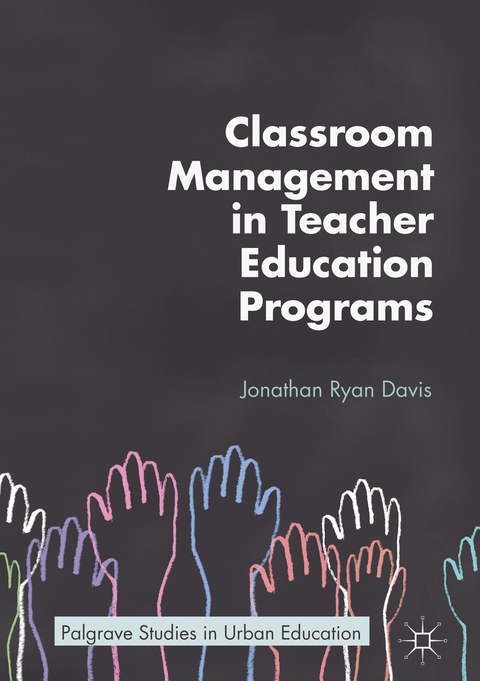
Classroom Management in Teacher Education Programs (eBook)
XIII, 272 Seiten
Springer International Publishing (Verlag)
978-3-319-63850-8 (ISBN)
Jonathan Ryan Davis is Associate Professor in the Department of Educational Administration and Secondary Education at The College of New Jersey, USA.
Jonathan Ryan Davis is Associate Professor in the Department of Educational Administration and Secondary Education at The College of New Jersey, USA.
Series Foreword 6
Acknowledgments 9
Contents 11
List of Tables 13
Chapter 1: Introduction: The Problem of Integrating Classroom Management into the Lives of Those Learning to Teach 14
Defining the Problem 15
The Lack of Classroom Management Courses in Teacher Preparation Programs1 16
Why Classroom Management Is Not Taught in Teacher Preparation Programs 19
The Importance of Classroom Management in Teacher Preparation Programs 20
The Challenge of Integrating Classroom Management Coursework into Teacher Preparation Programs 21
Framing the Book’s Research Questions 22
A Brief Preview of the Book 24
References 25
Chapter 2: Teaching without Classroom Management Coursework: A Case Study—Methods II into Student Teaching 28
Introduction to the Control Cohort’s Methods Course at Public University 29
Introduction to the Control Students 32
Dana’s Road to Teaching 32
Conrad’s Road to Teaching 33
Robyn’s Road to Teaching 34
The Methods Course: From Beginning to End 36
Expectations for Methods II 36
End of the Course: A Lack of Practical Strategies 40
Frustration with the Course Textbook 43
In-Class Teaching Experience 45
Fieldwork 47
Reflecting on Methods II: Changed Expectations and Fears and Hopes for Student Teaching 48
One Month into Student Teaching 51
Overview of Schools 51
Dana’s Student Teaching Setting 51
Conrad’s Student Teaching Context 53
Robyn’s Student Teaching Context 54
Initial Teaching Challenges with Classroom Management 55
Initial Teaching Successes 59
Usefulness of Methods II Course in Initial Student Teaching 63
Perception of Classroom Management After One Month of Student Teaching 65
References 68
Chapter 3: Teaching without Classroom Management Coursework: A Case Study Continued—After Student Teaching into Teaching 69
After Completing Student Teaching 70
Defining Classroom Management After Completing Student Teaching 70
Usefulness of Methods II Course After Completing Student Teaching 71
Struggles with Classroom Management 74
Classroom Management Strategies that Worked 77
Classroom Management Growth and Anticipated Changes to Help with Classroom Management 81
One Semester into Teaching 83
Overview of Schools 83
Robyn’s School Context 83
Conrad’s School Context 84
Dana’s School Context 84
Defining Classroom Management After Teaching Their Own Class 84
Usefulness of Methods II Course After Teaching Their Own Class 85
Struggles with Classroom Management 87
Classroom Management Strategies that Worked 92
Classroom Management Growth and Anticipated Changes to Help with Classroom Management 95
Concluding Thoughts 98
References 98
Chapter 4: The Dynamic Classroom Management Approach (DCMA): What It Is and How It Can Be Integrated into Methods Courses 99
A New Way of Thinking About Classroom Management 100
Framework for the Dynamic Classroom Management Approach 102
Principles of the Asset Model 102
Dynamic Classroom Management Approach (DCMA) Domains 104
Domain 1: Flexibility and Adaptability in One’s Management Style 107
Domain 2: Diversity in Context 108
Culture in Classroom Management (Culturally Responsive Classroom Management) 108
Social Class in Classroom Management 111
Gender and Sexuality in Classroom Management 112
Differential Language Learning in Classroom Management 114
Differential Abilities in Classroom Management 115
Domain 3: Creating Effective Pedagogy 116
Planning and Implementation in Classroom Management 117
Managing Misbehavior in Classroom Management 117
Domain 4: Creating a Positive Classroom Culture and Community 118
Creating a Caring Environment in Classroom Management 119
Creating a Safe Environment in Classroom Management 119
Creating an Encouraging Environment in Classroom Management 120
Empirical and Practical Implications for Teachers 120
How to Integrate DCMA into a Methods Course 121
References 124
Chapter 5: Teaching with Classroom Management Coursework: A Case Study—Methods II into Student Teaching 131
Introduction to the Experimental Cohort’s Methods Course at Public University 131
Introduction to the Experimental Students 135
Faye’s Road to Teaching 136
Kate’s Road to Teaching 136
Ezequiel’s Road to Teaching 138
The Methods Course: From Beginning to End 139
Expectations for Methods II 139
Defining Classroom Management from Beginning to End 143
Linking Pedagogical and Classroom Management Strategies to Fieldwork 146
Modeling of Pedagogical Strategies 152
Reflecting on Methods II: Changed Expectations and Fears and Hopes for Student Teaching 152
One Month into Student Teaching 159
Overview of Schools 159
Faye’s Student Teaching Context 159
Kate’s Student Teaching Context 161
Ezequiel’s Student Teaching Context 163
Initial Teaching Challenges with Classroom Management 167
Application of DCMA’s Tenets 170
Usefulness of Methods II Course in Initial Student Teaching 176
Perception of Classroom Management After One Month of Student Teaching 181
References 183
Chapter 6: Teaching with Classroom Management Coursework: A Case Study Continued—After Student Teaching into Teaching 184
After Completing Student Teaching 185
Defining Classroom Management After Completing Student Teaching 185
Usefulness of Methods II Course After Completing Student Teaching 185
Struggles with Classroom Management 190
Successes and the Application of DCMA’s Tenets 192
Classroom Management Growth and Anticipated Changes to Help with Classroom Management 199
One Semester into Teaching 204
Overview of Schools 204
Faye’s School Context 204
Kate’s School Context 205
Ezequiel’s School Context 206
Defining Classroom Management After Teaching Own Class 206
Usefulness of Methods II Course After Teaching Own Class 207
Struggles with Classroom Management 210
Classroom Management Strategies that Worked and Application of DCMA’s Tenets 215
Classroom Management Growth and Anticipated Changes to Help with Classroom Management 221
Concluding Thoughts 224
References 224
Chapter 7: Conclusion 225
Comparing the Experimental and Control Cohorts 226
Definition of Classroom Management 227
Usefulness of Coursework in Addressing Classroom Management 231
A Classroom Management Toolbox 235
Application of DCMA’s Tenets 238
Takeaways 241
A Professor’s Reflection on Teaching a Methods Course that Integrated Classroom Management: Professor Gold’s Experience 241
Challenges to Integrating Classroom Management Coursework into Teacher Preparation Coursework 243
Lessons Learned on How Teacher Educators Might Best Integrate Classroom Management Strategies into Their Teacher Education Programs 245
Final Thoughts 248
References 249
Appendix A: Introduction to the Book’s Study 251
Appendix B: Professor Lee’s Adolescent Social Studies Methods II Course 254
Course Catalog Description 254
Course Conceptual Framework 254
Social Studies Standards 255
Required Textbook 256
Recommended Readings 256
Class Schedule 256
Course Responsibilities1 257
I. Curriculum Project 258
II. Curriculum Presentation 259
III. Mini-Assignments 259
IV. Exit Letter 260
V. Class Participation & Attendance
Sample Template for Lesson Planning 260
List of Activities 264
NYC Museums 265
Online Resources for the Teaching of Global History 266
Annenberg Learner 266
Assal-Dhra Archaeological Project 266
Bank Street College Social Studies Lessons 266
Developing A Global Perspective 266
Film for the Love of Tomorrow 267
Frontline World 267
Library of Congress 267
Rethinking Schools 267
South African History Online 268
Textbooks 268
World History Matters 268
World History Connected 268
Appendix C: Professor Gold’s Adolescent Social Studies Methods II Course 269
Fall 2012 269
Introduction 269
Books 269
Assignments 270
Schedule and Weight 270
Social Studies Standards and Regents Websites: 270
Course Schedule 270
August 29: Introduction 270
September 5: Backwards Planning: Design 271
September 12: Backwards Planning: Content, Skills and Assessment 271
September 19: Backwards Planning: Lesson Planning 271
September 26: No Class 271
October 10: (No class Monday Schedule) 272
October 24: Culturally Responsive Teaching 272
October 31: Culturally Responsive Classroom Management 272
November 7: Museums/Historic Sites as Teaching Tools 272
November 14: Simulations 273
November 21 and November 28: Unit Plan Collaboration 273
Index 274
| Erscheint lt. Verlag | 22.9.2017 |
|---|---|
| Reihe/Serie | Palgrave Studies in Urban Education | Palgrave Studies in Urban Education |
| Zusatzinfo | XIII, 272 p. 1 illus. |
| Verlagsort | Cham |
| Sprache | englisch |
| Themenwelt | Sozialwissenschaften ► Pädagogik ► Bildungstheorie |
| Sozialwissenschaften ► Soziologie | |
| Schlagworte | Pedagogy • positive classroom culture • pre-service methods • Teacher preparation programs • urban studies |
| ISBN-10 | 3-319-63850-5 / 3319638505 |
| ISBN-13 | 978-3-319-63850-8 / 9783319638508 |
| Informationen gemäß Produktsicherheitsverordnung (GPSR) | |
| Haben Sie eine Frage zum Produkt? |
 PDF (Wasserzeichen)
DRM: Digitales Wasserzeichen
Dieses eBook enthält ein digitales Wasserzeichen und ist damit für Sie personalisiert. Bei einer missbräuchlichen Weitergabe des eBooks an Dritte ist eine Rückverfolgung an die Quelle möglich.
Dateiformat: PDF (Portable Document Format)
Mit einem festen Seitenlayout eignet sich die PDF besonders für Fachbücher mit Spalten, Tabellen und Abbildungen. Eine PDF kann auf fast allen Geräten angezeigt werden, ist aber für kleine Displays (Smartphone, eReader) nur eingeschränkt geeignet.
Systemvoraussetzungen:
PC/Mac: Mit einem PC oder Mac können Sie dieses eBook lesen. Sie benötigen dafür einen PDF-Viewer - z.B. den Adobe Reader oder Adobe Digital Editions.
eReader: Dieses eBook kann mit (fast) allen eBook-Readern gelesen werden. Mit dem amazon-Kindle ist es aber nicht kompatibel.
Smartphone/Tablet: Egal ob Apple oder Android, dieses eBook können Sie lesen. Sie benötigen dafür einen PDF-Viewer - z.B. die kostenlose Adobe Digital Editions-App.
Buying eBooks from abroad
For tax law reasons we can sell eBooks just within Germany and Switzerland. Regrettably we cannot fulfill eBook-orders from other countries.
aus dem Bereich