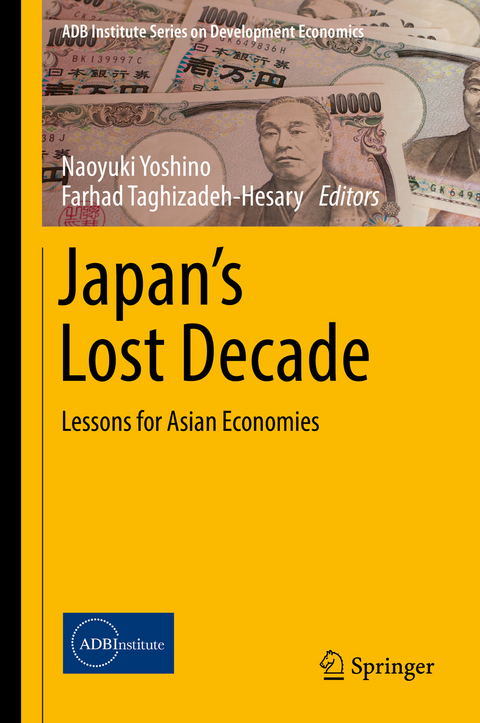
Japan’s Lost Decade (eBook)
XIX, 176 Seiten
Springer Singapore (Verlag)
978-981-10-5021-3 (ISBN)
This book discusses Japan's long-term economic recession and provides remedies for that recession that are useful for other Asian economies. The book addresses why Japan's economy has stagnated since the bursting of its economic bubble in the 1990s. Its empirical analysis challenges the beliefs of some economists, such as Paul Krugman, that the Japanese economy is caught in a liquidity trap. This book argues that Japan's economic stagnation stems from a vertical 'investment-saving' (IS) curve rather than a liquidity trap. The impact of fiscal policy has declined drastically, and the Japanese economy faces structural problems rather than a temporary downturn. These structural problems have many causes: an aging demographic (a problem that is frequently overlooked), an over-reliance by local governments on transfers from the central government, and Basel capital requirements that have made Japanese banks reluctant to lend money to start-up businesses and small and medium-sized enterprises. This latter issue has discouraged Japanese innovation and technological progress. All these issues are addressed empirically and theoretically, and several remedies for Japan's long-lasting recession are provided. This volume will be of interest to researchers and policy makers not only in Japan but also the People's Republic of China, many countries in the eurozone, and the United States, which may face similar challenges in the future.
This book discusses Japan's long-term economic recession and provides remedies for that recession that are useful for other Asian economies. The book addresses why Japan's economy has stagnated since the bursting of its economic bubble in the 1990s. Its empirical analysis challenges the beliefs of some economists, such as Paul Krugman, that the Japanese economy is caught in a liquidity trap. This book argues that Japan's economic stagnation stems from a vertical "e;investment-saving"e; (IS) curve rather than a liquidity trap. The impact of fiscal policy has declined drastically, and the Japanese economy faces structural problems rather than a temporary downturn. These structural problems have many causes: an aging demographic (a problem that is frequently overlooked), an over-reliance by local governments on transfers from the central government, and Basel capital requirements that have made Japanese banks reluctant to lend money to start-up businesses and small and medium-sized enterprises. This latter issue has discouraged Japanese innovation and technological progress. All these issues are addressed empirically and theoretically, and several remedies for Japan's long-lasting recession are provided. This volume will be of interest to researchers and policy makers not only in Japan but also the People's Republic of China, many countries in the eurozone, and the United States, which may face similar challenges in the future.
Summary 7
Preface and Introductory Remarks 8
Contents 13
About the Editors and Contributors 14
Editors 14
Contributors 15
Abbreviations 16
1 Japan's Lost Decade: Causes and Remedies 17
1.1 Introduction 18
1.2 Causes of the Long-Term Recession in Japan 19
Aging Population 19
Monetary Transfers from Central to Local Governments 20
Banking Behavior 21
Excessive Contractionary Monetary Policy 23
Reduced Effectiveness of Fiscal Policy 23
High Appreciation of the Yen in the Mid-1990s 24
Banking Crisis of 1998 25
Japan's Ineffective Monetary Policy 26
1.3 Comparison of the Economic Collapse in Japan and Greece 27
1.4 Empirical Analysis 28
Empirical Model 28
Unit Root Test 29
Empirical Results 31
1.5 Remedies for Stimulating Growth in Japan 32
Remedy 1: Required Reforms Regarding the Aging Population 32
Remedy 2: Increasing Female Participation in the Economy 33
Remedy 3: Reduction of Transfers from Central to Local Governments 34
Remedy 4: Reform of the Agriculture Sector 34
Remedy 5: Diversification of Households' Asset Allocation 36
Remedy 6: Switching Asset Allocation Pension Funds and Insurance Companies from Pay-as-You-Go to 401(k)-Style 39
Remedy 7: Review of Asset Management Fees 40
Remedy 8: Use of Hometown Investment Trust Funds to Finance Riskier Businesses 41
Remedy 9: Optimal Mix of Public and Private Funds 43
Remedy 10: Review of Monetary Policy Goals 45
Remedy 11: Diversification of the Energy Basket 46
1.6 Concluding Remarks 47
References 48
2 Changes in Economic Effect of Infrastructure and Financing Methods: The Japanese Case 50
2.1 Introduction 51
2.2 Changes to and Evaluation of Productivity Effect of Public Capital in Recent Years 51
Estimation Model of the Economic Effect of Public Capital 52
Methods for Measuring the Productivity Effect of Public Capital 53
Industrial and Regional Classification 55
Specification Method of the Estimation Model 55
2.3 Results of the Productivity Effect of Public Capital 56
Results for the Production Function 57
Derivation of Point Estimates of the Productivity Effect of Public Capital 60
Interval Estimation of Productivity Effect of Public Capital 60
2.4 Infrastructure Financing Through Private Funds 66
Public–Private Cooperation in High-Risk Projects 67
Increase in Rate of Return on Infrastructure Projects Through the Internalization of External Effects 68
Incentive Mechanisms of Infrastructure-Operating Entities 69
2.5 Conclusion 70
References 71
3 Optimal Fiscal Policy Rule for Achieving Fiscal Sustainability: A Japanese Case Study 73
3.1 Introduction and an Overview of the Japanese Bond Market 74
3.2 Related Literature 77
3.3 The Revised Domar Condition and Bohn's Condition Combined with the Bond Market 79
3.4 Mathematical Model 79
Revised Domar Condition Combined with the Bond Market 81
3.5 Fiscal Policy Rule and Tax Rule to Achieve Sustainability of the Budget 82
3.6 Empirical Survey 84
3.7 Conclusion 88
References 88
4 Macroeconomic Volatility Under High Accumulation of Government Debt: Lessons from Japan 90
4.1 Introduction 90
4.2 The Model 94
Household Preferences and Endowments 94
Production and Technology 98
Nontraded Services 98
Traded Goods 99
Labor Mobility 100
Calvo Pricing for Home Goods 100
Imported Goods 101
The Financial Sector 101
Fiscal Policy 103
Foreign Assets and Interest Rates 104
4.3 Calibrated Parameters and Bayesian Estimation 104
Parameter and Volatility Estimates 106
Volatility and Parameter Estimates 107
Variance Decomposition 109
4.4 Counterfactual Simulations 109
No-Risk Versus High-Risk Scenarios 110
Interest Rate Versus Exchange-Rate Rule for Monetary Policy 112
Taylor Rule with Exchange-Rate Targeting 115
4.5 Conclusion 118
References 121
5 Japan's Postwar Monetary Policies: Taylor Rules or Something Else? 122
5.1 Introduction 122
5.2 The Taylor Rule Framework 123
5.3 Preliminary Empirical Investigations 124
5.4 Tentative Conclusions and Future Research 127
References 129
6 Impact of the Fukushima Nuclear Disaster: Analysis on Japan's Oil Consuming Sectors 130
6.1 Introduction 131
6.2 Overview of Energy Consumption in Japan 132
Oil Consumption in Japan by Sector 134
6.3 Data Analysis 135
Variables 135
Unit Root Test 135
Augmented Dickey-Fuller Test 135
Phillips-Perron Test 137
Cointegration Test 137
Lag Length Selection 137
6.4 Empirical Analysis 138
Vector Autoregressive Model 138
Stability Test of VAR 139
Lagrange Multiplier Autocorrelation Test 140
Chow Test for Structural Breaks 140
Causality Tests Between Crude Oil Price and Each Sector's Consumption 141
Impulse Response Functions 141
6.5 Concluding Remarks 145
References 146
7 Three Arrows of “Abenomics” and the Further Remedy for the Japanese Economy 147
7.1 Introduction 148
7.2 Aggressive Monetary Policy and Fiscal Consolidation in Abenomics 149
Aggressive Monetary Policy 149
Fiscal Consolidation 151
7.3 Growth Strategy 152
Growth Strategies of the Current Japanese Government 153
Hometown Investment Trust Funds 154
7.4 Conclusion 156
References 157
8 The Ineffectiveness of Japan's Negative Interest Rate Policy 158
8.1 Introduction 159
8.2 Recent Global Oil Price Movements 160
Causes of Oil Price Drop 161
8.3 Oil Prices and the Japanese Economy 162
8.4 Lower Oil Prices and the Negative Interest Rate Policy of the BOJ 165
8.5 Simulation Results 173
8.6 Concluding Remarks 176
References 178
Index 180
| Erscheint lt. Verlag | 20.9.2017 |
|---|---|
| Reihe/Serie | ADB Institute Series on Development Economics | ADB Institute Series on Development Economics |
| Zusatzinfo | XIX, 176 p. 71 illus., 46 illus. in color. |
| Verlagsort | Singapore |
| Sprache | englisch |
| Themenwelt | Sozialwissenschaften ► Politik / Verwaltung |
| Wirtschaft ► Volkswirtschaftslehre ► Makroökonomie | |
| Wirtschaft ► Volkswirtschaftslehre ► Wirtschaftspolitik | |
| Schlagworte | Aging Population • Bubble economy • Japanese economy • Lost Decade • Vertical IS Curve |
| ISBN-10 | 981-10-5021-X / 981105021X |
| ISBN-13 | 978-981-10-5021-3 / 9789811050213 |
| Informationen gemäß Produktsicherheitsverordnung (GPSR) | |
| Haben Sie eine Frage zum Produkt? |
 PDF (Wasserzeichen)
DRM: Digitales Wasserzeichen
Dieses eBook enthält ein digitales Wasserzeichen und ist damit für Sie personalisiert. Bei einer missbräuchlichen Weitergabe des eBooks an Dritte ist eine Rückverfolgung an die Quelle möglich.
Dateiformat: PDF (Portable Document Format)
Mit einem festen Seitenlayout eignet sich die PDF besonders für Fachbücher mit Spalten, Tabellen und Abbildungen. Eine PDF kann auf fast allen Geräten angezeigt werden, ist aber für kleine Displays (Smartphone, eReader) nur eingeschränkt geeignet.
Systemvoraussetzungen:
PC/Mac: Mit einem PC oder Mac können Sie dieses eBook lesen. Sie benötigen dafür einen PDF-Viewer - z.B. den Adobe Reader oder Adobe Digital Editions.
eReader: Dieses eBook kann mit (fast) allen eBook-Readern gelesen werden. Mit dem amazon-Kindle ist es aber nicht kompatibel.
Smartphone/Tablet: Egal ob Apple oder Android, dieses eBook können Sie lesen. Sie benötigen dafür einen PDF-Viewer - z.B. die kostenlose Adobe Digital Editions-App.
Buying eBooks from abroad
For tax law reasons we can sell eBooks just within Germany and Switzerland. Regrettably we cannot fulfill eBook-orders from other countries.
aus dem Bereich