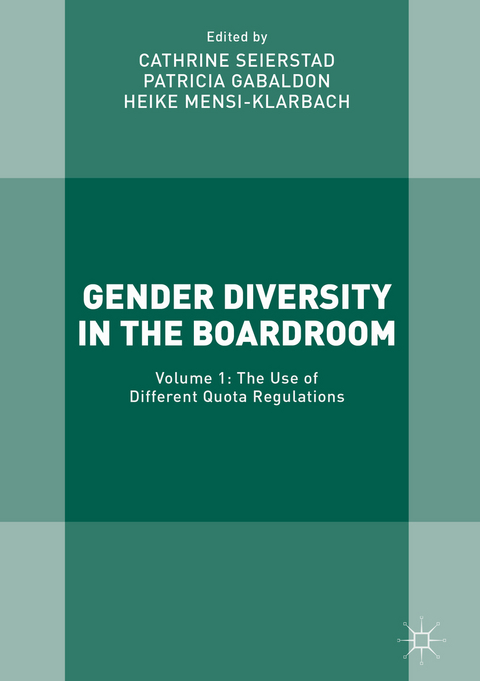
Gender Diversity in the Boardroom (eBook)
XXX, 263 Seiten
Springer International Publishing (Verlag)
978-3-319-56142-4 (ISBN)
This edited collection provides a structured and in-depth analysis of the current use of quota strategies for resolving the pressing issue of gender inequality, and the lack of female representation on corporate boards. Filling the gap in existing literature on this topic, the two volumes of Gender Diversity in the Boardroom offers systematic overviews of current debates surrounding the optimisation of gender diversity, and the suggested pathways for progress. Focusing on sixteen European countries, the skilled contributors explore the current situation in relation to women on boards debates and approaches taken. They include detailed reflections from critical stakeholders, such as politicians, practitioners and policy-makers. Volume 1 focuses on eight European countries having adopted quotas and is a promising and highly valuable resource for academics, practitioners, policy makers and anyone interested in gender diversity because it examines and critiques the current corporate governance system and national strategies for increasing the share of women not only on boards, but within companies beyond the boardroom.
Cathrine Seierstad is Lecturer in International Human Resource Management at Queen Mary University of London, UK, where she is also a member of CRED (Centre for Research in Equality and Diversity).
Patricia Gabaldon is Assistant Professor of Economic Environment at IE Business School in Madrid, Spain.
Heike Mensi-Klarbach is Guest Professor for Gender and Diversity at Leibniz University Hanover, Germany.
Cathrine Seierstad is Lecturer in International Human Resource Management at Queen Mary University of London, UK, where she is also a member of CRED (Centre for Research in Equality and Diversity). Patricia Gabaldon is Assistant Professor of Economic Environment at IE Business School in Madrid, Spain. Heike Mensi-Klarbach is Guest Professor for Gender and Diversity at Leibniz University Hanover, Germany.
Foreword 5
Preface 9
Acknowledgements 12
Contents 13
Editors, Contributors, and Contributing Actors 15
Abbreviations 20
List of Figures 23
List of Tables 24
1: Setting the Scene: Women on Boards in Countries with Quota Regulations 26
Introduction 26
Volume 1: The Use of Different Quota Regulations 30
The Structure and Content of the Book 32
References 34
2: Gender Quotas on Corporate Boards in Norway: Ten Years Later and Lessons Learned 36
Introduction 36
General Background 38
Status of Women in the Labour Market 39
Equality Initiatives 41
Welfare/Substantive Benefits 43
Corporate Governance in Norway 45
Owners 46
Corporate Boards and Governance Structures 47
Employee Participation and Co-determination 48
The Gender Quota Law 50
Reflections on the Gender Balance Law: Ten Years After the Introduction 52
Narrow Compliance 52
Decline of PLCs 53
Recruitment Procedure: Criteria Widening 54
Who Are the Women? 55
Company Performance. The Effects and the Need Look Beyond the Narrow Understanding of the Business Case 56
Critical Actors and Enabling and Hindering Forces 57
Reflection from an Actor 61
Concluding Remarks 63
Notes 64
References 65
3: Gender Diversity on Boards in Spain: A Non-mandatory Quota 71
Introduction 71
General Background: The Spanish Economy and Women in the Workplace 72
The Spanish Economy 73
Women in the Workplace 75
Spanish Corporate Governance 77
Board Composition and Board Members Selection 79
Women on Spanish Corporate Boards 80
Current National Public Policies for Women on Boards 80
Facts and Figures for Women on Boards in Spain 83
Relevant Actors on the Spanish Case 85
Other Enabling and Hindering Forces in the Spanish Scenario 87
Reflections of an Actor 89
Critical Reflection on the Spanish Case 93
Notes 95
References 95
4: Gender Diversity on Boards in Iceland: Pathway to Gender Quota Law Following a Financial Crisis 99
Introduction 99
General Background 101
Culture 102
Gender Equality in Historic Perspective 103
Political and Economic System 105
Discussion of National Public Policy Regarding Women on Boards 106
Governance Structure According to Company Law 106
Corporate Governance Codes 109
Gender Diversity and Director Selection in Icelandic Corporate Governance Codes 110
Enabling and Hindering Forces for Gender Quota in Iceland 112
Reflections of Actors 116
Critical Reflection on the Case: Takeaways 120
Notes 122
References 122
5: Gender Diversity on French Boards: Example of a Success from a Hard Law 126
Introduction 126
General Background of the Country 127
Characteristics of the Economic System 127
Labor Market and the Integration of Women in France 127
Other Characteristics of the Economic System 129
The French Corporate Governance System 130
The Dominant System Is a One-Tier System: A CEO with a Board 130
The Two-Tier System, with a Supervisory Board and an Executive Board 132
Board Nomination 132
National Public Policy Regarding Women on Boards 135
Corporate Governance Codes 135
Legislations 136
Diversity Figures Before and After the Regulation 137
Evolution of Board Gender Diversity in the Biggest French Companies: The CAC40 137
Listed Companies and Diversity 138
Enabling and Hindering Forces 139
Critical Reflection on the Case 140
Reflections of an Actor 142
Note 144
References 145
6: Women on Board in Italy: The Pressure of Public Policies 148
Introduction 148
General Background 149
Political and Economic System 150
Cultural System 152
Governance Structure 153
Ownership Structure 154
The Board of Directors in the Dualistic Horizontal System 155
Statutory Auditors as the Supervisory Board in the Dualistic Horizontal System 156
Corporate Governance Code and Regulation 156
Board Nomination Process 157
National Public Policy Regarding Women on Boards 158
The Gender Debate in Italy 158
The Italian Quota Law 159
Women´s Representation on Boards: Changes and Developments 161
Hindering and Enabling and Forces 163
Reflections of an Actor 165
Critical Reflection on the Case 168
Appendix 169
Notes 175
References 175
7: Belgium: Male/Female United in the Boardroom 178
Introduction 178
General Background 179
Gender Equality or Inequality? 180
Corporate Governance Model 182
Shareholder Base 182
Board Structure 183
Board Nomination Process: The Predominance of the `Old Boys´ Network´? 184
National Public Policy Regarding Women on Boards 185
Belgian Corporate Governance Code: A Flexible Approach to Female Representation in Boards 185
Gender Quota: Five Bills, One Compromise 186
Enabling and Hindering Forces 188
Critical Reflection on the Case: Takeaways 191
Gender Quota Law as Accelerator 191
Women in the Crowd 192
Reflections of an Actor 193
Notes 195
References 196
8: Gender Diversity on Corporate Boards in the Netherlands: Waiting on the World to Change 199
Introduction1 199
General Background: The Political, Economic and Social System 201
Governance Structure According to Company Law 203
Supervisory and Executive Boards 203
Corporate Governance Code 203
Facts and Figures 204
Women´s Participation in the Labor Market 204
Women´s Representation on Boards 207
National Law and Policy Regarding Women on Boards 208
The Gender Quotas in the Dutch Civil Code 208
The Lapsing of the Law Containing Gender Quotas 210
In the Meantime: A Legal Vacuum? 212
Very Recently: Diversity Policy in the Revised Corporate Governance Code 213
Enabling and Hindering Forces and Critical Reflection on the Dutch Case 214
Reflections of an Actor 218
Conclusions 220
Notes 222
References 222
9: Women´s Access to Boards in Germany— Regulation and Symbolic Change 227
Introduction 227
General Background 228
Women in the German Economy and Society 228
The Structure of Corporate Boards 230
The Representation of Women on Boards 234
Enabling and Hindering Forces: New Regulation and Resistances 236
A Protracted Path to Regulation on Board Gender Composition 236
The Statutory Regulation: Provisions, Criticisms and Compliance 240
Critical Reflection: Public Visibility, Social Legitimacy and Symbolic Change 244
Reflections of an Actor 247
Notes 249
References 250
10: Gender Diversity in the Boardroom: The Multiple Versions of Quota Laws in Europe 255
Introduction 255
Corporate Governance Structures 257
Corporate Governance Codes 260
Ownership Structure 261
Quota Regulations 262
Enabling and Hindering Forces 267
Final Thoughts 272
Note 275
References 275
Index 277
| Erscheint lt. Verlag | 13.9.2017 |
|---|---|
| Zusatzinfo | XXX, 263 p. 32 illus. |
| Verlagsort | Cham |
| Sprache | englisch |
| Themenwelt | Sachbuch/Ratgeber ► Beruf / Finanzen / Recht / Wirtschaft ► Bewerbung / Karriere |
| Sozialwissenschaften ► Soziologie | |
| Wirtschaft ► Betriebswirtschaft / Management ► Personalwesen | |
| Wirtschaft ► Betriebswirtschaft / Management ► Unternehmensführung / Management | |
| Schlagworte | Diversity • Gender Inequality • organization • Policy • public initiatives • Regulations • Strategy • Women |
| ISBN-10 | 3-319-56142-1 / 3319561421 |
| ISBN-13 | 978-3-319-56142-4 / 9783319561424 |
| Informationen gemäß Produktsicherheitsverordnung (GPSR) | |
| Haben Sie eine Frage zum Produkt? |
 PDF (Wasserzeichen)
DRM: Digitales Wasserzeichen
Dieses eBook enthält ein digitales Wasserzeichen und ist damit für Sie personalisiert. Bei einer missbräuchlichen Weitergabe des eBooks an Dritte ist eine Rückverfolgung an die Quelle möglich.
Dateiformat: PDF (Portable Document Format)
Mit einem festen Seitenlayout eignet sich die PDF besonders für Fachbücher mit Spalten, Tabellen und Abbildungen. Eine PDF kann auf fast allen Geräten angezeigt werden, ist aber für kleine Displays (Smartphone, eReader) nur eingeschränkt geeignet.
Systemvoraussetzungen:
PC/Mac: Mit einem PC oder Mac können Sie dieses eBook lesen. Sie benötigen dafür einen PDF-Viewer - z.B. den Adobe Reader oder Adobe Digital Editions.
eReader: Dieses eBook kann mit (fast) allen eBook-Readern gelesen werden. Mit dem amazon-Kindle ist es aber nicht kompatibel.
Smartphone/Tablet: Egal ob Apple oder Android, dieses eBook können Sie lesen. Sie benötigen dafür einen PDF-Viewer - z.B. die kostenlose Adobe Digital Editions-App.
Buying eBooks from abroad
For tax law reasons we can sell eBooks just within Germany and Switzerland. Regrettably we cannot fulfill eBook-orders from other countries.
aus dem Bereich