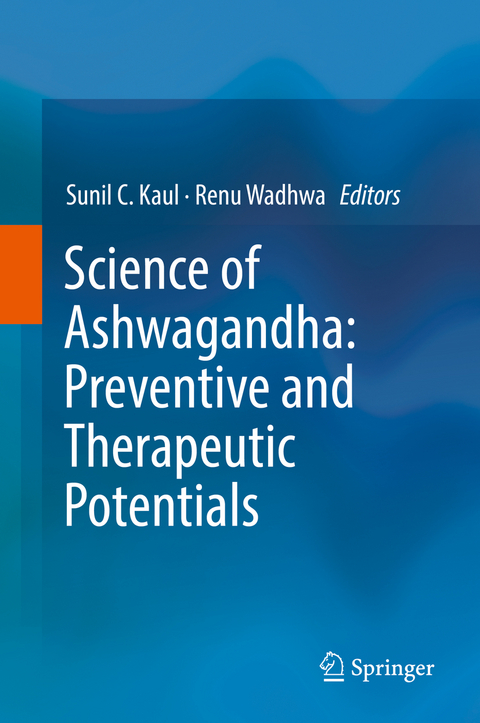
Science of Ashwagandha: Preventive and Therapeutic Potentials (eBook)
XX, 508 Seiten
Springer International Publishing (Verlag)
978-3-319-59192-6 (ISBN)
Dr. Sunil Kaul was born and brought up in Kalimpong (Darjeeling). He obtained his MPhil and PhD degrees from the University of Delhi, India. After his initial post-doctoral training, he was appointed as a researcher at the National Institute of Advanced Industrial Science & Technology (AIST) in Japan, and has been working there for last 28 years. He is now a Chief Senior Research Scientist. His major research interest is to understand the molecular mechanism of stress, aging and cancer. He has been merging the traditional knowledge with modern technologies like gene silencing and imaging to understand the mechanism of action of Ayurvedic herb, Ashwagandha and others. He is a coordinator of the DBT (India)-AIST (Japan) International Laboratory for Advanced Biomedicine at AIST, Japan. With more than 200 research publications in International peer revised journals and several invited talks Internationally, he has been in Editorial board of several scientific journals. He is a Fellow of Geriatrics Society of India (FGSI), Overseas Fellow of Biotech Research Society of India (FBRSI), Fellow of Indian Academy of Neuroscience (FIAN), and Foreign Fellow of National Academy of Sciences, India (FNASc).
Dr. Sunil Kaul was born and brought up in Kalimpong (Darjeeling). He obtained his MPhil and PhD degrees from the University of Delhi, India. After his initial post-doctoral training, he was appointed as a researcher at the National Institute of Advanced Industrial Science & Technology (AIST) in Japan, and has been working there for last 28 years. He is now a Chief Senior Research Scientist. His major research interest is to understand the molecular mechanism of stress, aging and cancer. He has been merging the traditional knowledge with modern technologies like gene silencing and imaging to understand the mechanism of action of Ayurvedic herb, Ashwagandha and others. He is a coordinator of the DBT (India)-AIST (Japan) International Laboratory for Advanced Biomedicine at AIST, Japan. With more than 200 research publications in International peer revised journals and several invited talks Internationally, he has been in Editorial board of several scientific journals. He is a Fellow of Geriatrics Society of India (FGSI), Overseas Fellow of Biotech Research Society of India (FBRSI), Fellow of Indian Academy of Neuroscience (FIAN), and Foreign Fellow of National Academy of Sciences, India (FNASc).
| Erscheint lt. Verlag | 13.9.2017 |
|---|---|
| Zusatzinfo | XX, 508 p. 102 illus., 76 illus. in color. |
| Verlagsort | Cham |
| Sprache | englisch |
| Themenwelt | Sachbuch/Ratgeber ► Gesundheit / Leben / Psychologie ► Krankheiten / Heilverfahren |
| Medizin / Pharmazie ► Naturheilkunde | |
| Medizin / Pharmazie ► Studium | |
| Sozialwissenschaften ► Pädagogik | |
| Schlagworte | Ashwagandha • Ayurveda • Biotechnology • Medicinal use • Molecular Mechanism |
| ISBN-10 | 3-319-59192-4 / 3319591924 |
| ISBN-13 | 978-3-319-59192-6 / 9783319591926 |
| Informationen gemäß Produktsicherheitsverordnung (GPSR) | |
| Haben Sie eine Frage zum Produkt? |
 PDF (Wasserzeichen)
DRM: Digitales Wasserzeichen
Dieses eBook enthält ein digitales Wasserzeichen und ist damit für Sie personalisiert. Bei einer missbräuchlichen Weitergabe des eBooks an Dritte ist eine Rückverfolgung an die Quelle möglich.
Dateiformat: PDF (Portable Document Format)
Mit einem festen Seitenlayout eignet sich die PDF besonders für Fachbücher mit Spalten, Tabellen und Abbildungen. Eine PDF kann auf fast allen Geräten angezeigt werden, ist aber für kleine Displays (Smartphone, eReader) nur eingeschränkt geeignet.
Systemvoraussetzungen:
PC/Mac: Mit einem PC oder Mac können Sie dieses eBook lesen. Sie benötigen dafür einen PDF-Viewer - z.B. den Adobe Reader oder Adobe Digital Editions.
eReader: Dieses eBook kann mit (fast) allen eBook-Readern gelesen werden. Mit dem amazon-Kindle ist es aber nicht kompatibel.
Smartphone/Tablet: Egal ob Apple oder Android, dieses eBook können Sie lesen. Sie benötigen dafür einen PDF-Viewer - z.B. die kostenlose Adobe Digital Editions-App.
Buying eBooks from abroad
For tax law reasons we can sell eBooks just within Germany and Switzerland. Regrettably we cannot fulfill eBook-orders from other countries.
aus dem Bereich