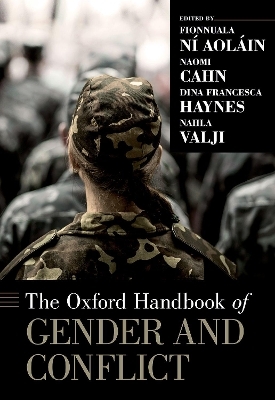
The Oxford Handbook of Gender and Conflict
Oxford University Press Inc (Verlag)
9780199300983 (ISBN)
Traditionally, much of the work studying war and conflict has focused on men. Men commonly appear as soldiers, commanders, casualties, and civilians. Women, by contrast, are invisible as combatants, and, when seen, are typically pictured as victims. The field of war and conflict studies is changing: more recently, scholars of war and conflict have paid increasing notice to men as a gendered category and given sizeable attention to women's multiple roles in conflict and post-conflict settings.
The Oxford Handbook of Gender and Conflict focuses on the multidimensionality of gender in conflict, yet it also prioritizes the experience of women, given both the changing nature of war and the historical de-emphasis on women's experiences. Today's wars are not staged encounters involving formal armies, but societal wars that operate at all levels, from house to village to city. Women are necessarily involved at each level. Operating from this basic intellectual foundation, the editors have arranged the volume into seven core sections: the theoretical foundations of the role of gender in violent conflicts; the sources for studying contemporary conflict; the conflicts themselves; the post-conflict process; institutions and actors; the challenges presented by the evolving nature of war; and, finally, a substantial set of case studies from across the globe. Genuinely comprehensive, this Handbook will not only serve as an authoritative overview of this massive topic, it will set the research agenda for years to come.
Fionnuala Ní Aoláin holds the Robina Chair in Law, Public Policy and Society at the University of Minnesota Law School and is concurrently Professor of Law & Associate Director at Ulster University's Transitional Justice Institute (Belfast). Her book Law in Times of Crisis with Oren Gross (CUP 2006) was awarded ASIL's Certificate of Merit for creative scholarship (2007). She is co-author of On the Frontlines: Gender, War and the Post Conflict Process with Naomi Chan and Dina Haynes (OUP 2011). Ní Aoláin was appointed by the UN Secretary-General as Special Expert on promoting gender equality in times of conflict and peace-making (2003). She has served as Expert to the ICC Trust Fund for Victims (2015), and Consultant to UN Women and OHCHR on a Study on Reparations for Conflict Related Sexual Violence (2013). She was nominated twice by the Irish Government as Judge to the European Court of Human Rights (2004 & 2007). Naomi Cahn is the Harold H. Greene Professor at George Washington University Law School. Her research and writing focus on gender issues in both domestic and international law. She first co-taught a "Women and International Law" course in 1992, at Georgetown University Law Center. With Fionnuala Ní Aoláin and Dina Francesca Haynes, she is the co-author of On the Frontlines (OUP 2011). She has written or co-written numerous other books and articles, including Marriage Markets: How Inequality is Remaking the American Family (OUP 2014)(with Professor June Carbone). Dina Francesca Haynes is Professor of Law at New England Law, Boston, where she teaches courses related to migration, refugees and human rights, as well as human trafficking and constitutional law. She has published numerous books, chapters and articles, including Deconstructing the Reconstruction: Human Rights and the Rule of Law in Postwar BiH (Ashgate 2008), and On the Frontlines (OUP 2011) with Fionnuala Ní Aoláin and Naomi Cahn. Prior to teaching law she served as Protection Officer with the UN High Commissioner of Refugees, Human Rights Officer with the UN High Commissioner for Human Rights, and Director General of the Human Rights Department of the Organization for Security and Cooperation in Europe. Nahla Valji is the Senior Gender Adviser in the Executive Office of the UN Secretary General. She was formerly the Deputy Chief, Peace and Security in UN Women's headquarters in New York, where she led at different points the organization's work on peacekeeping, peace negotiations, countering violent extremism, transitional justice, and rule of law, involving both global programming and policy work, particularly with regards to the Security Council. During this time, she headed the Secretariat for the Global Study on implementation of resolution 1325, a comprehensive study requested by the Security Council for the 15-year review of women, peace and security. Following the completion of the Global Study review, she headed the secretariats of the resulting Security Council mechanism the Informal Expert Group on Women, Peace and Security (established by resolution 2242).
Acknowledgments
Editors and Contributors Biographies
Forewords
Introduction
I. Background and Context
1. Theories of War
Laura Sjoberg
2. From Women and War to Gender and Conflict? Feminist Trajectories
Dubravka Zarkov
3. The Silences in the Rules that Regulate Women during Times of Armed Conflict
Judith Gardam
4. How Should we Explain the Recurrence of Violent Conflict, and What Might Gender Have to do with it?
Judy El-Bushra
5. The Gendered Nexus Between Conflict and Citizenship in Historical Perspective
Jo Butterfield and Elizabeth Heineman
6. Violent Conflict and Changes in Gender Economic Roles: Implications for Post-Conflict Economic Recovery
Patricia Justino
7. Men As Victims
Chris Dolan
II. The Security Council's WPS Agenda/Contemporary Survey
8. Women, Peace and Security: A Critical Analysis of the Security Council's Vision
Dianne Otto
9. Participation and Protection: Security Council Dynamics, Bureaucratic Politics and the Evolution of the Women, Peace and Security Agenda
Anne Marie Goetz and Rob Jenkins
10. A Critical Genealogy of the Centrality of Sexual Violence to Gender and Conflict
Karen Engle
11. 1325 +15 = Reflections on the Women, Peace and Security Agenda
Kimberly Theidon
12. Complemenentarity and Convergence? Women, Peace and Security and the Counterterrorism Agenda
Naureen Chowdhury Fink and Alison Davidian
13. Convergence Between CEDAW and Security Council Resolution 1325: Unlocking the Potential of CEDAW as an Important Accountability Tool for the Women, Peace and Security Agenda
Pramilla Patten
14. Indicators and Benchmarks
Pablo Castillo-Diaz and Hanny Cueva-Beteta
III. Legal and Political Elements
15. Humanitarian Intervention and Gender Dynamics
Gina Heathcote
16. (Re)Considering the Gender Jurisprudence of Conflict
Patricia Viseur Sellers
17. Complementarity as a Catalyst for Gender Justice in National Prosecutions
Amrita Kapur
18. Forced Marriage During Conflict and Mass Atrocity
Valerie Oosterveld
19. Advancing Justice and Making Amends through Reparations - Legal and Operational Considerations
Kristin Kalla
20. Colonialism
Amina Mama
21. Conflict, Displacement and Refugees
Lucy Hovil
22. Gender and Forms of Conflict; The Moral Hazards of Dating the Security Council
Vasuki Nesiah
IV. Conflict and Post-Conflict Space
23. The Martial Rape of Girls and Women in Antiquity and Modernity
Kathy L. Gaca
24. "Mind the Gap:" Measuring and Understanding Gendered Conflict Experiences
Amelia Hoover Green
25. Intersectionality: Working in Conflict
Eilish Rooney
26. Agency and Gender Norms in War Economies
Patti Petesch
27. Risk and Resilience: The Physical and Mental Health of Female Civilians During War
Lauren C. Ng and Theresa S. Betancourt
28. The Gender Implications of Small Arms and Light Weapons in Conflict Situations
Barbara Frey
29. Unmanned Weapons: Looking for the Gender Dimension
Christof Heyns and Tess Borden
30. Gender and Peacekeeping
Sabrina Karim and Marsha Henry
31. Peacekeeping, Human Trafficking, and Sexual Abuse and Exploitation
Martina Vandenberg
32. Women, Peace Negotiations and Peace Agreements: Opportunities and Challenges
Christine Bell
33. Women's Organizations and Peace Initiatives
Aili Mari Tripp
34. Gender and Disarmament, Demobilization and Reintegration: Reviewing and Advancing the Field
Dyan Mazurana, Roxanne Krystalli and Anton Baaré
35. Decolonial feminism, gender and transitional justice
Pascha Bueno-Hansen
36. Gender and Governance in post-conflict and democratizing settings
Lisa Kindervater and Sheila Meintjes
V. Case Studies
37. Who Defines the Red Lines? The Prospects for Safeguarding Women's Rights and Securing their Future in Post-Transition Afghanistan
Sari Kouvo and Corey Levine
38. "That's Not my Daughter": The Paradoxes of Documenting Jihadist Mass Rape in 1990's Algeria and Beyond
Karima Bennoune
39. Consequences of Conflict Related Sexual Violence on Post-Conflict Society: Case Study of Bosnia and Herzegovina
Lejla Hadzimesic
40. Colombia: Gender and Land Restitution
Donny Meertens
41. Knowing Gender and/in Armed Conflict?: Reflections from Research in the DRC
Maria Eriksson Baaz and Maria Stern
42. Northern Ireland: The Significance of A Bottom Up Women's Movement in a Politically Contested Society
Monica McWilliams and Avila Kilmurray
43. Gendered Suffering and the Eviction of the Native: The Politics of Birth in Occupied East Jerusalem
Nadera Shalhoub-Kevorkian
44. Rwanda: Women's Political Participation in Post-Conflict State-Building
Doris Buss and Jerusa Ali
45. Sri Lanka: The Impact of Militarization on Women
Ambika Satkunanathan
| Erscheinungsdatum | 29.01.2018 |
|---|---|
| Reihe/Serie | Oxford Handbooks |
| Verlagsort | New York |
| Sprache | englisch |
| Maße | 249 x 178 mm |
| Gewicht | 1356 g |
| Themenwelt | Sozialwissenschaften ► Politik / Verwaltung ► Politische Systeme |
| Sozialwissenschaften ► Soziologie ► Gender Studies | |
| ISBN-13 | 9780199300983 / 9780199300983 |
| Zustand | Neuware |
| Informationen gemäß Produktsicherheitsverordnung (GPSR) | |
| Haben Sie eine Frage zum Produkt? |
aus dem Bereich