


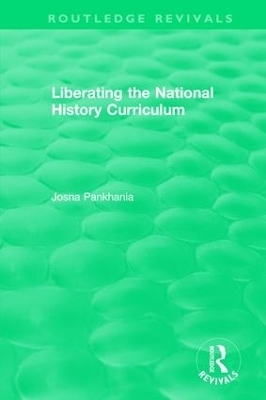
Liberating the National History Curriculum
Seiten
2017
Routledge (Verlag)
978-1-138-57306-2 (ISBN)
Routledge (Verlag)
978-1-138-57306-2 (ISBN)
First published in 1994, this book argues that the curriculum can be legitimately used to teach students the history of oppressed groups. It is important to note that Pankhania does this, not in a divisive spirit but with the intent to seek unity for the future by understanding and accepting the positive and negative aspects of a collective past.
Once there were bards who sang the songs which kept the listeners in touch with their past. They reminded them of the heroes who once walked among them and whose legacy provided a sense of shared greatness and national identity. Later, the bards became historians and history teachers and English history became a glorious roll call of those who had gone out and created an Empire and, at the same time, spread education and enlightenment. But recent doubts have raised questions about partiality and perhaps there were losses suffered by the Empire’s people. Perhaps "their" heritage should be "our" heritage and therefore a fit subject for history to deal with.
Originally published in 1994, this book argues that the curriculum can be legitimately used to teach students the history of oppressed groups. It is important to note that Pankhania manages to do this, not in a divisive spirit but with the intent to seek unity for the future by understanding and accepting the positive and negative aspects of a collective past.
Once there were bards who sang the songs which kept the listeners in touch with their past. They reminded them of the heroes who once walked among them and whose legacy provided a sense of shared greatness and national identity. Later, the bards became historians and history teachers and English history became a glorious roll call of those who had gone out and created an Empire and, at the same time, spread education and enlightenment. But recent doubts have raised questions about partiality and perhaps there were losses suffered by the Empire’s people. Perhaps "their" heritage should be "our" heritage and therefore a fit subject for history to deal with.
Originally published in 1994, this book argues that the curriculum can be legitimately used to teach students the history of oppressed groups. It is important to note that Pankhania manages to do this, not in a divisive spirit but with the intent to seek unity for the future by understanding and accepting the positive and negative aspects of a collective past.
Pankhania, Josna
List of Figures. Acknowledgements. Foreword. Introduction. 1. Making Sense of Inequalities in Society 2. The Unmasking of Black History 3. The Denial of Black History in the National Education Policies 4. Liberating the National History Curriculum 5. Weaving a People’s History into the National Curriculum. Conclusion. Appendix 1: Key Stage 3 Core Study Unit 3 The Making of the United Kingdom: Crowns, Parliaments and Peoples 1500-1750. Appendix 2: Key Stage 3 Supplementary Study Units. References. Index.
| Erscheinungsdatum | 05.11.2017 |
|---|---|
| Reihe/Serie | Routledge Revivals |
| Verlagsort | London |
| Sprache | englisch |
| Maße | 156 x 234 mm |
| Gewicht | 500 g |
| Themenwelt | Sozialwissenschaften ► Pädagogik ► Schulpädagogik / Grundschule |
| ISBN-10 | 1-138-57306-X / 113857306X |
| ISBN-13 | 978-1-138-57306-2 / 9781138573062 |
| Zustand | Neuware |
| Informationen gemäß Produktsicherheitsverordnung (GPSR) | |
| Haben Sie eine Frage zum Produkt? |
Mehr entdecken
aus dem Bereich


aus dem Bereich
für Kinder mit Down-Syndrom, Leseratten und Legastheniker
Buch | Softcover (2023)
Lehmanns Media (Verlag)
CHF 27,90
Unterrichtsstörungen, Beleidigungen und Gewalt erfolgreich eingrenzen
Buch | Softcover (2025)
Klett-Cotta (Verlag)
CHF 30,80
der Leitfaden für einen besseren Unterricht
Buch | Softcover (2025)
Klett-Cotta (Verlag)
CHF 23,80


