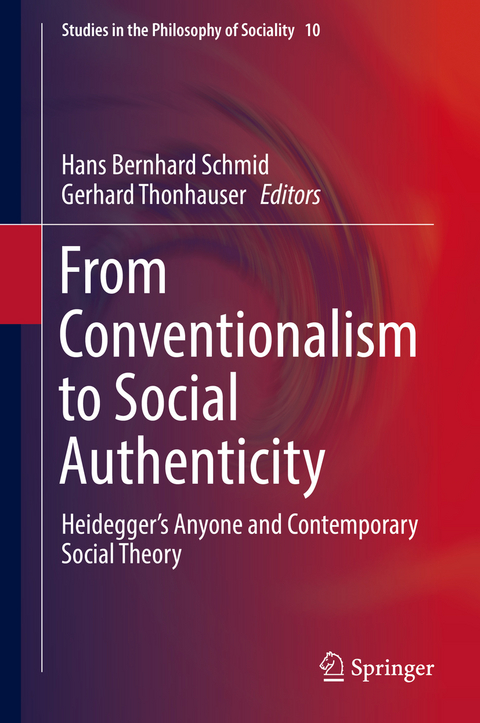
From Conventionalism to Social Authenticity (eBook)
278 Seiten
Springer International Publishing (Verlag)
978-3-319-56865-2 (ISBN)
This edited volume offers a new approach to understanding social conventions by way of Martin Heidegger. It connects the philosopher's conceptions of the anyone, everydayness, and authenticity with an analysis and critique of social normativity. Heidegger’s account of the anyone is ambiguous. Some see it as a good description of human sociality, others think of it as an important critique of modern mass society. This volume seeks to understand this ambiguity as reflecting the tension between the constitutive function of conventions for human action and the critical aspects of conformism. It argues that Heidegger’s anyone should neither be reduced to its pejorative nor its constitutive dimension. Rather, the concept could show how power and norms function.
This volume would be of interest to scholars and students of philosophy and the social sciences who wish to investigate the social applications of the works of Martin Heidegger.Hans Bernhard Schmid is Professor of Philosophy at the University of Vienna. He received his PhD (1998) and Habilitation (2005) from the University of Basel. His main research interests are Philosophy of Social Science, Social Ontology, Action Theory, Social and Sociological Theory, History of Philosophy (esp. Phenomenology and Existential Philosophy). He is the author of Subjekt, System, Diskurs: Edmund Husserls Begriff transzendentaler Subjektivität in sozialtheoretischen Bezügen (2000), Wir-Intentionalität: Kritik des ontologischen Individualismus und Rekonstruktion der Gemeinschaft (2005), Plural Action (2009), and Moralische Integrität: Kritik eines Konstrukts (2011).Gerhard Thonhauser studied philosophy and political science at the University of Vienna and Copenhagen University. He received his PhD in philosophy from the University of Vienna in 2015. He was the recipient of a DOC-fellowship of the Austrian Academy of Sciences in 2011-2012. His main research interests are Phenomenology, Existential Philosophy, Political Philosophy, and Social Ontology. He is the author of Über das Konzept der Zeitlichkeit bei Søren Kierkegaard mit ständigem Hinblick auf Martin Heidegger (2011) and Ein rätselhaftes Zeichen. Zum Verhältnis von Martin Heidegger und Søren Kierkegaard (2016), and the editor of Perspektiven mit Heidegger (2017).
1. Who is the Self of Everyday Existence? (Mark Wrathall).- 2. Das Man and Everydayness: A New Interpretation (Charlotte Knowles).- 3. Heidegger’s Underdeveloped Conception of the Undistinguishedness (Indifferenz) of Everyday Human Existence (Jo-Jo Koo).- 4. The Status of Division One of “Being and Time” and the Sources of Authenticity (Gerhard Thonhauser).- 5. Becoming Accountable – But for What? The Importance of Authenticity and the Unavoidability of Theory (Tobias Keiling).- 6. Unobtrusive Governance: Heidegger and Foucault on the Sources of Social Normativity ( Andreas Beinsteiner).- 7. The Inseparability of Anyone and Self, Production and Action: A Critical Proposal Between Heidegger and Arendt (Lucilla Guidi).- 8. Authenticity and Plurality: From Heidegger’s “Anyone” to Arendt’s “Common Sense” and Back Again (Ileana Bortun).- 9. Ambivalence of Power: Heidegger’s “Anyone” and Arendt’s “acting in concert” (Katrin Meyer).- 10. The Historicality of das Man: Foucault on Dolcility and Optimality (Kevin Thompson).- 11. How to change das Man? (Christian Schmidt).- 12. Social Authenticity: Towards a Heideggerian Analysis of Social Change (Martin Weichold).- 13. The “Reiterating Parodist” as a “World Transformer”: A Butlerian Reading of Heidegger on Social Change? (Gerhard Thonhauser).- 14. Authentic Role Play: A Political Solution to an Existential Paradox (Hans Bernhard Schmid).- 15. An I that is Anybody: Normativity and Freedom in Heidegger's Man (Dirk Setton).- 16. The Danger of Being Ridden by a Type: Everydayness and Authenticity in Context: Reading Heidegger with Henry James, Hegel, and Diderot (Dieter Thomä).
| Erscheint lt. Verlag | 10.8.2017 |
|---|---|
| Reihe/Serie | Studies in the Philosophy of Sociality | Studies in the Philosophy of Sociality |
| Zusatzinfo | VI, 278 p. 2 illus. |
| Verlagsort | Cham |
| Sprache | englisch |
| Themenwelt | Geisteswissenschaften ► Philosophie ► Allgemeines / Lexika |
| Sozialwissenschaften ► Soziologie | |
| Schlagworte | Arendt Heidegger • Everydayness • Foucault Heidegger • Heidegger das Man • Martin Heidegger • Normativity Heidegger • Plurality Heidegger • Social Authenticity • Social Change Heidegger • Social Roles Heidegger |
| ISBN-10 | 3-319-56865-5 / 3319568655 |
| ISBN-13 | 978-3-319-56865-2 / 9783319568652 |
| Informationen gemäß Produktsicherheitsverordnung (GPSR) | |
| Haben Sie eine Frage zum Produkt? |
 PDF (Wasserzeichen)
DRM: Digitales Wasserzeichen
Dieses eBook enthält ein digitales Wasserzeichen und ist damit für Sie personalisiert. Bei einer missbräuchlichen Weitergabe des eBooks an Dritte ist eine Rückverfolgung an die Quelle möglich.
Dateiformat: PDF (Portable Document Format)
Mit einem festen Seitenlayout eignet sich die PDF besonders für Fachbücher mit Spalten, Tabellen und Abbildungen. Eine PDF kann auf fast allen Geräten angezeigt werden, ist aber für kleine Displays (Smartphone, eReader) nur eingeschränkt geeignet.
Systemvoraussetzungen:
PC/Mac: Mit einem PC oder Mac können Sie dieses eBook lesen. Sie benötigen dafür einen PDF-Viewer - z.B. den Adobe Reader oder Adobe Digital Editions.
eReader: Dieses eBook kann mit (fast) allen eBook-Readern gelesen werden. Mit dem amazon-Kindle ist es aber nicht kompatibel.
Smartphone/Tablet: Egal ob Apple oder Android, dieses eBook können Sie lesen. Sie benötigen dafür einen PDF-Viewer - z.B. die kostenlose Adobe Digital Editions-App.
Buying eBooks from abroad
For tax law reasons we can sell eBooks just within Germany and Switzerland. Regrettably we cannot fulfill eBook-orders from other countries.
aus dem Bereich