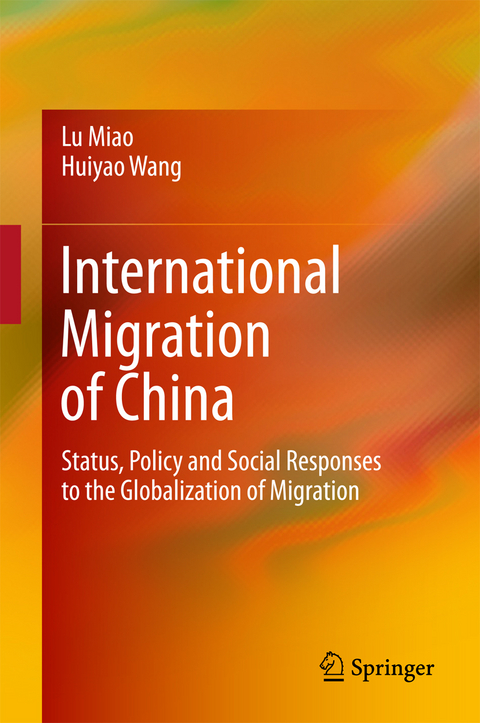
International Migration of China (eBook)
135 Seiten
Springer Singapore (Verlag)
978-981-10-6074-8 (ISBN)
This book provides a systemic and detailed monographic study of Chinese outbound migration. It not only breaks down the basic trends of this migration with respect to destinations and the like, but also analyzes its unique features, which include the largely middle- and upper-class makeup of emigrants and their investment activities overseas, particularly when it comes to buying property. The Chinese are the largest foreign buyers of real estate in the US, Canada and Australia. By explaining this and other special aspects of Chinese emigration and their impact on China and receiving countries, this book provides a fresh and interesting look at this important phenomenon.
Dr. Lu Miao is Executive General Secretary for the CCG and General Secretary of the Ministry of Human Resources and Social Security’s China Global Talent Society. She received her Ph.D. in contemporary Chinese studies from Beijing Normal University and has been a visiting scholar at New York University’s China House and the Fairbank Center at Harvard University. Dr. Miao has authored several research papers and edited a number of books, including The Chinese Overseas Students’ Development Report, 2013 and Chinese Overseas Returnees’ Development, both of which she edited for the Chinese Academy’s Social Sciences Press. She is also the author of Global Think Tanks, which was published last year by the People’s Publishing House in Beijing. Dr. Huiyao Wang is the founder and President of the Center for China & Globalization (CCG), which was rated as one of the top three independent think tanks in China and one of the top 50 Asian think tanks in a recent University of Pennsylvania survey. Dr. Wang has published nearly 50 books and over 100 articles on China and globalization, focusing on the global circulation of Chinese talent and Chinese firms investing abroad. Several of these books, notably Globalizing China: the strategy, influence and success of Chinese returnee entreprenuers (London: Emerald Publishing Group, 2012), have been published in the West. He is also the Counselor of the China State Council Counselors Office, Vice Chairman of the China Association for International Economic Cooperation under the Ministry of Commerce, a member of the Migration Advisory Board of the International Organization for Migration, and serves on the Yale University Asia Development Council. He has been a senior fellow at the Harvard Kennedy School of Government and a visiting fellow at the Brookings Institution as well as an adjunct/visiting professor at the Gunaghua School of Management, Peking University, Ivey School of Business, University of Western Ontario, and China University of Political Science and Law. Dr. Wang studied at the University of Manchester, where he received his MBA and Ph.D. in management.
Acknowledgements 5
Contents 6
About the Authors 9
List of Figures 11
List of Tables 13
Introduction 14
Definition and Classification 14
Causes of International Migration 15
Globalization of Migration 16
Immigration Bonus 17
New Immigration Trends 19
Immigrants Integration 20
International Migration of China 22
References 22
1 In the Era of Globalization: The Phenomenon of International Migration in China 25
1.1 Introduction: Chinese International Migration 25
1.2 Causes of Chinese International Migration 25
1.2.1 Economic Development Gap and Income Disparities 26
1.2.2 Social Security 26
1.2.3 Educational Resources 26
1.2.4 Environmental Issues 28
1.2.5 The Political and Legal Environment—The Concept of Freedom 29
1.3 Current Situation of Chinese International Migration 30
1.3.1 Chinese Migrants in the U.S. 30
1.3.2 Chinese Migrants in European Union (EU) Member Countries 31
1.3.3 Chinese Migrants in Australia and New Zealand 32
1.3.4 Chinese Migrants in Japan 33
1.3.5 Chinese Migrants in Africa 33
1.4 Characteristics and Trends of Chinese International Migration 34
1.5 Concluding Remarks 36
References 36
2 In a Different Region of the World: The Categories of Chinese Migrants Abroad 38
2.1 Introduction: Categories of Chinese Migrants Abroad 38
2.2 Chinese Investor Migrants 39
2.2.1 Destinations of Chinese Investor Migrants 40
2.2.1.1 North America 40
2.2.1.2 European Union (EU) 42
2.2.1.3 Australia 43
2.2.2 High-Net-Worth Individuals (HNWI) in Developed Countries/Region 44
2.2.2.1 Investment Immigration and Dual Locations 45
2.2.2.2 Categories of Investment 45
2.2.2.3 Chinese Investor Migrants and Property Investment Abroad 45
2.2.2.4 International Chinese Migrants’ Role in Promoting Enterprise Globalization 47
2.2.3 Future Trends of Investor Migrants 48
2.3 Chinese Skilled Migrants 48
2.3.1 Geographic Distribution 49
2.3.1.1 North America 50
2.3.1.2 European Union (EU) 54
2.3.1.3 Australia 55
2.3.2 The Characteristics of Chinese Skilled Migrants 58
2.3.2.1 Diverse Distribution in Profession 58
2.3.2.2 Overlapping with Investor Migrants 59
2.3.2.3 Increasing Participation in Academic Fields 60
2.3.2.4 Circulate Migration 61
2.4 Chinese Students Overseas 62
2.4.1 Overview of Mobility of Overseas Chinese Students 62
2.4.2 Development Trends of Overseas Chinese Students 66
2.4.2.1 Changing Trends of Chinese Students 66
2.4.2.2 Performance of Chinese International Students 67
2.4.2.3 Diverse Choice and Disciplines 68
2.4.3 Factors Influencing Chinese Students 70
2.4.3.1 Reasons of Studying Abroad 70
2.4.3.2 Sources of Information 71
2.5 Concluding Remarks 72
References 72
3 Reverse Migration in China: Contemporary Chinese Returnees 75
3.1 Introduction: Contemporary Chinese Returnees 75
3.2 Survey on Contemporary Chinese Returnees: Employment and Entrepreneurship Traits 76
3.2.1 Survey on Chinese Returnees 77
3.2.1.1 Motivation for Returning to China 78
3.2.1.2 Different Career Choices 81
3.2.1.3 Factors Hindering Overseas Chinese from Returning to China 83
3.2.1.4 Policy Effects on Returnees with Different Overseas Experience 86
3.2.2 Survey on Chinese Returnee Entrepreneurs 87
3.2.2.1 Location Distribution 87
3.2.2.2 Industry Distribution of Returnee Entrepreneurial Firms 89
3.2.2.3 Funding Sources of Returnee Entrepreneurial Firms 89
3.2.2.4 The Composition of Returnee Entrepreneurial Team 91
3.2.2.5 Acquisition of Technological Resources 92
3.2.2.6 Research and Development (R& D) Investment
3.2.3 General Situation of Returnees’ Employment 94
3.2.3.1 Employment Location of Returnees 95
3.2.3.2 Returnees’ Choice of Careers 96
3.2.3.3 Industry Distribution of Employers 97
3.3 Returning Chinese Promoting the Development of China’s New Economy 99
3.3.1 Entrepreneurial Start-Up Environment in China 100
3.3.1.1 Business Environment 100
3.3.1.2 Entrepreneurial Park 101
3.3.1.3 Talent Programs 102
3.3.2 Major Forces Impacting the Development of China’s New Economy 103
3.3.2.1 Helping Chinese Enterprises in “Going Global” 103
3.3.2.2 Managing MNCs in China 104
3.3.2.3 Creating a New Business Culture in China 105
3.4 Concluding Remarks 105
References 105
4 Global Talent Migration: The Barrier and Breakthrough of Foreign Immigrants in China 107
4.1 Introduction: Global Talent Migration 107
4.2 The Migration Status of Foreign Talents in China 108
4.2.1 Foreign Investment Immigrants in China 108
4.2.2 Foreign Students in China 109
4.2.3 Foreign Skilled Immigrants in China 111
4.2.4 China Become an Attractive Destination 112
4.3 Global Talent Migration: Barriers and Breakthroughs 113
4.3.1 Normalization of Global Talent Movement 113
4.3.2 Imbalance of Global Talent Flow in China 115
4.3.2.1 Imbalance in Flow of High-Tech Talents 115
4.3.2.2 Flows of High-Quality Labor Workers 115
4.3.3 Barriers to Global Talent in China 116
4.3.3.1 Ease of Talents Migration 116
4.3.3.2 Residence Procedures and Difficulties 117
4.3.3.3 Employment Policy for International Students in China 118
4.3.4 Breakthroughs of Chinese Global Talent Migration 119
4.3.4.1 Loosen Permanent Residence Permit Conditions 119
4.3.4.2 Reduce Time Required for China’s Green Card Issuance 120
4.3.4.3 Establish a System to Turn Permanent Residence Permit into Chinese Citizenship 120
4.3.4.4 Lower the Bar for Foreign Students to Enter China’s Job Market 120
4.3.4.5 Improve Effectiveness of Working Visa for Foreign Students 121
4.3.4.6 Build Systems of Chinese Ethnic Card and Overseas Chinese Identification Certificates 121
4.3.4.7 Build Social Security System in Align with International Standard for Foreign Talent 122
4.3.4.8 Formulates Immigration Law and Complete Building of Institutional System 122
4.3.4.9 Set Up Immigration Bureau to Optimize Administration and Services 122
4.3.4.10 Promote Policies and Measures to Attract Foreign Talent 123
4.4 Concluding Remarks 123
References 124
5 Evolution of China’s Immigration Policies: Visa Polices and Talent Attraction Programs 126
5.1 Introduction: China’s Immigration Policies Past and Present 126
5.2 Promoting the Reformation of Visa Policy in China 128
5.2.1 Influencing Factors of Promoting the Reformation 128
5.2.1.1 Exit and Entry Personnel 129
5.2.1.2 Aging Society 130
5.2.1.3 Lack of the Progress in Visa Policy 131
5.2.2 Facilitation of Visa Policies Between China and Other Countries 132
5.2.3 Attracting Overseas Chinese to Return to China 133
5.3 Talents Attraction Programs 134
5.3.1 Thousand Talents Program 134
5.3.2 Talents Attraction Program in Provincial/Municipal Level 137
5.3.2.1 Beijing 137
5.3.2.2 Shanghai 138
5.3.2.3 Fujian Province 138
5.3.2.4 Zhejiang Province 139
5.4 Polices for Retaining Talents 139
5.4.1 Welfare Services for Permanent Residents 140
5.4.2 Expanding the Talent Hunting Scope 141
5.5 Future Possibilities to Promote China’s Immigration Policies 141
5.6 Concluding Remarks 143
References 144
6 Suggestions on Establishing the Internationally Competitive Talent Immigration System 146
6.1 Introduction: The Status Quo of Talents Immigration in China 146
6.2 Overseas Chinese Roles in Enhancing “The Belt and Road” Initiative 147
6.3 Suggestions on Establishing a Systematic Immigration System 148
6.3.1 To Accelerate the Study of the “Investment Immigration Act” and “Skilled Immigration Act” 149
6.3.2 To Establish a Unified Regulatory Agency for the Foreign High-Level Talent 150
6.3.3 To Complete and Open the Investment Immigration and Skilled Immigration Category and Lower the Application Threshold 150
6.3.3.1 The Interests of the State Green Card Category 151
6.3.3.2 Investment Green Card Category 151
6.3.3.3 Skilled Green Card Category 151
6.3.4 To Make the Foreigners Naturalization Policy 152
6.3.5 To Establish the Migration Bureau in China 153
6.4 To Strengthen the Immigrants Integration Services and Unconventional Immigration Management 153
6.5 Further Improve the Visa Approval System 155
6.6 Concluding Remarks 155
References 156
| Erscheint lt. Verlag | 8.8.2017 |
|---|---|
| Zusatzinfo | XXVII, 135 p. 41 illus., 5 illus. in color. |
| Verlagsort | Singapore |
| Sprache | englisch |
| Themenwelt | Sozialwissenschaften ► Politik / Verwaltung |
| Sozialwissenschaften ► Soziologie | |
| Wirtschaft ► Volkswirtschaftslehre ► Makroökonomie | |
| Schlagworte | Chinese Overseas Professional • Emigration • Globalization of Migration • Inbound Migration • International Immigration • Migration for Investment • Transnational Migration |
| ISBN-10 | 981-10-6074-6 / 9811060746 |
| ISBN-13 | 978-981-10-6074-8 / 9789811060748 |
| Informationen gemäß Produktsicherheitsverordnung (GPSR) | |
| Haben Sie eine Frage zum Produkt? |
 PDF (Wasserzeichen)
DRM: Digitales Wasserzeichen
Dieses eBook enthält ein digitales Wasserzeichen und ist damit für Sie personalisiert. Bei einer missbräuchlichen Weitergabe des eBooks an Dritte ist eine Rückverfolgung an die Quelle möglich.
Dateiformat: PDF (Portable Document Format)
Mit einem festen Seitenlayout eignet sich die PDF besonders für Fachbücher mit Spalten, Tabellen und Abbildungen. Eine PDF kann auf fast allen Geräten angezeigt werden, ist aber für kleine Displays (Smartphone, eReader) nur eingeschränkt geeignet.
Systemvoraussetzungen:
PC/Mac: Mit einem PC oder Mac können Sie dieses eBook lesen. Sie benötigen dafür einen PDF-Viewer - z.B. den Adobe Reader oder Adobe Digital Editions.
eReader: Dieses eBook kann mit (fast) allen eBook-Readern gelesen werden. Mit dem amazon-Kindle ist es aber nicht kompatibel.
Smartphone/Tablet: Egal ob Apple oder Android, dieses eBook können Sie lesen. Sie benötigen dafür einen PDF-Viewer - z.B. die kostenlose Adobe Digital Editions-App.
Buying eBooks from abroad
For tax law reasons we can sell eBooks just within Germany and Switzerland. Regrettably we cannot fulfill eBook-orders from other countries.
aus dem Bereich