


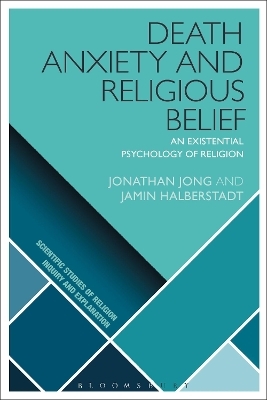
Death Anxiety and Religious Belief
An Existential Psychology of Religion
Seiten
2018
Bloomsbury Academic (Verlag)
978-1-350-06160-6 (ISBN)
Bloomsbury Academic (Verlag)
978-1-350-06160-6 (ISBN)
There are no atheists in foxholes; or so we hear. The thought that the fear of death motivates religious belief has been around since the earliest speculations about the origins of religion. There are hints of this idea in the ancient world, but the theory achieves prominence in the works of Enlightenment critics and Victorian theorists of religion, and has been further developed by contemporary cognitive scientists. Why do people believe in gods? Because they fear death.
Yet despite the abiding appeal of this simple hypothesis, there has not been a systematic attempt to evaluate its central claims and the assumptions underlying them. Do human beings fear death? If so, who fears death more, religious or nonreligious people? Do reminders of our mortality really motivate religious belief? Do religious beliefs actually provide comfort against the inevitability of death?
In Death Anxiety and Religious Belief, Jonathan Jong and Jamin Halberstadt begin to answer these questions, drawing on the extensive literature on the psychology of death anxiety and religious belief, from childhood to the point of death, as well as their own experimental research on conscious and unconscious fear and faith. In the course of their investigations, they consider the history of ideas about religion’s origins, challenges of psychological measurement, and the very nature of emotion and belief.
Yet despite the abiding appeal of this simple hypothesis, there has not been a systematic attempt to evaluate its central claims and the assumptions underlying them. Do human beings fear death? If so, who fears death more, religious or nonreligious people? Do reminders of our mortality really motivate religious belief? Do religious beliefs actually provide comfort against the inevitability of death?
In Death Anxiety and Religious Belief, Jonathan Jong and Jamin Halberstadt begin to answer these questions, drawing on the extensive literature on the psychology of death anxiety and religious belief, from childhood to the point of death, as well as their own experimental research on conscious and unconscious fear and faith. In the course of their investigations, they consider the history of ideas about religion’s origins, challenges of psychological measurement, and the very nature of emotion and belief.
Jonathan Jong is Deputy Director of the Belief, Brain and Behaviour research group at the Centre for Research in Psychology, Behaviour and Achievement, Coventry University, UK; and Research Coordinator at the Institute of Cognitive and Evolutionary Anthropology, University of Oxford, UK. Jamin Halberstadt is a Professor of Social Psychology at the University of Otago, New Zealand.
List of Tables and Figures
Preface
Acknowledgments
1. The whats and whys of religious belief
2. A history of thanatocentric theories of religion
3. Measuring faith and fear
4. Are people afraid of death?
5. The religious correlates of death anxiety
6. Death anxiety and religion: Causes and consequences
7. The future of immortality, literal and symbolic
References
Index
| Erscheinungsdatum | 12.08.2017 |
|---|---|
| Reihe/Serie | Scientific Studies of Religion: Inquiry and Explanation |
| Verlagsort | London |
| Sprache | englisch |
| Maße | 160 x 236 mm |
| Gewicht | 420 g |
| Themenwelt | Geisteswissenschaften ► Psychologie ► Allgemeine Psychologie |
| Geisteswissenschaften ► Religion / Theologie | |
| Sozialwissenschaften ► Soziologie ► Mikrosoziologie | |
| ISBN-10 | 1-350-06160-3 / 1350061603 |
| ISBN-13 | 978-1-350-06160-6 / 9781350061606 |
| Zustand | Neuware |
| Informationen gemäß Produktsicherheitsverordnung (GPSR) | |
| Haben Sie eine Frage zum Produkt? |
Mehr entdecken
aus dem Bereich


aus dem Bereich
Paket bestehend aus »Das Patienten-Manual« und »Das Trainer-Manual«
Buch | Softcover (2025)
Schattauer (Verlag)
CHF 125,95


