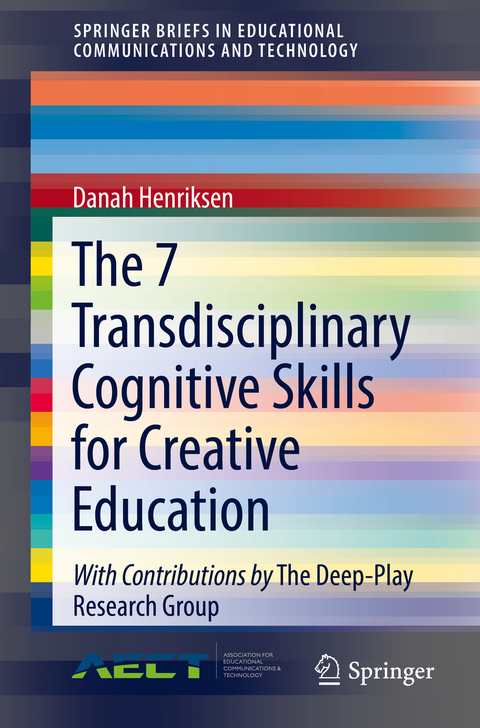
The 7 Transdisciplinary Cognitive Skills for Creative Education (eBook)
XV, 92 Seiten
Springer International Publishing (Verlag)
978-3-319-59545-0 (ISBN)
Danah Henriksen is an Assistant Professor of Educational Leadership and Innovation at Arizona State University. Her current work and research highlight aspects of creativity, thinking skills, and design thinking for education. Her work has been published in both peer-reviewed educational journals such as Teachers College Record and Educational Technology, as well as practitioner venues such as Educational Leadership and Art Education Journal. She has been guest co-editor for a special issue of the Journal of Technology and Teacher Education focused on creativity, as well as a special issue co-editor of TechTrends about technology and teacher education. She is currently the Co-Chair of the Creativity SIG for the Society of Information Technology in Education. Dr. Henriksen teaches courses on varied topics in educational psychology, systems change and leadership, design thinking and creativity in educational settings. More information on her interests and accomplishments can be found at http://danah-henriksen.com.
Danah Henriksen is an Assistant Professor of Educational Leadership and Innovation at Arizona State University. Her current work and research highlight aspects of creativity, thinking skills, and design thinking for education. Her work has been published in both peer-reviewed educational journals such as Teachers College Record and Educational Technology, as well as practitioner venues such as Educational Leadership and Art Education Journal. She has been guest co-editor for a special issue of the Journal of Technology and Teacher Education focused on creativity, as well as a special issue co-editor of TechTrends about technology and teacher education. She is currently the Co-Chair of the Creativity SIG for the Society of Information Technology in Education. Dr. Henriksen teaches courses on varied topics in educational psychology, systems change and leadership, design thinking and creativity in educational settings. More information on her interests and accomplishments can be found at http://danah-henriksen.com.
Dedication 5
Foreword 6
Acknowledgements 10
Contents 11
Chapter 1: Introducing a Frame for Creativity: Transdisciplinary Thinking and the Seven Skills in This Book 14
Transdisciplinary Thinking Skills 15
Building Out the Ideas 18
References 18
Chapter 2: Learning to See: Perceiving as a Transdisciplinary Habit of Mind 20
Disciplinary Lenses Shape Our Personal Worlds 21
On Looking: A Framework for Perceiving 21
Perceiving in Educative Terms 23
Conclusion 24
References 24
Chapter 3: Making Sense of What You See: Patterning as a Transdisciplinary Habit of Mind 26
Pattern Recognition 27
Pattern Selection 28
Pattern Formation 28
Patterning in the Classroom 29
Conclusion 32
References 33
Chapter 4: Finding the Foundational Ideas: Abstracting as a Transdisciplinary Habit of Mind 34
Experiencing the Abstract 35
“Abstracting Is Just Like” … Categories and Analogies 35
Analogies in Disciplines and Human Cognition 36
Abstracting in Action 37
Abstracting and Creativity 38
Abstracting in Education 39
Examples of Abstraction in Education 39
Conclusion 41
References 42
Chapter 5: Thinking with the Body: Embodied Thinking as a Transdisciplinary Habit of Mind 43
Putting the Body Back into the Mind 45
A Tool for Thinking Across the Disciplines 46
Constructing the World Through Embodied Ideas 47
Embodied Thinking for Creative Education 48
Conclusion 51
References 51
Chapter 6: Embodied Thinking as Empathy through Gaming: Perspective Taking in a Complex World 53
Frameworks for Empathy 55
Empathy as an Essential Skill for Twenty-First Century Learning 56
Conclusion 61
References 62
Chapter 7: Representations of Real-World Phenomena: Modeling as a Transdisciplinary Formative Skill and Practice 63
Models and Modeling 66
Modeling as a Learned Competency 68
Modeling for Creative Education 70
Conclusion 74
References 74
Chapter 8: Playing with Ideas for Creativity and Learning: Play as a Transdisciplinary Habit of Mind 76
Developing Through Play: Evolution’s Motivating Force for Learning 77
Playing and Learning 78
Creating Worlds Through Creative Play: Worldplay 79
Playing at Work, Working at Play 80
Exemplifying Play in Creative Education 81
Conclusion 83
References 84
Chapter 9: Transform and Transcend: Synthesis as a Transdisciplinary Approach to Thinking and Learning 86
Thinking Across Disciplines: What Is Synthesis in Thinking? 87
Exemplifying Synthesis 88
Unpacking Synthesis: From Synthesis for Meaning to Creative Synthesis 90
Digital Tools for Synthesis 91
Conclusion 93
References 93
Chapter 10: Connecting the Threads 95
Valuing Creativity in the Present and into the Future 96
The Challenge in Creative Education 97
References 98
Index 100
| Erscheint lt. Verlag | 22.7.2017 |
|---|---|
| Reihe/Serie | SpringerBriefs in Educational Communications and Technology | SpringerBriefs in Educational Communications and Technology |
| Zusatzinfo | XV, 92 p. 19 illus., 17 illus. in color. |
| Verlagsort | Cham |
| Sprache | englisch |
| Themenwelt | Sozialwissenschaften ► Pädagogik ► Schulpädagogik / Grundschule |
| Schlagworte | AECT • cognitive skills • creative education • design thinking • Learning and Instruction • Transdisciplinary Creativity |
| ISBN-10 | 3-319-59545-8 / 3319595458 |
| ISBN-13 | 978-3-319-59545-0 / 9783319595450 |
| Informationen gemäß Produktsicherheitsverordnung (GPSR) | |
| Haben Sie eine Frage zum Produkt? |
 PDF (Wasserzeichen)
DRM: Digitales Wasserzeichen
Dieses eBook enthält ein digitales Wasserzeichen und ist damit für Sie personalisiert. Bei einer missbräuchlichen Weitergabe des eBooks an Dritte ist eine Rückverfolgung an die Quelle möglich.
Dateiformat: PDF (Portable Document Format)
Mit einem festen Seitenlayout eignet sich die PDF besonders für Fachbücher mit Spalten, Tabellen und Abbildungen. Eine PDF kann auf fast allen Geräten angezeigt werden, ist aber für kleine Displays (Smartphone, eReader) nur eingeschränkt geeignet.
Systemvoraussetzungen:
PC/Mac: Mit einem PC oder Mac können Sie dieses eBook lesen. Sie benötigen dafür einen PDF-Viewer - z.B. den Adobe Reader oder Adobe Digital Editions.
eReader: Dieses eBook kann mit (fast) allen eBook-Readern gelesen werden. Mit dem amazon-Kindle ist es aber nicht kompatibel.
Smartphone/Tablet: Egal ob Apple oder Android, dieses eBook können Sie lesen. Sie benötigen dafür einen PDF-Viewer - z.B. die kostenlose Adobe Digital Editions-App.
Buying eBooks from abroad
For tax law reasons we can sell eBooks just within Germany and Switzerland. Regrettably we cannot fulfill eBook-orders from other countries.
aus dem Bereich