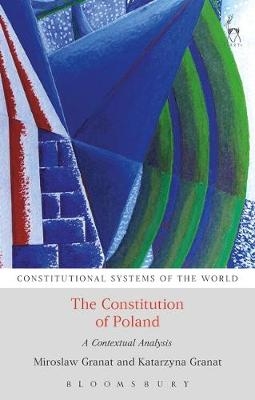
The Constitution of Poland
Hart Publishing (Verlag)
978-1-5099-1394-7 (ISBN)
In addition to explaining the 1997 Constitution in its political, historical, and social context, the book tackles the radical changes, in particular within the judicial branch, introduced by the new governing majority since 2015. These new regulations, constitutional in character, but without formally changing the Constitution, challenged the rule of law, a key component of membership in the European Union. Despite the negative nature of these recent developments, the anchoring of Polish constitutional law in European constitutionalism presents a source of optimism that the 1997 Constitution will regain its position as the supreme law of the state.
Miroslaw Granat is Professor of Constitutional Law at Cardinal Stefan Wyszynski University, Warsaw. He served as a Judge at the Polish Constitutional Court from 2007 to 2016. Katarzyna Granat is Junior Research Fellow and Marie Curie Fellow at Durham Law School.
1. Polish Constitutional History and Tradition
I. Introduction
II. Independence and Republicanism
III. Democratic Tradition
IV. Freedom in Polish Constitutionalism
V. The Evolution of Human Rights in Poland
VI. The Development – and Crisis – of Constitutional Review
VII. Conclusion
2. The Fundamental Principles of the Polish Constitution
I. Introduction
II. Key Principles of the Polish Constitution
III. Sources of Law
IV. The Functioning of the Constitution without a Formal Amendment
V. Conclusion
3. Parliament
I. Introduction
II. The Electoral System and the Composition of Parliament
III. The Impact of Political Parties on the Parliament
IV. The Functioning of Parliament in the Presence of Majority Governments and Weak Bicameralism
V. The Parliament and European Integration
VI. The Future of Poland’s Second Chamber
VII. Conclusion
4. The Executive
I. Introduction
II. The President
III. The Council of Ministers and Government Administration
IV. Conclusion
5. Judicial Power
I. Introduction
II. The Constitutional Structure of the Polish Courts
III. Independent Courts and Independent Judges as the Backbone of Judicial Power
IV. National Judges as EU Judges
V. Conclusion
6. Constitutional Review and Constitutional Accountability
I. Introduction
II. The Constitutional Court
III. Constitutional Accountability (Tribunal of State)
IV. Conclusion
7. Local Governance
I. Between a Civil Society and a Political State
II. Citizens as the Beneficiaries of Local Self-Government
III. Self-Government and Government Administration at the Local Level
IV. Difficulties in Oversight of Local Self-Government
V. Local Self-Government in the EU
VI. Conclusion
8. Constitutional Freedoms and Rights
I. Introduction
II. Three Bills of Rights
III. General Principles of Human Rights in Poland
IV. The Limited Scope of Individual Obligations
V. The Mechanisms of Protection of Fundamental Rights
VI. Conclusion
9. Facing the Future
I. Introduction
II. The Constitution in Action
III. The EU’s Response to the Judicial Crisis
IV. Constitutional Amendment Proposals under Discussion
V. The Role of Constitutional Identity in the Battle for the Constitution
VI. Conclusion
| Erscheinungsdatum | 16.01.2021 |
|---|---|
| Reihe/Serie | Constitutional Systems of the World |
| Verlagsort | Oxford |
| Sprache | englisch |
| Maße | 146 x 220 mm |
| Gewicht | 520 g |
| Themenwelt | Recht / Steuern ► Allgemeines / Lexika |
| Recht / Steuern ► EU / Internationales Recht | |
| Recht / Steuern ► Öffentliches Recht | |
| Sozialwissenschaften ► Politik / Verwaltung ► Staat / Verwaltung | |
| ISBN-10 | 1-5099-1394-7 / 1509913947 |
| ISBN-13 | 978-1-5099-1394-7 / 9781509913947 |
| Zustand | Neuware |
| Informationen gemäß Produktsicherheitsverordnung (GPSR) | |
| Haben Sie eine Frage zum Produkt? |
aus dem Bereich