Class (eBook)
John Wiley & Sons (Verlag)
978-1-119-39547-8 (ISBN)
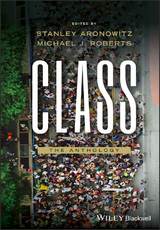
Using an innovative framework, this reader examines the most important and influential writings on modern class relations.
- Uses an interdisciplinary approach that combines scholarship from political economy, social history, and cultural studies
- Brings together more than 50 selections rich in theory and empirical detail that span the working, middle, and capitalist classes
- Analyzes class within the larger context of labor, particularly as it relates to conflicts over and about work
- Provides insight into the current crisis in the global capitalist system, including the Occupy Wall Street Movement, the explosion of Arab Spring, and the emergence of class conflict in China
STANLEY ARONOWITZ is Distinguished Professor of Sociology and Urban Education at the Graduate Center of the City University of New York, USA. He is also Director of the Center for the Study of Culture, Technology, and Work at the Graduate Center. He is the author of twenty-five books, including The Death and Life of American Labor: Toward a New Worker's Movement (2014); Taking It Big: C. Wright Mills and the Making of Political Intellectuals (2012); Against Schooling: For an Education that Matters (2008); Left Turn: Forging a New Political Future (2006); and How Class Works (2003).
MICHAEL JAMES ROBERTS is Associate Professor of Sociology at San Diego State University, USA. He is the author of Tell Tchaikovsky the News: Rock'n'Roll, the Labor Question and the Musicians' Union 1942-1968 (2014), which was nominated for the annual Mary Douglas Prize for Best Book by the American Sociological Association's section on culture. His work has also been published in the journals Critical Sociology, Race & Class, Rethinking Marxism, Mobilization, Popular Music, and The Sociological Quarterly.
Using an innovative framework, this reader examines the most important and influential writings on modern class relations. Uses an interdisciplinary approach that combines scholarship from political economy, social history, and cultural studies Brings together more than 50 selections rich in theory and empirical detail that span the working, middle, and capitalist classes Analyzes class within the larger context of labor, particularly as it relates to conflicts over and about work Provides insight into the current crisis in the global capitalist system, including the Occupy Wall Street Movement, the explosion of Arab Spring, and the emergence of class conflict in China
STANLEY ARONOWITZ is Distinguished Professor of Sociology and Urban Education at the Graduate Center of the City University of New York, USA. He is also Director of the Center for the Study of Culture, Technology, and Work at the Graduate Center. He is the author of twenty-five books, including The Death and Life of American Labor: Toward a New Worker's Movement (2014); Taking It Big: C. Wright Mills and the Making of Political Intellectuals (2012); Against Schooling: For an Education that Matters (2008); Left Turn: Forging a New Political Future (2006); and How Class Works (2003). MICHAEL JAMES ROBERTS is Associate Professor of Sociology at San Diego State University, USA. He is the author of Tell Tchaikovsky the News: Rock'n'Roll, the Labor Question and the Musicians' Union 1942-1968 (2014), which was nominated for the annual Mary Douglas Prize for Best Book by the American Sociological Association's section on culture. His work has also been published in the journals Critical Sociology, Race & Class, Rethinking Marxism, Mobilization, Popular Music, and The Sociological Quarterly.
General Introduction vii
How to Read This Book xvii
Part One The Working Class
1 Representing the Working Class 3
Michael J. Roberts
2 The Realm of Freedom and The Magna Carta of the Legally Limited Working Day 23
Karl Marx
3 Time, Work-Discipline, and Industrial Capitalism 27
E. P. Thompson
4 The Wages of Whiteness: Race and the Making of the American Working Class 41
David R. Roediger
5 A Living Wage: American Workers and the Making of Consumer Society 57
Lawrence B. Glickman
6 The Stop Watch and The Wooden Shoe: Scientific Management and the Industrial Workers of the World 69
Mike Davis
7 The Power of Women and the Subversion of the Community 79
Mariarosa Dalla Costa and Selma James
8 Ladies of Labor, Girls of Adventure: Working Women, Popular Culture, and Labor Politics at the Turn of the Twentieth Century 87
Nan Enstad
9 Three Strikes That Paved the Way 103
Art Preis
10 Jukebox Blowin' a Fuse: The Working-Class Roots of Rock-and-Roll 111
Michael J. Roberts
11 Labor's Time: Shorter Hours, the UAW, and the Struggle for American Unionism 125
Jonathan Cutler
12 The Unmaking of the English Working Class: Deindustrialization, Reification, and Heavy Metal 141
Ryan M. Moore
13 The Jobless Future: Sci-Tech and the Dogma of Work 151
Stanley Aronowitz and William DiFazio
14 Shiftless of the World Unite! 165
Robin D.G. Kelley
15 Occupy the Hammock: The Sign of the Slacker behind Disturbances in the Will to Work 171
Michael J. Roberts
Part Two The Middle Class
16 The Vanishing Middle 193
Stanley Aronowitz
17 The Struggle Over the Saloon 205
Roy Rosenzweig
18 The Salaried Masses: Duty and Distraction in Weimar Germany 221
Siegfried Kracauer
19 The Twilight of the Middle Class: Post-World War II American Fiction and White-Collar Work 229
Andrew Hoberek
20 The Rise of Professionalism: A Sociological Analysis 263
Magali Sarfatti Larson
21 The New Working Class 287
Serge Mallet
22 How the University Works: Higher Education and the Low-Wage Nation 299
Marc Bousquet
23 The Mental Labor Problem 315
Andrew Ross
24 Neoliberalism, Debt and Class Power 337
Justin Sean Myers
Part Three The Capitalist Class
25 The Capitalist Class: Accumulation, Crisis and Discipline 353
Michael J. Roberts
26 The Secret of Primitive Accumulation 383
Karl Marx
27 The Monied Metropolis: New York City and the Consolidation of the American Bourgeoisie, 1850-1896 393
Sven Beckert
28 Class Struggle and the New Deal: Industrial Labor, Industrial Capital, and the State 413
Rhonda F. Levine
29 Scientific Management 437
Harry Braverman
30 Labor and Franklin Delano Roosevelt's New Dream 449
Benjamin Kline Hunnicutt
31 Nixon's Class Struggle 467
Jefferson Cowie
32 The Global Reserve Army of Labor and the New Imperialism 485
John Bellamy Foster and Robert W. McChesney
33 The End of Retirement 503
Teresa Ghilarducci
34 The Politics of Austerity and the Ikarian Dream 513
Kristin Lawler
Selected Bibliography 519
Index 523
General Introduction
Stanley Aronowitz and Michael J. Roberts
This volume of documents, classic articles and original analysis by the editors remains controversial on several grounds. Despite the growing evidence that the global economy is dominated by a handful of leading corporations and the very rich individuals who control them, the conventional wisdom is that we live in a world of mom and pop enterprises. Accordingly, most citizens of the most industrially developed countries are termed “middle class.” For those who do not own their own businesses, we measure class by income and by consumption. Beneath this vast social group is the relatively small corps of the poor, a diminishing proportion of the population.
Mainstream political science insists that there is no ruling class or power elite in the functions of the state. Following the dictum, most forcefully established in the late 1950s by Yale political scientist Robert Dahl, whose book Who Governs? remains a bible for many, American politics consists of a plurality of organizations, including business, political parties, pressure groups on single issues, and unions, none of which, in advance, constitutes the leading edge of governance. This idea of American classlessness can be traced back to the immensely influential book Why There is No Socialism in the United States (1906) by the German economist and sociologist Werner Sombart. Sombart advanced the thesis that the workers were not a class in the European sense. They did not exhibit solidarity as a class because America is really the land of opportunity. It had no feudal tradition and possessed unlimited natural and economic resources. The urban political machines address and often solve the most pressing issues facing workers outside the workplace. Yet in subsequent years, especially the 1930s, 1940s and 1960s, American workers engaged in some of the sharpest strikes, factory occupations and demonstrations of any working class in advanced industrial capitalism, most of which were unauthorized by law.1 Even so, conventional social science remains adamant that class plays a subordinate or no role in the conduct of politics and the political economy. According to this view, the United States is a middle class society with a tiny stratum of the rich and a slightly larger underclass of the poor, who are declining over time. And the poor are poor because their families are dysfunctional or they lack the energy and the will to take advantage of prevailing opportunities to lift themselves out of poverty. Some anthropologists and sociologists advanced the theory that the poor wallow in a “culture of poverty” that effectively cuts them off from mainstream society. In the absence of outside intervention, either by the state or by private philanthropies this culture, it is held, is self‐reproducing. Among the leading scholars of this position were Daniel Patrick Moynihan and Nathan Glazer, whose book Beyond the Melting Pot stirred fierce debate in the 1960s when the question of poverty commanded the nation’s attention and became a subject of national policy.
However, the most disputed idea that underlies this project is that we declare that our societies are constituted by three classes: a capitalist ruling class consisting of the tycoons of finance, the top political managers, the corporate elite, and in the United States what C. Wright Mills termed the “warlords” at the pinnacle of the military; a middle class of small business owners and salaried professionals and technical operatives who still enjoy some autonomy in the performance of their work; and the working class, employed or not, with decent or low income, who have little or no control over their labor.2 More, we argue that class and class conflict has riven society throughout the history of capitalism and, indeed, constitutes how capitalism has developed. Capital accumulation is not an automatic process initiated solely by investment. It is spurred by economic and social struggles. When force does not work, the demands of labor are often met by capitalists through the introduction of job‐destroying technologies that may yield higher wages, but to fewer employees. Capitalism has penetrated agriculture in these societies, so that there is no longer a peasantry. Capitalist agriculture is almost entirely industrialized; it imposes a factory‐like division of labor, hours of work and forms of supervision. Most people who work the land are either a diminishing group of small producers, seasonal laborers on middle sized farms, many of whom are immigrants, often undocumented, or workers for giant agricultural corporations. The developing world, which still has billions of peasants – small owners, tenant farmers, subsistence farmers, workers on state or privately‐owned industrial farms – has experienced, over the last 40 years, an explosion in manufacturing industry. The primary site for the industrialization is China. Following the death in 1977 of Mao, the revolution’s key figure, the leadership of the Communist Party began a major program of industrialization. In predominantly peasant society, its first task was to create a working class. With a population of over a billion, it adopted the most extensive enclosure in human history. The expulsion of farm labor from the countryside made the parallel effort of the British seventeenth and eighteenth centuries look like a tea party. In the 1980s and 1990s, 150 million people were driven from the land into China’s major cities.3 There they were employed in construction, factories and urban service industries, and some remained unemployed pending economic expansion. Second, under state control, the government invited foreign private capital to establish industrial plants and other enterprises. Third, the state began a program of expanded vocational and higher education to train skilled workers, scientific and technical personnel and managers. In contrast to the years following the conquest of power in 1949, the party and the government were eager to learn from the capitalist West, and to import its technologies. For example, scientists, engineers and students were sent abroad to acquire knowledge and training in their respective fields and western consultants were brought to China to train the indigenous population in management skills and technical fields.
By 2000 China was already a major global industrial power. It quickly overtook western countries in the production of textiles, shoes and clothing, but moved beyond light manufacturing to heavy machinery such as construction vehicles, electronics (computers, telephones and other equipment), petrochemicals and, within a few years, automobiles. Much of its industrial production was destined for export; its main internal market was among the growing middle class of small producers and professionals. The regime retained a substantial state sector, but the emphasis on attracting private capital marked a new phase in the country’s history. China’s exports to the United States and Europe far exceeded its imports. By 2010, China was supplying inexpensive cars to the growing middle class of Southeast Asia and was beginning to penetrate the African and Latin American markets.
Working and living conditions in the private sector were, in the main, abysmal. The 1990s witnessed the beginning of a steady wave of worker protest against these conditions. Workers demanded higher wages, but also fought for decent working conditions and housing. The state permitted strikes and demonstrations against private sector employers, but strictly forbid industrial action against state enterprises. Its argument was that because the Chinese state is a workers’ state, workers cannot strike against themselves. Yet the past 20 years have been rife with class conflict. Since the early 1990s, official reports count the number of protests each year at about 7000; in recent years the number has reached nearly twice that amount.4 In some instances the government and the private employers have responded by instituting reforms. In other cases, conditions have not materially improved. Workers are often required to labor for 12–16 hours a day and occasionally are forced to spend 30 hours or more on the job. Beyond the factory the government’s vast urban development program has been met with resistance. As the government tore down thousands of residential buildings to make way for industrial plants and middle class housing, residents responded by what the official press termed “riots,” which obliged the authorities to promise relocation to alternative housing, a promise not always fulfilled. Will the great proletarian revolution break out in China?
Following World War Two, experts left, right and center have, with numbing regularity, declared the era of class and class struggle at an end. In the advanced societies, workers enjoyed rising living standards brought about by a combination of economic growth in Western Europe and North America and the legalization of collective bargaining and state‐sponsored social benefits. The strike weapon proved potent, providing upward pressure for change. While Europeans hesitate to call this phenomenon a symptom of the “bourgeoisification” of the working class, sociologists in the United Kingdom and the United States argued that workers had become “middle class” and the concept of struggle between classes was permanently overcome by welfare capitalism.5 State and private pensions insured the continuation of economic security beyond employment; unemployment compensation effectively tided over those temporarily afflicted by...
| Erscheint lt. Verlag | 3.7.2017 |
|---|---|
| Sprache | englisch |
| Themenwelt | Sozialwissenschaften ► Kommunikation / Medien ► Medienwissenschaft |
| Sozialwissenschaften ► Pädagogik ► Sozialpädagogik | |
| Sozialwissenschaften ► Soziologie ► Allgemeines / Lexika | |
| Sozialwissenschaften ► Soziologie ► Makrosoziologie | |
| Schlagworte | Austerity • blue collar • Capitalism • Class Relations • Cultural Studies • Intellectuals • Kulturwissenschaften • Labor • middle class • Philosophie • Philosophy • Political & Economic Philosophy • Politische u. Ökonomische Philosophie • Social History • Social Identity • socioeconomic • Sociology • Soziale Identität • Soziologie • Unions • White Collar • Working Class |
| ISBN-10 | 1-119-39547-X / 111939547X |
| ISBN-13 | 978-1-119-39547-8 / 9781119395478 |
| Informationen gemäß Produktsicherheitsverordnung (GPSR) | |
| Haben Sie eine Frage zum Produkt? |
 EPUB (Adobe DRM)
Kopierschutz: Adobe-DRM
Adobe-DRM ist ein Kopierschutz, der das eBook vor Mißbrauch schützen soll. Dabei wird das eBook bereits beim Download auf Ihre persönliche Adobe-ID autorisiert. Lesen können Sie das eBook dann nur auf den Geräten, welche ebenfalls auf Ihre Adobe-ID registriert sind.
Details zum Adobe-DRM
Dateiformat: EPUB (Electronic Publication)
EPUB ist ein offener Standard für eBooks und eignet sich besonders zur Darstellung von Belletristik und Sachbüchern. Der Fließtext wird dynamisch an die Display- und Schriftgröße angepasst. Auch für mobile Lesegeräte ist EPUB daher gut geeignet.
Systemvoraussetzungen:
PC/Mac: Mit einem PC oder Mac können Sie dieses eBook lesen. Sie benötigen eine
eReader: Dieses eBook kann mit (fast) allen eBook-Readern gelesen werden. Mit dem amazon-Kindle ist es aber nicht kompatibel.
Smartphone/Tablet: Egal ob Apple oder Android, dieses eBook können Sie lesen. Sie benötigen eine
Geräteliste und zusätzliche Hinweise
Buying eBooks from abroad
For tax law reasons we can sell eBooks just within Germany and Switzerland. Regrettably we cannot fulfill eBook-orders from other countries.
aus dem Bereich