Zum Hauptinhalt springen
Nicht aus der Schweiz? Besuchen Sie lehmanns.de
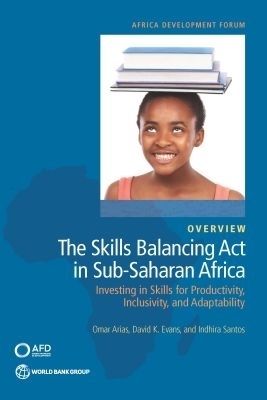
The Skills Balancing Act in Sub-Saharan Africa - Omar Arias, Indhira Santos, David K. Evans

The Skills Balancing Act in Sub-Saharan Africa

Investing in Skills for Productivity, Inclusivity, and Adaptability
Buch | Softcover
340 Seiten
2019
World Bank Publications (Verlag)
978-1-4648-1149-4 (ISBN)
CHF 62,85 inkl. MwSt
Nowhere in the world is skills building more vital than in Sub-Saharan Africa. While the region faces challenges similar to those faced by other regions at similar stages of development, its challenges are also unique. With economic, demographic, and technological changes, the world of work and production is rapidly changing. Multiple skills are needed in modernizing economies, including foundational cognitive and socio-emotional skills as well as technical skills. Yet, despite unprecedented progress getting more children into schools, Sub-Saharan African countries have significant gaps in skills formation. Child stunting rates remain stubbornly high and in most of the region there is a learning crisis. Skills investments in the region require a balancing act. Countries face hard choices to strike the right balance between investing in skills that meet the needs of today's highly informal and agrarian economies (e.g., basic skills to improve livelihoods) and investing in the skills needed to foster economic transformation (e.g., technical skills for catalytic sectors); and between investing in the skills for the current generation and in those for upcoming ones. While challenging, the region has opportunities for leap-frogging. There is today more rigorous evidence on interventions that work to improve learning, and Sub-Saharan Africa is often at the frontier of these innovations.

The World Bank came into formal existence in 1945 following the international ratification of the Bretton Woods agreements. It is a vital source of financial and technical assistance to developing countries around the world. The organization's activities are focused on education, health, agriculture and rural development, environmental protection, establishing and enforcing regulations, infrastructure development, governance and legal institutions development. The World Bank is made up of two unique development institutions owned by its 185 Member Countries. The International Bank for Reconstruction and Development (IBRD) focuses on middle income and creditworthy poor countries and the International Development Association (IDA), which focuses on the poorest countries in the world.

Erscheinungsdatum
Verlagsort Washington
Sprache englisch
Maße 149 x 226 mm
Gewicht 620 g
Themenwelt Sozialwissenschaften Pädagogik Berufspädagogik
Wirtschaft Betriebswirtschaft / Management Finanzierung
Wirtschaft Volkswirtschaftslehre Makroökonomie
ISBN-10 1-4648-1149-0 / 1464811490
ISBN-13 978-1-4648-1149-4 / 9781464811494
Zustand Neuware
Informationen gemäß Produktsicherheitsverordnung (GPSR)
Haben Sie eine Frage zum Produkt?
Mehr entdecken
aus dem Bereich