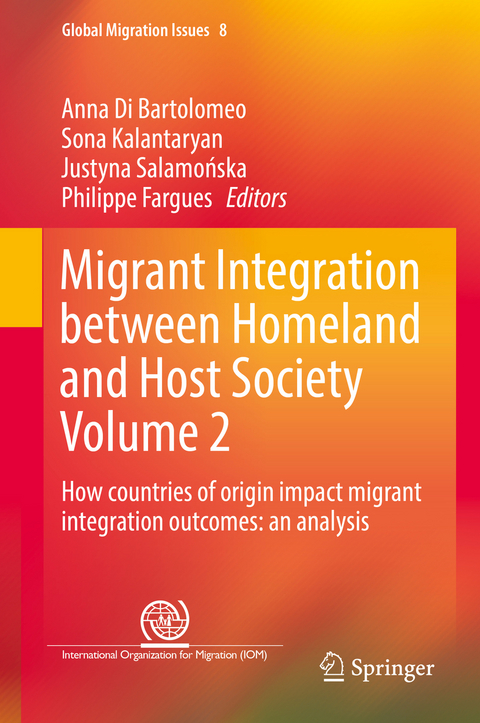
Migrant Integration between Homeland and Host Society Volume 2 (eBook)
X, 236 Seiten
Springer International Publishing (Verlag)
9783319563701 (ISBN)
This book provides solid empirical evidence into the role that countries and communities of origin play in the migrant integration processes at destination. Coverage explores several important questions, including: To what extent do policies pursued by receiving countries in Europe and the US complement or contradict each other? What effective contribution do they make to the successful integration of migrants? What obstacles do they put in their way?
This title is the second of two complementary volumes, each of which is designed to stand alone and provide a different approach to the topic. Here, renowned contributors present evidence from the studies of 55 origin countries on five continents and 28 countries of destination in Europe where both quantitative and qualitative research was conducted.
In addition, the chapters detail results of a unique worldwide survey of 900 organisations working on migrant integration and diaspora engagement. The results draw on an innovative methodology and new approaches to the analysis of large-scale survey data.
This examination into the tensions between integration policies and diaspora engagement policies will appeal to academics, policymakers, integration practitioners, civil society organisations, as well as students. Overall, the chapters provide empirical evidence that builds upon a theoretical framework developed in a complementary volume: Migrant integration between Homeland and Host society. Vol. 1. Where does the country of origin fit? by A. Unterreiner, A. Weinar. and P. Fargues.
Foreword by Philippe Fargues .- 1. Introduction by Anna Di Bartolomeo, Sona Kalantaryan, Justyna Salamońska .- 2. Introducing emigration and diaspora policies in integration studies by Anna Di Bartolomeo, Sona Kalantaryan, Justyna Salamońska, Cameron Thibos.- 3. Counting the uncountable – measuring migrant integration between origin and destination by Anna Di Bartolomeo, Sona Kalantaryan.- 4. Civil society organisations and the diaspora-integration nexus by Justyna Salamońska and Anne Unterreiner.- 5. Countries of origin as organisers of emigration: Moroccans and Turks in Belgium by Sonia Gsir, Jérémy Mandin, Elsa Mescoli.- 6. Asylum seekers in diaspora: Turks and Iranians in Sweden by Francesco Pasetti.- 7. Following the global competition for talent: what risks to integration in the UK?by Anne Unterreiner.- 8. Turkish and Russian pathways to integration in Germany by Agnieszka Weinar, Jan Scheider.- 9 Ukrainian and Russian immigrants in Poland: Whither Integration?by Magdalena Lesińska.- 10. Integration in Italy among selected migrant communities: does country of origin matter? by Anna Di Bartolomeo, Giuseppe Gabrielli, Salvatore Strozza.- 11. Historical vs. geographical proximity. The integration of Ecuadorian and Moroccan migrants in SpainMagdalena Lesińska.- 12. A Comparative Analysis of the Migration and Integration of Indian and Chinese Immigrants in the United States by Kate Hooper, Susanna Groves.- 13. Conclusions by Anna Di Bartolomeo, Sona Kalantaryan, Justyna Salamońska.
| Erscheint lt. Verlag | 10.7.2017 |
|---|---|
| Reihe/Serie | Global Migration Issues | Global Migration Issues |
| Zusatzinfo | X, 236 p. 18 illus. |
| Verlagsort | Cham |
| Sprache | englisch |
| Themenwelt | Sozialwissenschaften ► Soziologie ► Spezielle Soziologien |
| Schlagworte | Diaspora and emigration policies • Integration index • Interact project • International migration and integration policy • Multidimensional integration |
| ISBN-13 | 9783319563701 / 9783319563701 |
| Informationen gemäß Produktsicherheitsverordnung (GPSR) | |
| Haben Sie eine Frage zum Produkt? |
 PDF (Wasserzeichen)
DRM: Digitales Wasserzeichen
Dieses eBook enthält ein digitales Wasserzeichen und ist damit für Sie personalisiert. Bei einer missbräuchlichen Weitergabe des eBooks an Dritte ist eine Rückverfolgung an die Quelle möglich.
Dateiformat: PDF (Portable Document Format)
Mit einem festen Seitenlayout eignet sich die PDF besonders für Fachbücher mit Spalten, Tabellen und Abbildungen. Eine PDF kann auf fast allen Geräten angezeigt werden, ist aber für kleine Displays (Smartphone, eReader) nur eingeschränkt geeignet.
Systemvoraussetzungen:
PC/Mac: Mit einem PC oder Mac können Sie dieses eBook lesen. Sie benötigen dafür einen PDF-Viewer - z.B. den Adobe Reader oder Adobe Digital Editions.
eReader: Dieses eBook kann mit (fast) allen eBook-Readern gelesen werden. Mit dem amazon-Kindle ist es aber nicht kompatibel.
Smartphone/Tablet: Egal ob Apple oder Android, dieses eBook können Sie lesen. Sie benötigen dafür einen PDF-Viewer - z.B. die kostenlose Adobe Digital Editions-App.
Buying eBooks from abroad
For tax law reasons we can sell eBooks just within Germany and Switzerland. Regrettably we cannot fulfill eBook-orders from other countries.
aus dem Bereich