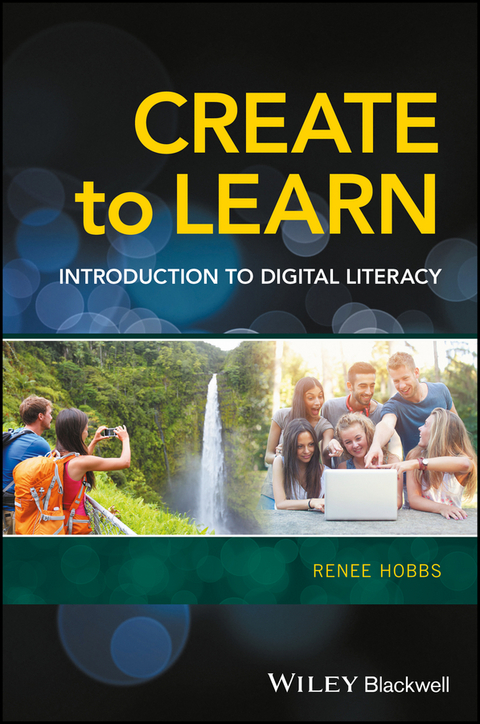
Create to Learn (eBook)
John Wiley & Sons (Verlag)
978-1-118-96837-6 (ISBN)

Want to learn something well? Make media to advance knowledge and gain new ideas.
You don't have to be a communication professional to create to learn. Today, with free and low-cost digital tools, everyone can compose videos, blogs and websites, remixes, podcasts, screencasts, infographics, animation, remixes and more. By creating to learn, people internalize ideas and express information creatively in ways that may inspire others.
Create to Learn is a ground-breaking book that helps learners create multimedia texts as they develop both critical thinking and communication skills. Written by Renee Hobbs, one of the foremost experts in media literacy, this book introduces a wide range of conceptual principles at the heart of multimedia composition and digital pedagogy. Its approach is useful for anyone who sees the profound educational value of creating multimedia projects in an increasingly digital and connected world.
Students will become skilled multimedia communicators by learning how to gather information, generate ideas, and develop media projects using contemporary digital tools and platforms. Illustrative examples from a variety of student-produced multimedia projects along with helpful online materials offer support and boost confidence.
Create to Learn will help anyone make informed and strategic communication decisions as they create media for any academic, personal or professional project.
Renee Hobbs is a Professor at Temple University's School of Communications and Theater in Philadelphia, where she founded the Media Education Lab. She holds a BA in English Literature and Film/Video Studies and an MA in Communication from the University of Michigan and an EdD from the Harvard Graduate School of Education. She teaches graduate and undergraduate courses in media literacy, digital authorship, children and media, media education and contemporary propaganda to students in Education, English, Communication Studies and Library and Information Studies.
Want to learn something well? Make media to advance knowledge and gain new ideas. You don t have to be a communication professional to create to learn. Today, with free and low-cost digital tools, everyone can compose videos, blogs and websites, remixes, podcasts, screencasts, infographics, animation, remixes and more. By creating to learn, people internalize ideas and express information creatively in ways that may inspire others. Create to Learn is a ground-breaking book that helps learners create multimedia texts as they develop both critical thinking and communication skills. Written by Renee Hobbs, one of the foremost experts in media literacy, this book introduces a wide range of conceptual principles at the heart of multimedia composition and digital pedagogy. Its approach is useful for anyone who sees the profound educational value of creating multimedia projects in an increasingly digital and connected world. Students will become skilled multimedia communicators by learning how to gather information, generate ideas, and develop media projects using contemporary digital tools and platforms. Illustrative examples from a variety of student-produced multimedia projects along with helpful online materials offer support and boost confidence. Create to Learn will help anyone make informed and strategic communication decisions as they create media for any academic, personal or professional project.
Renee Hobbs is a Professor at Temple University's School of Communications and Theater in Philadelphia, where she founded the Media Education Lab. She holds a BA in English Literature and Film/Video Studies and an MA in Communication from the University of Michigan and an EdD from the Harvard Graduate School of Education. She teaches graduate and undergraduate courses in media literacy, digital authorship, children and media, media education and contemporary propaganda to students in Education, English, Communication Studies and Library and Information Studies.
Title Page 5
Copyright Page 6
Contents 7
What to Expect in this Book 9
Part I Developing a Communication Strategy 11
Overview of Part I 11
Chapter 1 Create to Learn 13
Knowledge Matters 14
Literacy Matters 15
Learning Matters 16
Creating Media as a Way to Learn 18
Learning in College and Beyond 19
The Ethics of Digital Authorship 22
Digital Authorship: A Checklist 23
Activity: Reflect on Your Identity as a Digital Author 24
Chapter 2 Getting Creative 25
Play and Learning in Coursework 26
Create to Learn: A Five?Step Process 27
Where Creativity Comes From 29
Creative Constraints and Creative Control 32
Why Creative Constraints Promote Learning 32
The Creative Practice in Action 34
Creativity is an Act of Intellectual Freedom 35
Students and Teachers Create to Learn 36
Activity: Build a Creative Brief 37
Chapter 3 Decisions, Decisions 39
Strategic Communication Decisions 42
Rhetorical Modes: Purpose and Target Audience 42
Critically Analyzing Media to Understand Principles of Effective Design 44
Choosing the Medium 46
What Type of Media to Create? 54
Activity: Develop a Communication Strategy 54
Chapter 4 Accessing and Analyzing Ideas 55
Wondering about Makeup Tutorials 56
The Power of Inquiry 57
Knowledge Management 59
Analyzing and Evaluating Information 62
Learning to Think Like a Researcher 65
The Power of Representation to Shape the World 67
The Practice of Critical Reading 69
Five Critical Questions 71
Authors and Audiences 73
Messages and Meanings 73
Representation and Realities 74
Generating Ideas through Critical Analysis 77
Activity: Critically Analyze a Mentor Text 78
Chapter 5 Creating Ideas 79
Collaboration as Play 81
Standing on the Shoulders of Giants 83
Remix Creativity 85
Transformative Use 85
Unleashing the Power of Structure 89
Structuring Time 92
To Create is to be Seen 93
Deadlines and Prototyping 93
Tenacity and Persistence 94
Activity: Create a Scope of Work Plan 95
Chapter 6 Reflecting and Taking Action 97
Metacognition and Critical Reflection 99
Thick and Thin Engagement 100
Risks of Civic Participation 102
Reproducing the Status Quo or Challenging it 103
Internet Memes for Social Change 104
Talking Back to Media 106
Parody, Resistance, and Transgression 107
Social Action and the Multiperspectival Imagination 109
Reflection Activity: Dream It, Do It 110
Part II Nine Media Forms Help You Create to Learn 113
Overview of Part II 113
Chapter 7 Blogs and Web Sites 117
Blogs as Diary 119
Developing a Personal and Professional Voice 120
The Power of Hyperlinks 121
Designing Your Blog or Web Site 122
User Experience Considerations 123
Choosing Typefaces and Fonts 125
“About” Pages 126
Killer Headlines and Powerful Subheads 126
Clickbait and Online Economics 127
The Ethics of Blogging 128
Developing a Civic Identity through Blogging 130
Activity: Create Your Blog or Web Site 131
Chapter 8 Digital Audio and Podcasting 133
Theater of the Mind 134
Podcasting, Radio, and the Art of the Spoken Word 135
Entertainment, Emotion, and Social Commentary 136
Narrative Persuasion 136
Stories for Social Change 137
The Voice 138
Planning an Oral Performance 140
Audio Recording 141
The Art of Asking Questions 142
The Power of Sound and Music 143
Music is Magic 144
Vox Pop Interviews 145
Podcast Production 145
Representational Ethics 146
Activity: Create a Digital Story 146
Chapter 9 Images 149
The World in Images 151
What Makes a Great Photo? 151
The Emotional Truth of Photos 152
Truth, Beauty, and Emotional Valence 154
Structure Matters: The Rule of Thirds 156
The Power of Sequence: Why People Love Slideshows 156
Ambiguity and Specificity 158
Representational Ethics: Headlines and Captions 158
The Damage a Headline Can Do: A Research Study 160
Staging, Photo Editing, and Image Manipulation Ethics 160
The Instagram Revolution 163
Activity: Document a Place, a Person, or a Process 163
Chapter 10 Infographics and Data Visualization 165
Why Infographics Work 167
Controlling Attention with Dynamic Content 168
Controlling Attention with Comparison/Contrast 169
People’s Engagement with Visualization 171
Can You Trust an Infographic? 171
How to Make an Infographic in Five Easy Steps 172
Analyzing an Infographic 174
Information Economics 175
Where Does Data Come From? 177
The Ethics and the Economics of Information 177
Activity: Create an Infographic Resume 178
Chapter 11 Vlogs and Screencasts 179
Vlogging and Screencasting 181
Developing an Argument 181
A Short History of Online Video 183
Choices, Choices 184
Ethos and Performance: The Power of Personality 185
Participatory Complications 187
How to Create a Vlog 189
Screencasting in Education 190
How to Make a Screencast 192
Ethical Issues: Dealing with Feedback 193
Activity: Create a Screencast or Vlog 194
Chapter 12 Video Production 197
Amateur and Professional Video 199
The Personal Video Essay 202
“How To” and Educational Videos 203
Documentary Structure 205
Eyewitness Video: The Power of Actuality 207
How to Film a Live Event 208
The Ethics of Contemporary Propaganda 210
Film and Video as Forms of Advocacy 211
Activity: Create a Video of an Event 213
Chapter 13 Animation 215
Life as Story 216
Drawing as Abstraction 218
Education and the Imagination 219
Animation Styles 222
The Power of Animation 223
Non-Narrative Animation 225
Computer-Generated Animation 227
Animated Interviews 228
Activity: Create an Animation 229
Chapter 14 Remix Production 231
Swimming in a Sea of Media 232
Fans as Active Audiences 233
Cut-and-Paste Culture 234
Learning Through Imitation 236
Critical Distance and Affinity 237
Celebrating Media Culture 237
Why Pop Culture is Popular 239
Critiquing Media Culture 240
Intertextuality 242
Copyright, Remix and Fair Use 243
The Ethics of Memes 244
Balancing the Familiar and Unfamiliar 246
Activity: Create a Remix 246
Chapter 15 Social Media 249
Sharing as Relational Expression 250
Human Behavior Adjusts to Technologies 253
To Share or Not to Share: Understanding Virality 253
Measuring Impact 256
Privacy 256
Social Media for Civic Activism 257
Managing Social Media: Personal and Professional Life 259
Context Collapse 259
Activity: Develop a Social Media Campaign 260
Notes 261
Index 281
EULA 296
| Erscheint lt. Verlag | 22.6.2017 |
|---|---|
| Sprache | englisch |
| Themenwelt | Sozialwissenschaften ► Kommunikation / Medien ► Medienwissenschaft |
| Sozialwissenschaften ► Politik / Verwaltung | |
| Sozialwissenschaften ► Soziologie ► Empirische Sozialforschung | |
| Schlagworte | academic multimedia • Academic Projects • animation production • audience engagement • Berichterstattung, Schreiben u. Redaktion • Blogging • Communication & Media Studies • compose multimedia • create a video documentary • create a website • create blog • Create to Learn • creating a video public service announcement • creating ideas for multimedia productions • Creating multimedia productions • Digital Literacy • evaluate multimedia designs • guide to creating multimedia productions • guide to designing multimedia productions • handbook for creating multimedia • how to design multimedia productions • how to edit multimedia • how to polish multimedia • how to revise multimedia • Kommunikation u. Medienforschung • Media Education Lab • Media Literacy • Media Studies • Medienforschung • multimedia literacy • Neue Medien • New Media • Performance • remix production • Reporting, Writing & Editing • resource for creating multimedia • rules of designing multimedia • slideshow production • Speaking • video production • website production • Writing |
| ISBN-10 | 1-118-96837-9 / 1118968379 |
| ISBN-13 | 978-1-118-96837-6 / 9781118968376 |
| Informationen gemäß Produktsicherheitsverordnung (GPSR) | |
| Haben Sie eine Frage zum Produkt? |
 PDF (Adobe DRM)
Kopierschutz: Adobe-DRM
Adobe-DRM ist ein Kopierschutz, der das eBook vor Mißbrauch schützen soll. Dabei wird das eBook bereits beim Download auf Ihre persönliche Adobe-ID autorisiert. Lesen können Sie das eBook dann nur auf den Geräten, welche ebenfalls auf Ihre Adobe-ID registriert sind.
Details zum Adobe-DRM
Dateiformat: PDF (Portable Document Format)
Mit einem festen Seitenlayout eignet sich die PDF besonders für Fachbücher mit Spalten, Tabellen und Abbildungen. Eine PDF kann auf fast allen Geräten angezeigt werden, ist aber für kleine Displays (Smartphone, eReader) nur eingeschränkt geeignet.
Systemvoraussetzungen:
PC/Mac: Mit einem PC oder Mac können Sie dieses eBook lesen. Sie benötigen eine
eReader: Dieses eBook kann mit (fast) allen eBook-Readern gelesen werden. Mit dem amazon-Kindle ist es aber nicht kompatibel.
Smartphone/Tablet: Egal ob Apple oder Android, dieses eBook können Sie lesen. Sie benötigen eine
Geräteliste und zusätzliche Hinweise
Buying eBooks from abroad
For tax law reasons we can sell eBooks just within Germany and Switzerland. Regrettably we cannot fulfill eBook-orders from other countries.
aus dem Bereich