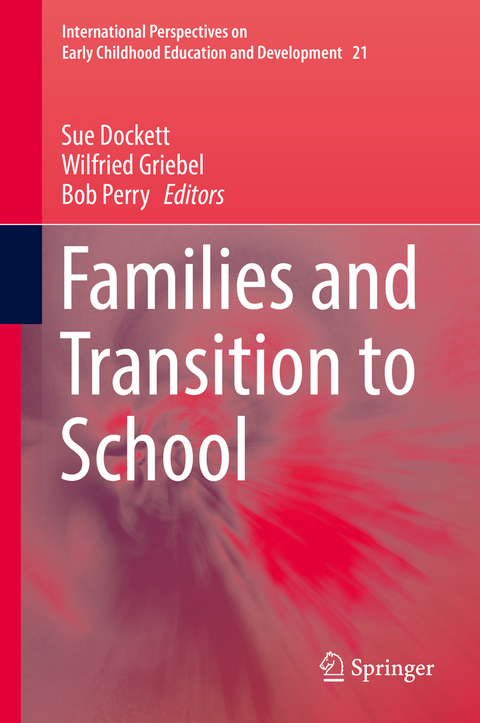
Families and Transition to School (eBook)
XV, 271 Seiten
Springer International Publishing (Verlag)
978-3-319-58329-7 (ISBN)
Contents 6
Contributors 8
Chapter 1: Transition to School: A Family Affair 17
1.1 Introduction 17
1.2 Defining Transition 18
1.3 Transition in Context 19
1.4 Exploring Transition 20
1.4.1 Transition as Movement 20
1.4.2 Events That Mark Transition 21
1.4.3 Processes of Transition 23
1.4.3.1 Proximal Processes 23
1.4.3.2 Routines as Processes 24
1.4.3.3 Transformational Processes 24
1.5 Families: More Than Context 25
1.6 Families and Transition 26
1.6.1 Home-School Connections 26
1.6.2 Families in Transition 29
1.7 In Summary 30
References 30
Part I: Experiences and Expectations of Families as Children Start School 35
Chapter 2: Transition to Being Parents of a School-Child: Parental Perspective on Coping of Parents and Child Nine Months After School Start 36
2.1 Theoretical Background 36
2.2 State of Research 37
2.3 Research Questions – Hypotheses 38
2.4 Method 39
2.4.1 Sample 39
2.4.2 Data Collection and Analysis 40
2.5 Results 41
2.5.1 Parents’ Awareness of Own Transition 41
2.5.2 Characteristics of ‘Positive Copers’ vs. ‘Negative Copers’ 42
2.5.2.1 Individual Level 43
2.5.2.2 Interactional Level 43
2.5.2.3 Contextual Level 43
2.6 Discussion and Conclusions 45
Appendix 47
References 49
Chapter 3: Giving Voice to Families from Immigrant and Refugee Backgrounds During Transition to School 52
3.1 Introduction 52
3.2 Theoretical Perspectives 53
3.3 Backpacks and Transitions 56
3.4 The Study 57
3.5 Perspectives 58
3.5.1 Sharing Teachers’ Perspectives 58
3.5.2 Giving Voice to Families 61
3.6 Conclusion: Easing the Load? 62
References 63
Chapter 4: Hope, Despair and Everything in Between – Parental Expectations of Educational Transition for Young Children with Intellectual Disability 65
4.1 Introduction 65
4.2 Theoretical Perspectives 66
4.3 Parental Expectations and Involvement in Educational Transitions – Previous Research 68
4.4 The Swedish Context and Project Description 70
4.5 Results 72
4.5.1 The Decision to Start School 73
4.5.1.1 Receiving the Correct Support 73
4.5.1.2 Belonging Within the Mainstream of Society 73
4.5.2 Smooth Transition 74
4.5.2.1 How to Bridge Knowledge 74
4.5.2.2 Knowledge to Be Bridged 75
4.5.3 Dualism in Expectations 76
4.5.3.1 Expectations of Professionalism 76
4.5.3.2 Worries About Increased Demands 76
4.5.3.3 Worries About Transportation and Information 77
4.6 Discussion 77
References 79
Chapter 5: ‘Everybody Has Got Their Own Story’: Urban Aboriginal Families and the Transition to School 81
5.1 Introduction 81
5.2 What Is Parent Involvement in Schools? 82
5.3 A Framework of Parent Involvement in Schools 83
5.4 Parent Involvement in Schools for Families of Aboriginal Children 84
5.5 The Rhetoric-Reality Gap 85
5.6 The Gudaga Study 86
5.6.1 Case Study 1 86
5.6.2 Case Study 2 88
5.6.3 Case Study 3 89
5.7 Discussion 91
5.8 Concluding Thoughts 93
References 94
Part II: Resources Families Bring to Transition to School 97
Chapter 6: Primary School Choice and the ‘Good’ Mother: Balancing Complex Support Needs and Responsibility 98
6.1 Introduction 98
6.2 School Choice 98
6.3 Good Mothers and School Choice 100
6.4 Background to the Research 101
6.5 Research Focus and Approach 102
6.5.1 Lydia 103
6.5.2 June 104
6.5.3 Andrea 105
6.6 Discussion 105
6.6.1 Possible Choices 106
6.6.2 Looking to the Future 107
6.6.3 Belonging 107
6.6.4 Networks 107
6.6.5 Family History 108
6.6.6 Responsibility 108
6.6.7 Emotional Work 109
6.6.8 Missing from the Data 109
6.7 Conclusion 110
References 111
Chapter 7: Connected Dynamics: Theoretical and Empirical Perspectives on Family Life and the Transition to School 114
7.1 Introduction 114
7.1.1 Family as an Original Sphere of Education 114
7.1.2 Good Education in a Networking Landscape 115
7.1.3 Optimising Education in Close Relationships 116
7.2 Case Study: Shaping the Transition to Primary School Within the Family 117
7.2.1 Theoretical Framework 118
7.2.2 Methodological Aspects 118
7.2.3 The Feltz Family 119
7.2.3.1 Portrait 119
7.2.3.2 Familial Practices as Practices of Transition 120
7.2.4 The Carter Family 122
7.2.4.1 Portrait 122
7.2.4.2 Familial Practices and the Transition to School 123
7.2.5 Cross-Case Theses and Findings 125
7.3 Conclusion 127
References 128
Chapter 8: ‘I Had a Grandfather Who Taught Me Everything’: Grandparents as Family Capital in Transition to School 130
8.1 Introduction 130
8.2 Grandparents as an Asset in Transition to School 131
8.3 Research Design 132
8.4 Results 133
8.4.1 Close Relationships 133
8.4.2 Support Provided by Grandparents 135
8.4.3 Inherited Intergenerational Assets 137
8.5 Conclusion 138
8.6 Epilogue 139
References 141
Chapter 9: School Choice and Parent Involvement Among Australian Children Starting School 143
9.1 Introduction 143
9.2 School Choice Policy and Practice 144
9.3 Reasons for Choice of School 146
9.4 School Choice and Parent Involvement 149
9.5 Conclusion and Future Directions 151
References 153
Part III: Parent and System Perspectives on Transition to School 156
Chapter 10: Parents’ Emotional and Academic Attitudes Towards Children’s Transition to Preschool Class – Dimensions of School Readiness and Continuity 157
10.1 Introduction 157
10.2 Children’s Transition from Preschool to School in Sweden 158
10.3 Parents in Transition 159
10.4 Transitions and School Readiness 160
10.5 Theoretical Framework 160
10.6 Method 162
10.7 Results 162
10.7.1 The Transition as a Big Change and a Critical Event 163
10.7.2 A Big, Competent Preschool Child Ready for Transition 163
10.7.3 A Small School Child in Need of Care 165
10.8 Discussion 166
10.8.1 An Emotional vs. An Academic Attitude Towards the Transition – Dimensions of Readiness and Continuity 167
10.8.2 Implications for Practice 169
References 169
Chapter 11: Transition to School from the Perspective of the Girls’ and Boys’ Parents 172
11.1 Introduction 172
11.2 Theoretical Perspectives 173
11.3 Transition to School 173
11.4 Gender and the Transition to School 174
11.5 Family Context and Transition to School 176
11.6 The Study 177
11.7 Results 178
11.7.1 Transition to School in the Opinion of Parents and Teachers 178
11.7.1.1 Parents’ Assessment of the Work of School 178
11.7.1.2 Parents’ Educational Expectations 178
11.7.1.3 Parental Anxiety Before School Start 179
11.7.1.4 Parental Involvement in Children’s Education as Perceived by Teachers 179
11.8 Conclusions 179
References 180
Chapter 12: Are We All Talking the Same Language? Parents, Practitioners and Teachers Preparing Children to Start School 183
12.1 Introduction 183
12.2 Starting School in England 184
12.3 The Early Years Foundation Stage and Transitions 184
12.4 Transition, Relationships and Adjustment 185
12.5 The English Political Readiness Discourse 186
12.6 The Case Study 186
12.7 Findings 189
12.7.1 Parents’, ECEC Practitioners’ and Teachers’ Beliefs About for What Children Are Being Prepared 189
12.7.2 Parents’, ECEC Practitioners’ and Teachers’ Relationships and Preparing Children for School and Year 1 192
12.7.2.1 Phase 1 Preparations for the Move from the ECEC Setting to the School Reception Class 192
12.7.2.2 Phase 2: The First Day in the Reception Class and Preparations for Year 1 194
12.8 Discussion 196
12.9 Conclusion 197
References 198
Part IV: Relationships and Collaboration 200
Chapter 13: Preparing to Start School: Parent and Early Childhood Educator Narratives 201
13.1 Introduction 201
13.2 Theoretical and Conceptual Framework 202
13.3 Methodology 203
13.3.1 Research Design 203
13.3.2 Site and Participants 203
13.3.3 Procedure 203
13.3.4 Data and Analysis 204
13.3.5 Ethical Considerations 204
13.4 Findings and Discussion 204
13.4.1 Matéo 204
13.4.2 Nicholas 205
13.4.3 Emma 206
13.4.4 School Readiness 207
13.4.5 Deficiency 209
13.4.6 Pedagogicalization 211
13.5 Conclusion 212
13.5.1 Limitations 213
13.5.2 Implications for Research, Policy, and Practice 213
References 214
Chapter 14: Partnering in the Periphery 217
14.1 Introduction 217
14.2 The Wider Research Project 219
14.3 The Conceptual Framework 219
14.4 Partnering at the Periphery 220
14.4.1 Background Information 220
14.4.2 Participants and Settings 221
14.5 Partnership at Site 1 221
14.5.1 Team Meetings 222
14.5.2 Working with Families 222
14.5.3 Team Meeting 2 223
14.5.4 Team Meeting 3 225
14.5.5 Final Team Meeting 226
14.6 Partnering in the Periphery 227
14.7 Conclusion 228
References 229
Chapter 15: The Transition to Primary School as a Challenge for Parents 231
15.1 Introduction 231
15.2 Background and the Current State of Research 232
15.2.1 Transition to Primary School – A Challenge for Parents 232
15.2.2 Collaboration for Helping Parents Cope with the Transition 233
15.3 Research Focus and Approach 236
15.4 Research Questions 237
15.5 Results 238
15.5.1 Activities, Levels and Settings of Collaboration Between ECECs, Primary Schools and Parents in the Transition Phase 238
15.5.1.1 Collaboration Setting I – Traditional Informative Collaboration 238
15.5.1.2 Collaboration Setting II: Informative Collaboration with Many Variants 240
15.5.1.3 Collaboration Setting III: Intensive Collaboration 240
15.5.2 Parents’ Transition Experience and Contentment 240
15.5.3 Perceived Effects of the Collaboration on How Parents Cope with the Transition 241
15.5.3.1 Results of the Parental Survey 241
Positive Aspects of Effects 241
Negative Aspects of Effects 243
Contentment 243
15.5.3.2 Results from the Interview “Example of Good Collaboration Practice in the Transition from ECEC to Primary School” 243
The Effects of Collaboration on How Parents Cope with School Transition 244
15.6 Conclusion 244
References 246
Chapter 16: Partnerships or Relationships: The Perspectives of Families and Educators 249
16.1 Introduction 249
16.2 Families Making the Transition to School 250
16.3 Family-Educator Partnerships 250
16.4 Theoretical Foundations 252
16.5 Research Design 252
16.6 Family Members’ Perspectives 252
16.7 Educators’ Perspectives 255
16.8 Relationships or Partnerships? 257
16.9 Future Directions 259
References 260
Chapter 17: Families and Transition: Transition and Families 264
17.1 Introduction 264
17.2 Family-Educator Relationships 266
17.3 Change for Families 269
17.4 Future Directions 271
17.4.1 Reconceptualising Family Engagement 271
17.4.2 Broader Understandings of Transition/Transition as Transformation? 272
17.5 Conclusion 274
References 275
| Erscheint lt. Verlag | 4.7.2017 |
|---|---|
| Reihe/Serie | International Perspectives on Early Childhood Education and Development | International Perspectives on Early Childhood Education and Development |
| Zusatzinfo | XV, 271 p. 12 illus. |
| Verlagsort | Cham |
| Sprache | englisch |
| Themenwelt | Sozialwissenschaften ► Pädagogik ► Vorschulpädagogik |
| Schlagworte | families of children with learning disabilities transition • gender and transition to school • grandparents and transition to school • immigrant and refugee families starting school • impact of families on transition to school • impact of transition to school on families • language and transition to school • partnerships between parents and educators • research, policy and practice on families transition to school • school choice • starting preschool class • starting primary school • urban Aboriginal families and the transition to school |
| ISBN-10 | 3-319-58329-8 / 3319583298 |
| ISBN-13 | 978-3-319-58329-7 / 9783319583297 |
| Informationen gemäß Produktsicherheitsverordnung (GPSR) | |
| Haben Sie eine Frage zum Produkt? |
 PDF (Wasserzeichen)
DRM: Digitales Wasserzeichen
Dieses eBook enthält ein digitales Wasserzeichen und ist damit für Sie personalisiert. Bei einer missbräuchlichen Weitergabe des eBooks an Dritte ist eine Rückverfolgung an die Quelle möglich.
Dateiformat: PDF (Portable Document Format)
Mit einem festen Seitenlayout eignet sich die PDF besonders für Fachbücher mit Spalten, Tabellen und Abbildungen. Eine PDF kann auf fast allen Geräten angezeigt werden, ist aber für kleine Displays (Smartphone, eReader) nur eingeschränkt geeignet.
Systemvoraussetzungen:
PC/Mac: Mit einem PC oder Mac können Sie dieses eBook lesen. Sie benötigen dafür einen PDF-Viewer - z.B. den Adobe Reader oder Adobe Digital Editions.
eReader: Dieses eBook kann mit (fast) allen eBook-Readern gelesen werden. Mit dem amazon-Kindle ist es aber nicht kompatibel.
Smartphone/Tablet: Egal ob Apple oder Android, dieses eBook können Sie lesen. Sie benötigen dafür einen PDF-Viewer - z.B. die kostenlose Adobe Digital Editions-App.
Buying eBooks from abroad
For tax law reasons we can sell eBooks just within Germany and Switzerland. Regrettably we cannot fulfill eBook-orders from other countries.
aus dem Bereich