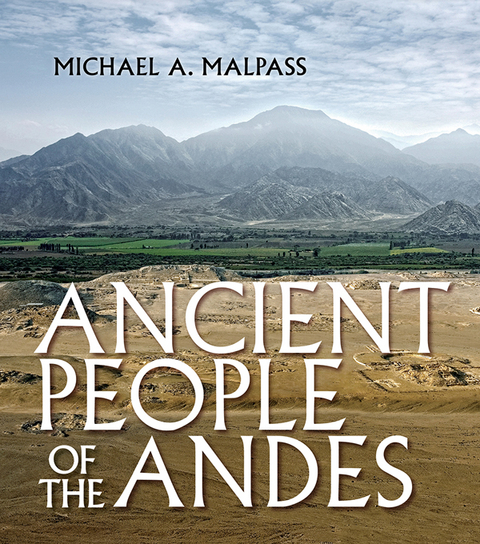
Ancient People of the Andes (eBook)
312 Seiten
Cornell University Press (Verlag)
978-1-5017-0392-8 (ISBN)
In Ancient People of the Andes, Michael A. Malpass describes the prehistory of western South America from initial colonization to the Spanish Conquest. All the major cultures of this region, from the Moche to the Inkas, receive thoughtful treatment, from their emergence to their demise or evolution.
In Ancient People of the Andes, Michael A. Malpass describes the prehistory of western South America from initial colonization to the Spanish Conquest. All the major cultures of this region, from the Moche to the Inkas, receive thoughtful treatment, from their emergence to their demise or evolution. No South American culture that lived prior to the arrival of Europeans developed a writing system, making archaeology the only way we know about most of the prehispanic societies of the Andes. The earliest Spaniards on the continent provided first-person accounts of the latest of those societies, and, as descendants of the Inkas became literate, they too became a source of information. Both ethnohistory and archaeology have limitations in what they can tell us, but when we are able to use them together they are complementary ways to access knowledge of these fascinating cultures.
Malpass focuses on large anthropological themes: why people settled down into agricultural communities, the origins of social inequalities, and the evolution of sociopolitical complexity. Ample illustrations, including eight color plates, visually document sites, societies, and cultural features. Introductory chapters cover archaeological concepts, dating issues, and the region's climate. The subsequent chapters, divided by time period, allow the reader to track changes in specific cultures over time.
In Ancient People of the Andes, Michael A. Malpass describes the prehistory of western South America from initial colonization to the Spanish Conquest. All the major cultures of this region, from the Moche to the Inkas, receive thoughtful treatment, from their emergence to their demise or evolution. No South American culture that lived prior to the arrival of Europeans developed a writing system, making archaeology the only way we know about most of the prehispanic societies of the Andes. The earliest Spaniards on the continent provided first-person accounts of the latest of those societies, and, as descendants of the Inkas became literate, they too became a source of information. Both ethnohistory and archaeology have limitations in what they can tell us, but when we are able to use them together they are complementary ways to access knowledge of these fascinating cultures.
Malpass focuses on large anthropological themes: why people settled down into agricultural communities, the origins of social inequalities, and the evolution of sociopolitical complexity. Ample illustrations, including eight color plates, visually document sites, societies, and cultural features. Introductory chapters cover archaeological concepts, dating issues, and the region's climate. The subsequent chapters, divided by time period, allow the reader to track changes in specific cultures over time.
Michael A. Malpass is Charles A. Dana Professor in the Social Sciences and Professor of Anthropology at Ithaca College. He is the author of Daily Life in the Inca Empire, editor of Provincial Inca: Archaeological and Ethnohistorical Assessment of the Impact of the Inca State, and coeditor of Distant Provinces in the Inka Empire: Toward a Deeper Understanding of Inka Provincialism.
1 Learning about the Past
2 Geography of the Central and South Andes
3 The Time Before Temples: The Early and Middle Preceramic Periods
4 Settling Down and Settling In: The Late Preceramic Period
5 Societal Growth and Differentiation: The Initial Period
6 Of Masks and Monoliths: The Early Horizon
7 Art and Power: The Early Intermediate Period
8 Clash of the Titans? Tiwanaku, Wari, and the Middle Horizon
9 Auca Runa, the Epoch of Warfare: The Late Intermediate Period
10 Expansion and Empire: The Inkas and the Late Horizon
| Zusatzinfo | 8-page color insert, 60 halftones, 43 line figures, 14 maps, 3 tables, 2 charts |
|---|---|
| Verlagsort | Ithaca |
| Sprache | englisch |
| Maße | 220 x 220 mm |
| Gewicht | 28 g |
| Themenwelt | Geisteswissenschaften ► Archäologie |
| Geschichte ► Allgemeine Geschichte ► Vor- und Frühgeschichte | |
| Sozialwissenschaften ► Ethnologie | |
| Sozialwissenschaften ► Pädagogik | |
| Sozialwissenschaften ► Soziologie | |
| Schlagworte | western South American, Spanish Conquest, ethnohistory, archeology, social inequalities, anthropology |
| ISBN-10 | 1-5017-0392-7 / 1501703927 |
| ISBN-13 | 978-1-5017-0392-8 / 9781501703928 |
| Informationen gemäß Produktsicherheitsverordnung (GPSR) | |
| Haben Sie eine Frage zum Produkt? |
 EPUB (Adobe DRM)
Kopierschutz: Adobe-DRM
Adobe-DRM ist ein Kopierschutz, der das eBook vor Mißbrauch schützen soll. Dabei wird das eBook bereits beim Download auf Ihre persönliche Adobe-ID autorisiert. Lesen können Sie das eBook dann nur auf den Geräten, welche ebenfalls auf Ihre Adobe-ID registriert sind.
Details zum Adobe-DRM
Dateiformat: EPUB (Electronic Publication)
EPUB ist ein offener Standard für eBooks und eignet sich besonders zur Darstellung von Belletristik und Sachbüchern. Der Fließtext wird dynamisch an die Display- und Schriftgröße angepasst. Auch für mobile Lesegeräte ist EPUB daher gut geeignet.
Systemvoraussetzungen:
PC/Mac: Mit einem PC oder Mac können Sie dieses eBook lesen. Sie benötigen eine
eReader: Dieses eBook kann mit (fast) allen eBook-Readern gelesen werden. Mit dem amazon-Kindle ist es aber nicht kompatibel.
Smartphone/Tablet: Egal ob Apple oder Android, dieses eBook können Sie lesen. Sie benötigen eine
Geräteliste und zusätzliche Hinweise
Buying eBooks from abroad
For tax law reasons we can sell eBooks just within Germany and Switzerland. Regrettably we cannot fulfill eBook-orders from other countries.
aus dem Bereich