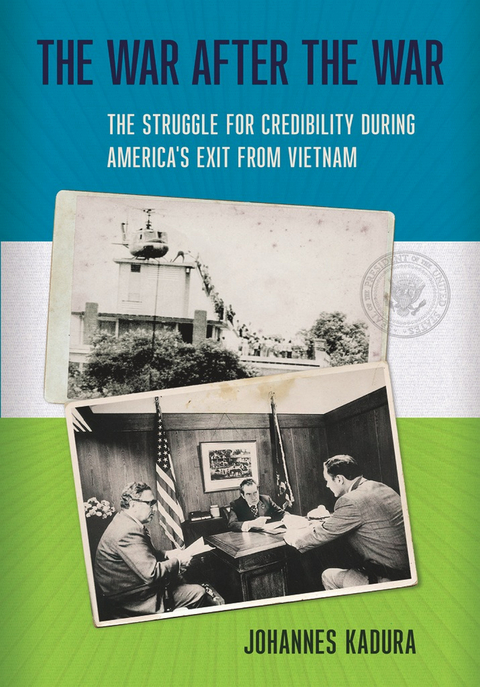
The War after the War (eBook)
248 Seiten
Cornell University Press (Verlag)
978-1-5017-0378-2 (ISBN)
In The War after the War, Johannes Kadura offers a fresh interpretation of American strategy in the wake of the cease-fire that began in Vietnam on January 28, 1973.
In The War after the War, Johannes Kadura offers a fresh interpretation of American strategy in the wake of the cease-fire that began in Vietnam on January 28, 1973. The U.S. exit from Vietnam continues to be important in discussions of present-day U.S. foreign policy, so it is crucial that it be interpreted correctly. In challenging the prevailing version of the history of the events, Kadura provides interesting correctives to the different accounts, including the ones of the key actors themselves, President Richard Nixon and Secretary of State Henry Kissinger foremost among them. In so doing, Kadura aims to forge a synthesis between orthodox and revisionist interpretations of this important period.Kadura finds that the strategy employed by Nixon and Kissinger centered on the concepts of "equilibrium strategy" and "insurance policy." That approach allowed them to follow a twofold strategy of making a major effort to uphold South Vietnam while at the same time maintaining a fallback strategy of downplaying the overall significance of Vietnam. Whether they won or lost on their primary bet to secure South Vietnam, Nixon and Kissinger expected to come through the crisis in a viable strategic position.
In The War after the War, Johannes Kadura offers a fresh interpretation of American strategy in the wake of the cease-fire that began in Vietnam on January 28, 1973. The U.S. exit from Vietnam continues to be important in discussions of present-day U.S. foreign policy, so it is crucial that it be interpreted correctly. In challenging the prevailing version of the history of the events, Kadura provides interesting correctives to the different accounts, including the ones of the key actors themselves, President Richard Nixon and Secretary of State Henry Kissinger foremost among them. In so doing, Kadura aims to forge a synthesis between orthodox and revisionist interpretations of this important period.
Kadura finds that the strategy employed by Nixon and Kissinger centered on the concepts of "equilibrium strategy" and "insurance policy." That approach allowed them to follow a twofold strategy of making a major effort to uphold South Vietnam while at the same time maintaining a fallback strategy of downplaying the overall significance of Vietnam. Whether they won or lost on their primary bet to secure South Vietnam, Nixon and Kissinger expected to come through the crisis in a viable strategic position.
Johannes Kadura is founding partner and managing director of Think Asia Group. He is also an Associate Fellow at the German Council on Foreign Relations and an Adjunct Professor at Peking University.
Introduction. Contingency Planning in Turbulent Times
1. The Strategy of the Cease-fire
2. The X Plus 60 Period
3. The Collapse of the Equilibrium Strategy
4. Going Down with Colors Flying
5. Ford and the Fall of Saigon
6. Beyond Defeat in Indochina
Conclusion. A Mixed Record
| Erscheint lt. Verlag | 1.2.2016 |
|---|---|
| Zusatzinfo | 5 halftones, 2 maps |
| Verlagsort | Ithaca |
| Sprache | englisch |
| Maße | 150 x 150 mm |
| Gewicht | 28 g |
| Themenwelt | Sachbuch/Ratgeber ► Geschichte / Politik ► 20. Jahrhundert bis 1945 |
| Geschichte ► Allgemeine Geschichte ► Neuzeit (bis 1918) | |
| Geschichte ► Allgemeine Geschichte ► Zeitgeschichte | |
| Geisteswissenschaften ► Geschichte ► Regional- / Ländergeschichte | |
| Geschichte ► Teilgebiete der Geschichte ► Militärgeschichte | |
| Sozialwissenschaften ► Politik / Verwaltung ► Europäische / Internationale Politik | |
| Schlagworte | Vietnam, America, Kissinger, U.S. foreign policy, Nixon, equilibrium strategy, insurance policy |
| ISBN-10 | 1-5017-0378-1 / 1501703781 |
| ISBN-13 | 978-1-5017-0378-2 / 9781501703782 |
| Informationen gemäß Produktsicherheitsverordnung (GPSR) | |
| Haben Sie eine Frage zum Produkt? |
 EPUB (Adobe DRM)
Kopierschutz: Adobe-DRM
Adobe-DRM ist ein Kopierschutz, der das eBook vor Mißbrauch schützen soll. Dabei wird das eBook bereits beim Download auf Ihre persönliche Adobe-ID autorisiert. Lesen können Sie das eBook dann nur auf den Geräten, welche ebenfalls auf Ihre Adobe-ID registriert sind.
Details zum Adobe-DRM
Dateiformat: EPUB (Electronic Publication)
EPUB ist ein offener Standard für eBooks und eignet sich besonders zur Darstellung von Belletristik und Sachbüchern. Der Fließtext wird dynamisch an die Display- und Schriftgröße angepasst. Auch für mobile Lesegeräte ist EPUB daher gut geeignet.
Systemvoraussetzungen:
PC/Mac: Mit einem PC oder Mac können Sie dieses eBook lesen. Sie benötigen eine
eReader: Dieses eBook kann mit (fast) allen eBook-Readern gelesen werden. Mit dem amazon-Kindle ist es aber nicht kompatibel.
Smartphone/Tablet: Egal ob Apple oder Android, dieses eBook können Sie lesen. Sie benötigen eine
Geräteliste und zusätzliche Hinweise
Buying eBooks from abroad
For tax law reasons we can sell eBooks just within Germany and Switzerland. Regrettably we cannot fulfill eBook-orders from other countries.
aus dem Bereich