


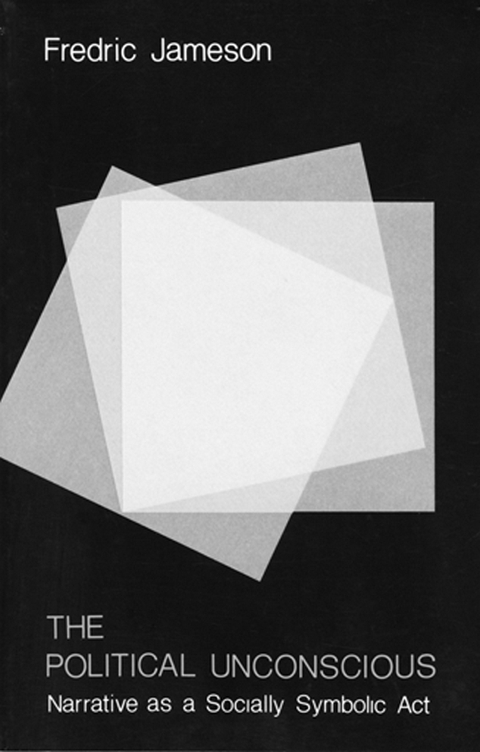
The Political Unconscious (eBook)
320 Seiten
Cornell University Press (Verlag)
978-0-8014-7156-8 (ISBN)
A masterly introduction to both the method and the practice of Marxist criticism. Defining a mode of criticism and applying it successfully to individual works, it bridges the gap between theoretical speculation and textual analysis.
"Monumental...Its learning and range of references are exceeded only be the imperial embrace of its complex argument, whose elaboration never imposes a sacrifice of clarity...Indispensable for all university and college libraries."—Choice
Fredric Jameson, in The Political Unconscious, opposes the view that literary creation can take place in isolation from its political context. He asserts the priority of the political interpretation of literary texts, claiming it to be at the center of all reading and understanding, not just a supplement or auxiliary to other methods current today.
Jameson supports his thesis by looking closely at the nature of interpretation. Our understanding, he says, is colored by the concepts and categories that we inherit from our culture's interpretive tradition and that we use to comprehend what we read. How then can the literature of other ages be understood by readers from a present that is culturally so different from the past? Marxism lies at the foundation of Jameson's answer, because it conceives of history as a single collective narrative that links past and present; Marxist literary criticism reveals the unity of that uninterrupted narrative.
Jameson applies his interpretive theory to nineteenth- and twentieth-century texts, including the works of Balzac, Gissing, and Conrad. Throughout, he considers other interpretive approaches to the works he discusses, assessing the importance and limitations of methods as different as Lacanian psychoanalysis, semiotics, dialectical analysis, and allegorical readings. The book as a whole raises directly issues that have been only implicit in Jameson's earlier work, namely the relationship between dialectics and structuralism, and the tension between the German and the French aesthetic traditions.
The Political Unconscious is a masterly introduction to both the method and the practice of Marxist criticism. Defining a mode of criticism and applying it successfully to individual works, it bridges the gap between theoretical speculation and textual analysis.
Fredric Jameson, in The Political Unconscious, opposes the view that literary creation can take place in isolation from its political context. He asserts the priority of the political interpretation of literary texts, claiming it to be at the center of all reading and understanding, not just a supplement or auxiliary to other methods current today.
Jameson supports his thesis by looking closely at the nature of interpretation. Our understanding, he says, is colored by the concepts and categories that we inherit from our culture's interpretive tradition and that we use to comprehend what we read. How then can the literature of other ages be understood by readers from a present that is culturally so different from the past? Marxism lies at the foundation of Jameson's answer, because it conceives of history as a single collective narrative that links past and present; Marxist literary criticism reveals the unity of that uninterrupted narrative.
Jameson applies his interpretive theory to nineteenth- and twentieth-century texts, including the works of Balzac, Gissing, and Conrad. Throughout, he considers other interpretive approaches to the works he discusses, assessing the importance and limitations of methods as different as Lacanian psychoanalysis, semiotics, dialectical analysis, and allegorical readings. The book as a whole raises directly issues that have been only implicit in Jameson's earlier work, namely the relationship between dialectics and structuralism, and the tension between the German and the French aesthetic traditions.
The Political Unconscious is a masterly introduction to both the method and the practice of Marxist criticism. Defining a mode of criticism and applying it successfully to individual works, it bridges the gap between theoretical speculation and textual analysis.
Fredric Jameson is Professor of French at Yale University. He is author of Marxism and Form; The Prison-House of Language; and Fables of Aggression: Wyndham Lewis, the Modernist as Fascist.
1. On Interpretation: Literature as a Socially Symbolic Act2. Magical Narratives: On the Dialectical Use of Genre Criticism3. Realism and Desire: Balzac and the Problem of the Subject4. Authentic Ressentiment: Generic Discontinuities and Ideologemes in the "Experimental" Novels of George Gissing5. Romance and Reification: Plot Construction and Ideological Closure in Joseph Conrad6. Conclusion: The Dialectic of Utopia and IdeologyIndex
| Erscheint lt. Verlag | 11.4.2014 |
|---|---|
| Verlagsort | Ithaca |
| Sprache | englisch |
| Maße | 140 x 140 mm |
| Themenwelt | Geisteswissenschaften ► Geschichte |
| Geisteswissenschaften ► Philosophie | |
| Geisteswissenschaften ► Sprach- / Literaturwissenschaft ► Anglistik / Amerikanistik | |
| Geisteswissenschaften ► Sprach- / Literaturwissenschaft ► Literaturwissenschaft | |
| Geisteswissenschaften ► Sprach- / Literaturwissenschaft ► Sprachwissenschaft | |
| Sozialwissenschaften | |
| Schlagworte | Adorno • always historicise • books about narratology • books for literary scholars • books on literary theory • books on rhetoric • communisim in literature • Communism and literature • critical theory in literature • dialectical thought • English literature • Genre Criticism • hermeneutics • historical context in literature • historicise • History of theory • How to Read Literature • introduction to literary theory • Linguistics • Literary Analysis • Literary criticism • Literary movements • Literary scholars • Literary Studies • Literary Theory • literature symbology • magical narrative • Marxist Criticism • marxist view on literature • Narration • narrative enterprises • Narratology • Negative theology • philosophical positions • philosophy of narrative • Phylosophy • plot construction • political interpretations • political theory history • political theory on literature • postmodern literature • rhetoric • Semiotics • simlacra and simulation • social symbology • social symbols • the powers of horror • The Sublime Object of Ideology • ways to read literature • what is narratology |
| ISBN-10 | 0-8014-7156-7 / 0801471567 |
| ISBN-13 | 978-0-8014-7156-8 / 9780801471568 |
| Informationen gemäß Produktsicherheitsverordnung (GPSR) | |
| Haben Sie eine Frage zum Produkt? |
 EPUB (Adobe DRM)
Kopierschutz: Adobe-DRM
Adobe-DRM ist ein Kopierschutz, der das eBook vor Mißbrauch schützen soll. Dabei wird das eBook bereits beim Download auf Ihre persönliche Adobe-ID autorisiert. Lesen können Sie das eBook dann nur auf den Geräten, welche ebenfalls auf Ihre Adobe-ID registriert sind.
Details zum Adobe-DRM
Dateiformat: EPUB (Electronic Publication)
EPUB ist ein offener Standard für eBooks und eignet sich besonders zur Darstellung von Belletristik und Sachbüchern. Der Fließtext wird dynamisch an die Display- und Schriftgröße angepasst. Auch für mobile Lesegeräte ist EPUB daher gut geeignet.
Systemvoraussetzungen:
PC/Mac: Mit einem PC oder Mac können Sie dieses eBook lesen. Sie benötigen eine
eReader: Dieses eBook kann mit (fast) allen eBook-Readern gelesen werden. Mit dem amazon-Kindle ist es aber nicht kompatibel.
Smartphone/Tablet: Egal ob Apple oder Android, dieses eBook können Sie lesen. Sie benötigen eine
Geräteliste und zusätzliche Hinweise
Buying eBooks from abroad
For tax law reasons we can sell eBooks just within Germany and Switzerland. Regrettably we cannot fulfill eBook-orders from other countries.
aus dem Bereich


