Intolerance (eBook)
328 Seiten
Hamilton Books (Verlag)
978-0-7618-6916-0 (ISBN)

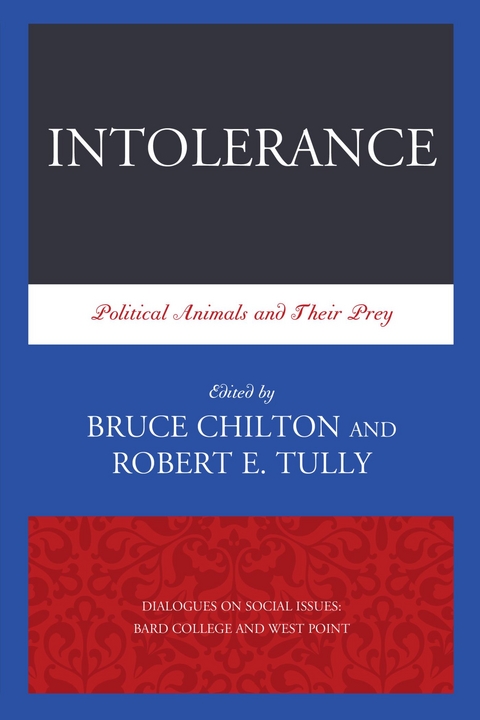
Aristotle accurately characterized humans as political animals. Whether through birth or from choice, people naturally cluster into groups for protection, advancement, and the pursuit of well-being. But Aristotle's description does not hint at the powerful binary tension within this human tendency. Leaders enhance a social group's sense of identity by appealing to the members' commitments and shared traditions, to their hopes, strengths, sacrifices, and fears. Often, however, they cultivate not only an awareness of difference but even a sense of superiority, since for every social group there are those outsider, the "e;them"e;. Maintaining a group's solidarity can too easily lead to the righteousness of intolerance towards those who are excluded. The reinforcement of group-identity in this way runs so deep in human nature that holding up a mirror to ourselves inevitably reveals a split image: the people we want to see and the people we're glad we're not. Intolerance: Political Animals and Their Prey presents stark examples of how the "e;us"e; have treated the "e;them"e;. The papers in this volume hold up various unflattering mirrors of intolerance from the areas of History, Law, Philosophy, Political Science, and Religion. The authors of these scholarly studies do not condemn. Rather, their research compels us to look at ourselves as the political animals we are. Intolerance: Political Animals and Their Prey is the product of a year-long multi-disciplinary collaboration between faculty members of Bard College and the United States Military Academy at West Point. The project involved parallel seminar courses at both institutions along with Joint Sessions, all focused on the central theme of intolerance, and culminated in a three-day academic Conference at Bard in the Spring of 2015. This volume inaugurates a new series being published by Hamilton Books under the general title, Dialogues on Social Issues: Bard College and West Point.
Bruce Chilton is Bernard Iddings Professor of Religion at Bard College. His books include Rabbi Jesus, A Galilean Rabbi and His Bible, The Temple of Jesus, Pure Kingdom, and Visions of the Apocalypse. He has written the first critical commentary on the Aramaic version of Isaiah (The Isaiah Targum).Robert Tully is Professor of Philosophy at the United States Military Academy and Professor Emeritus at the University of Toronto. He co-authored with Frederic Portoraro a textbook on symbolic logic and has published many articles on Russell, Moore and Wittgenstein. With Bruce Chilton and Jacob Neusner he edited Just War in Religion and Politics, to which he also contributed an essay.
Introduction, Bruce ChiltonPart I: WarfareBarbarians at the Gates: the Complexities, Contradictions and Concerns about Modern Asymmetrical Warfare, David Wallace and Cynthia MarshallWalzer Contra Walzer: Uncovering the Pluralist Roots of Walzer’s Just War Theory, Graham ParsonsThe Hegemon’s Dilemma: Power Intolerance from Ancient Athens to the United States of America, Scott A. SilverstoneMeans and Methods of Warfare: Towards an Objective Assessment for Selecting Military Targets—Beyond “Enemy Thinking”? Mirjam de BruinPart II: Internal divisionsFrom Slavery to Black Power: Racial Intolerance at West Point, 1778–2015, Ty SeiduleAll Men Are Created Equal: Misogyny under Law, Maritza RyanPart III: Religious intoleranceOn Religious (in)Tolerance, Nelly LahoudTheological Complicity in Religious Violence, Ellen T. Charry“And who is my neighbor?” American Liberators in Transnational Context, Stephen F. BarkerPoisoned Virtue: Child Sacrifice in Abrahamic Scriptures and Interpretation, Bruce ChiltonPart IV: Political and philosophical considerationsPlagues and Politics: Epidemics and “Re-Framing” in Modern American History, Andrew J. ForneyResidue of Intolerance: Polluting Civil Rights, Robert J. GoldsteinCynicism and Perennial Intolerance: Mendelssohn against the Decisionists, Dustin AtlasOvercoming Modernity and Violence, Gennady ShkliarevskyContrariety in Philosophy, Robert E. TullyWho Takes Whom to Tango: UN Neoliberal Peacebuilding in Sierra Leone, Darya Pushkina and Philippe Ch.-A. Guillot with Susanna AnEpilogue: A Taxonomy of Intolerance, Robert E. TullyList of contributorsIndex
| Erscheint lt. Verlag | 14.7.2017 |
|---|---|
| Reihe/Serie | Dialogues on Social Issues: Bard College and West Point |
| Sprache | englisch |
| Themenwelt | Geisteswissenschaften ► Philosophie ► Allgemeines / Lexika |
| Geisteswissenschaften ► Philosophie ► Ethik | |
| Geisteswissenschaften ► Religion / Theologie | |
| Sozialwissenschaften ► Ethnologie | |
| Sozialwissenschaften ► Politik / Verwaltung | |
| Sozialwissenschaften ► Soziologie | |
| Schlagworte | African Peacebuilding • Child sacrifice • Epidemics in America • International Humanitarian Law • Just War Theory • Philosophical Intolerance • Racial Discrimination |
| ISBN-10 | 0-7618-6916-6 / 0761869166 |
| ISBN-13 | 978-0-7618-6916-0 / 9780761869160 |
| Informationen gemäß Produktsicherheitsverordnung (GPSR) | |
| Haben Sie eine Frage zum Produkt? |
 EPUB (Adobe DRM)
Kopierschutz: Adobe-DRM
Adobe-DRM ist ein Kopierschutz, der das eBook vor Mißbrauch schützen soll. Dabei wird das eBook bereits beim Download auf Ihre persönliche Adobe-ID autorisiert. Lesen können Sie das eBook dann nur auf den Geräten, welche ebenfalls auf Ihre Adobe-ID registriert sind.
Details zum Adobe-DRM
Dateiformat: EPUB (Electronic Publication)
EPUB ist ein offener Standard für eBooks und eignet sich besonders zur Darstellung von Belletristik und Sachbüchern. Der Fließtext wird dynamisch an die Display- und Schriftgröße angepasst. Auch für mobile Lesegeräte ist EPUB daher gut geeignet.
Systemvoraussetzungen:
PC/Mac: Mit einem PC oder Mac können Sie dieses eBook lesen. Sie benötigen eine
eReader: Dieses eBook kann mit (fast) allen eBook-Readern gelesen werden. Mit dem amazon-Kindle ist es aber nicht kompatibel.
Smartphone/Tablet: Egal ob Apple oder Android, dieses eBook können Sie lesen. Sie benötigen eine
Geräteliste und zusätzliche Hinweise
Buying eBooks from abroad
For tax law reasons we can sell eBooks just within Germany and Switzerland. Regrettably we cannot fulfill eBook-orders from other countries.
aus dem Bereich