


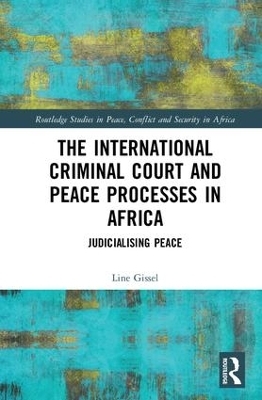
The International Criminal Court and Peace Processes in Africa
Judicialising Peace
Seiten
2018
Routledge (Verlag)
978-1-138-10401-3 (ISBN)
Routledge (Verlag)
978-1-138-10401-3 (ISBN)
Offers an interpretive account of how peace negotiators and mediators in peace processes in Uganda and Kenya sought to navigate the new terrain of international justice, while also tracing how and why international decision-making processes interfered with the negotiations, narrated the conflicts, and insisted on a narrow scope of justice.
The book investigates how involvement by the International Criminal Court (ICC) affects efforts to negotiate peace. It offers an interpretive account of how peace negotiators and mediators in two peace processes in Uganda and Kenya sought to navigate and understand the new terrain of international justice, while also tracing how and why international decision-making processes interfered with the negotiations, narrated the conflicts and insisted on a narrow scope of justice. Building on this interpretive analysis, a comparative analysis of peace processes in Uganda, Kenya and Colombia explores a set of general features pertaining to the judicialisation of peace.
Line Engbo Gissel argues that the level and timing of ICC involvement is key to the ICC’s impact on peace processes and explains why this is the case: a high level of ICC involvement during the negotiation phase of a peace process delegates politico-legal and discursive authority away from peace process actors, while a low level of ICC involvement during the negotiation phase retains such forms of authority at the level of the peace process. As politico-legal authority enables the resolution of sticking points and discursive authority constructs the conflict and its resolution, the location of authority is important for the peace process. Furthermore, judicialisation also affects the negotiation and implementation of a justice policy, with a narrowing scope for justice accompanying increasing levels of ICC involvement.
The book investigates how involvement by the International Criminal Court (ICC) affects efforts to negotiate peace. It offers an interpretive account of how peace negotiators and mediators in two peace processes in Uganda and Kenya sought to navigate and understand the new terrain of international justice, while also tracing how and why international decision-making processes interfered with the negotiations, narrated the conflicts and insisted on a narrow scope of justice. Building on this interpretive analysis, a comparative analysis of peace processes in Uganda, Kenya and Colombia explores a set of general features pertaining to the judicialisation of peace.
Line Engbo Gissel argues that the level and timing of ICC involvement is key to the ICC’s impact on peace processes and explains why this is the case: a high level of ICC involvement during the negotiation phase of a peace process delegates politico-legal and discursive authority away from peace process actors, while a low level of ICC involvement during the negotiation phase retains such forms of authority at the level of the peace process. As politico-legal authority enables the resolution of sticking points and discursive authority constructs the conflict and its resolution, the location of authority is important for the peace process. Furthermore, judicialisation also affects the negotiation and implementation of a justice policy, with a narrowing scope for justice accompanying increasing levels of ICC involvement.
Line Engbo Gissel is an Assistant Professor in the Department of Social Sciences and Business at Roskilde University, Denmark.
1. Introduction: International Justice and the Problem of Peace
2. Studying ICC Involvement: An Analytical Framework
3. ICC Involvement in the Juba Peace Talks
4. Narratives, Justice and the Return to War
5. ICC Involvement in the Kenya National Dialogue and Reconciliation
6. Political Authority, Justice and Power-Sharing
7. Impact of ICC Involvement in Uganda and Kenya: A Comparison
8. Conclusion: Understanding the Judicialisation of Peace
| Erscheinungsdatum | 20.04.2018 |
|---|---|
| Reihe/Serie | Routledge Studies in Peace, Conflict and Security in Africa |
| Zusatzinfo | 11 Tables, black and white; 6 Line drawings, black and white; 6 Illustrations, black and white |
| Verlagsort | London |
| Sprache | englisch |
| Maße | 156 x 234 mm |
| Gewicht | 440 g |
| Themenwelt | Recht / Steuern ► Allgemeines / Lexika |
| Recht / Steuern ► EU / Internationales Recht | |
| Sozialwissenschaften ► Politik / Verwaltung ► Europäische / Internationale Politik | |
| ISBN-10 | 1-138-10401-9 / 1138104019 |
| ISBN-13 | 978-1-138-10401-3 / 9781138104013 |
| Zustand | Neuware |
| Informationen gemäß Produktsicherheitsverordnung (GPSR) | |
| Haben Sie eine Frage zum Produkt? |
Mehr entdecken
aus dem Bereich


aus dem Bereich
kurze Geschichte einer langen Beziehung
Buch | Hardcover (2025)
Suhrkamp (Verlag)
CHF 36,40
Amerikas Strategie der Vorherrschaft und der Kampf um Eurasien
Buch | Softcover (2024)
NOMEN Verlag
CHF 27,95
erfolgreiche Interessenvertretung durch Prozesskompetenz im komplexen …
Buch | Hardcover (2023)
Wiley-VCH (Verlag)
CHF 58,75


