


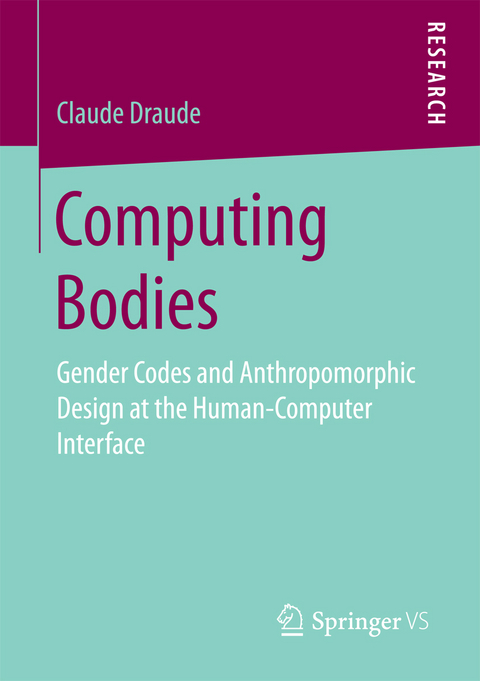
Computing Bodies (eBook)
IX, 210 Seiten
Springer Fachmedien Wiesbaden (Verlag)
978-3-658-18660-9 (ISBN)
Claude Draude analyzes embodied software agents - interface solutions that are designed to talk back and give emotional feedback - from a gender and media studies perspective. She addresses technological and sociocultural concepts in their interplay of shifting the boundary between what is considered as human and what as machine. The author discusses the technological realization of specific personality models that define the design of embodied software agents - emotion and gaze models, in particular. Finally, she explores these models in their broader cultural context by relating them to the prominent topic of the Turing test and the notion of the Uncanny Valley.
Prof. Dr. Claude Draude is head of the department for Gender/Diversity in Informatics Systems (GeDIS) at the Faculty of Electrical Engineering/Computing at the University of Kassel, Germany.
Prof. Dr. Claude Draude is head of the department for Gender/Diversity in Informatics Systems (GeDIS) at the Faculty of Electrical Engineering/Computing at the University of Kassel, Germany.
Contents 6
Figures 8
Introduction 9
A Personal Assistant 9
Notes on Research Material and Approach 14
1.The Interface 22
1.1. Reconsidering the Interface 22
1.2. Human-Computer Interface: Bridging the Gap – Establishing the Gap 28
1.3. The Embodied Agent Interface 37
1.3.1. Interface Metaphors 37
1.3.2. New Functionality, New Look: The Embodied Agent Interface 40
1.3.3. The Spark of Life 45
2.Reflections 52
2.1. Mirrors and Windows: Amplifying the Imaginary 52
2.1.1. The Changing Role of the Screen 52
2.1.2. Entering a Mathematical Wonderland 55
2.2. "The so-called mirror is always already coded." 73
2.2.1. The Interface as a Place of Sign/Signal Mediating 75
2.2.2. Principles of New Media Objects 82
2.3. Between Science and Fiction 87
2.3.1. Boundary Objects 87
2.3.2. Narrations 93
3.Realizing the Agent Interface 102
3.1. The Return of the Body 102
3.1.1. Addressing the Body 102
3.1.2. Bodies in Action 111
3.1.3. Agency: Embodiment and the Ability to Act 118
3.1.4. The Gender Generator 125
3.2. “Once more with feeling”: The Role of Emotions 131
3.2.1. The Computer as Affective Device 131
3.2.2. “The Agent that Walked Out of the Display…” 139
3.2.3. The OCC Model of Emotion 145
3.2.4. Alternative Approaches to Emotion 150
3.3. "The object stares back" 159
3.3.1. Beyond the Screen 159
3.3.2. Gaze Behavior in Embodied Conversational Agents 166
3.3.3. The Object Stares Back? Summing Up Thoughts on Gaze 173
4. Passing as Human 180
4.1. Uncanny Doppelgängers 180
4.1.1. The Uncanny Valley 180
4.1.2. Doubles 184
4.2. Counting as Machine – Counting as Human: Rereading the Turing Test 187
4.2.1. The Gender Imitation Game 187
4.2.2. Ambiguous Positions at Peril: The Case of Olimpia and the Virtual Human 191
Appendix 200
Bibliography 202
| Erscheint lt. Verlag | 13.6.2017 |
|---|---|
| Zusatzinfo | IX, 210 p. 35 illus. |
| Verlagsort | Wiesbaden |
| Sprache | englisch |
| Themenwelt | Sozialwissenschaften ► Kommunikation / Medien |
| Sozialwissenschaften ► Politik / Verwaltung | |
| Sozialwissenschaften ► Soziologie | |
| Schlagworte | Artificial Intelligence • Gender Studies • Human-Computer interaction • Media research • turing test • Uncanny Valley • virtual humans |
| ISBN-10 | 3-658-18660-7 / 3658186607 |
| ISBN-13 | 978-3-658-18660-9 / 9783658186609 |
| Informationen gemäß Produktsicherheitsverordnung (GPSR) | |
| Haben Sie eine Frage zum Produkt? |
 PDF (Wasserzeichen)
DRM: Digitales Wasserzeichen
Dieses eBook enthält ein digitales Wasserzeichen und ist damit für Sie personalisiert. Bei einer missbräuchlichen Weitergabe des eBooks an Dritte ist eine Rückverfolgung an die Quelle möglich.
Dateiformat: PDF (Portable Document Format)
Mit einem festen Seitenlayout eignet sich die PDF besonders für Fachbücher mit Spalten, Tabellen und Abbildungen. Eine PDF kann auf fast allen Geräten angezeigt werden, ist aber für kleine Displays (Smartphone, eReader) nur eingeschränkt geeignet.
Systemvoraussetzungen:
PC/Mac: Mit einem PC oder Mac können Sie dieses eBook lesen. Sie benötigen dafür einen PDF-Viewer - z.B. den Adobe Reader oder Adobe Digital Editions.
eReader: Dieses eBook kann mit (fast) allen eBook-Readern gelesen werden. Mit dem amazon-Kindle ist es aber nicht kompatibel.
Smartphone/Tablet: Egal ob Apple oder Android, dieses eBook können Sie lesen. Sie benötigen dafür einen PDF-Viewer - z.B. die kostenlose Adobe Digital Editions-App.
Buying eBooks from abroad
For tax law reasons we can sell eBooks just within Germany and Switzerland. Regrettably we cannot fulfill eBook-orders from other countries.
aus dem Bereich


