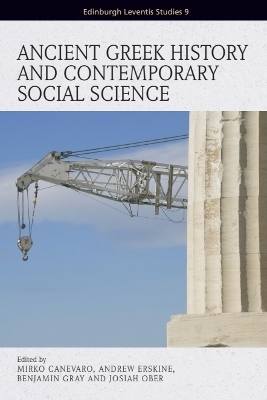
Ancient Greek History and Contemporary Social Science
Edinburgh University Press (Verlag)
978-1-4744-2177-5 (ISBN)
There is a long history of successful engagement between social science and classical studies. Social science has been a source of new and productive approaches to understanding ancient Greece, while classical Greek history and culture has been a touchstone for social theorists since the 19th century. This new collection of essays surveys the current state of the new field of ‘social science Greek history’ and demonstrates the potential of this interdisciplinary field.
Substantial bodies of work that have contributed in fundamental ways to our understanding of classical Greece and its cultural legacy were produced in 20th century, by employing methods from anthropology, sociology, and psychology. More recently, the use of quantitative methods and formal theory, drawn from contemporary political science, economics, and sociology, has led to a new understanding of ancient Greek economic and political development. Meanwhile, normative considerations, drawn from contemporary political philosophy, have led to a richer understanding of Greek political thought and Greek institutional innovations – notably including democracy and the rule of law.
Mirko Canevaro is Professor of Greek History at the University of Edinburgh. He has published extensively on the history of the Greek polis, particularly on Demosthenes and Athens (2013, 2016) and Aristotle's Politics (2014, 2022), on dynamics of honour and recognition, and on class struggle in the Grek polis. Andrew Erskine is Professor of Ancient History at the University of Edinburgh. Benjamin Gray is lecturer in Ancient History, Birkbeck, University of London and also, until August 2018, Alexander von Humboldt Research Fellow, Institut für Geschichtswissenschaften, Humboldt-Universität Berlin. Josiah Ober is Constantine Mitsotakis Professor in the School of Humanities and Sciences at Stanford University. He is the author of The Rise and Fall of Classical Greece (Princeton, 2015), Democracy and Knowledge: Innovation and Learning in Classical Athens (Princeton, 2008), Athenian Legacies: Essays on the Politics of Going on Together (Princeton, 2005), Political Dissent in Democratic Athens (Princeton, 1998), The Athenian Revolution (Princeton, 1996), Mass and Elite in Democratic Athens (Princeton, 1989), Fortress Attica (Brill, 1985). He is co-author of Origins of Democracy in Ancient Greece (University of California Press, 2007).
List of Contributors
Introduction
Section I: Theory and Method
1. Behavioural Economics and Economic Activity in Classical Athens, David Lewis
2. The City in Chorus: For a Choral History of Athenian Society, Vincent Azoulay and Paulin Ismard
3. Approaching the Hellenistic Polis through Modern Political Theory: the Public Sphere, Pluralism and Prosperity, Benjamin Gray
Section II: Institutions
4. Majority Rule vs. Consensus: the practice of democratic deliberation in the Greek poleis, Mirko Canevaro
5. Rethinking Mass and Elite: Decision-Making in the Athenian Law-Courts, Federica Carugati and Barry R. Weingast
6. Ancient and Modern Conceptions of the Rule of Law, Sara Forsdyke
7. What can Data drawn from the Hansen-Nielsen Inventory tell us about Political Transitions in Ancient Greece?, Robert K. Fleck and F. Andrew Hanssen
Section III: Behaviour
8. Patronage in Ancient Sparta, Ingvar B. Mæhle
9. Understanding the politics of Pericles around 450 BCE: the benefits of an economic perspective, Carl Hampus Lyttkens and Henrik Gerding
10. Cash and crowns: a network approach to Greek athletic prizes, Christian Mann
Section IV: Wealth, Poverty and Inequality
11. Property Security and its Limits in Classical Greece, Emily Mackil
12. Economic (in)equality and democracy: the political economy of poverty in Athens, Claire Taylor
13. The Distribution of Wealthy Athenians in the Attic Demes, James Kierstead and Roman Klapaukh
Section V: Interstate Relations
14. Exploring inter-community political activity in fourth-century Greece, Peter Liddel
15. Hegemonic Legitimacy (and its Absence) in Classical Greece, Polly Low
16. The Koinon Dogma, the Mercenary Threat, and the Consolidation of the Democratic Revolutions in mid 5th Century Sicily, David Teegarden
Section VI: Technology and Innovation
17. Muddle wrestling: grappling for conceptual clarity in archaic money, Peter van Alfen
18. Entanglement, Materiality, and the Social Organization of Construction Workers in Classical Athens, Diane Harris Cline
19. Technology and Society in Classical Athens: A study of the social context of mining and metallurgy at Laurion, Kim van Liefferinge
Overview: Greek history at a crossroads, John K. Davies
| Erscheinungsdatum | 04.10.2018 |
|---|---|
| Reihe/Serie | Edinburgh Leventis Studies |
| Zusatzinfo | 17 black and white illustrations, 26 colour illustrations, 4 black and white tables |
| Verlagsort | Edinburgh |
| Sprache | englisch |
| Maße | 156 x 234 mm |
| Gewicht | 1030 g |
| Themenwelt | Geschichte ► Allgemeine Geschichte ► Vor- und Frühgeschichte |
| Geisteswissenschaften ► Geschichte ► Geschichtstheorie / Historik | |
| Sozialwissenschaften ► Politik / Verwaltung ► Politische Theorie | |
| Sozialwissenschaften ► Soziologie ► Empirische Sozialforschung | |
| ISBN-10 | 1-4744-2177-6 / 1474421776 |
| ISBN-13 | 978-1-4744-2177-5 / 9781474421775 |
| Zustand | Neuware |
| Informationen gemäß Produktsicherheitsverordnung (GPSR) | |
| Haben Sie eine Frage zum Produkt? |
aus dem Bereich