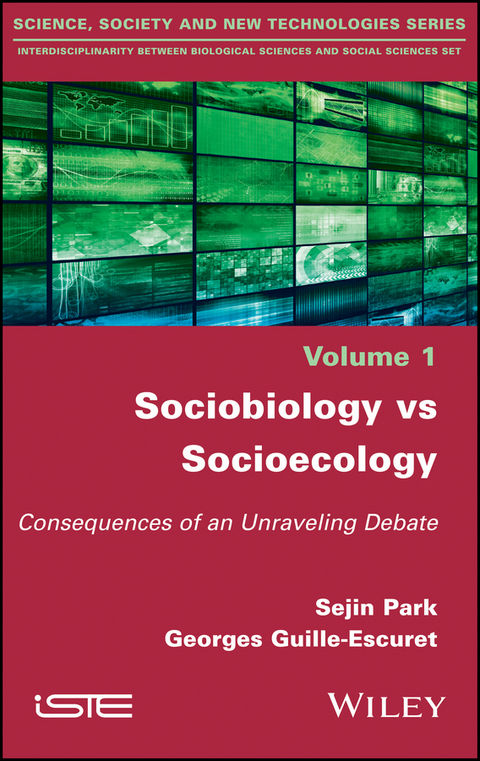
Sociobiology vs Socioecology (eBook)
John Wiley & Sons (Verlag)
978-1-119-42747-6 (ISBN)
Sejin Park, Seoul National University, South Korea. Georges Guille-Escuret, CNRS, France.
Introduction ix
Chapter 1 From Altruism to Sociobiology: Historical and Epistemological Summary 1
1.1 Introduction 1
1.2 The "social Darwinism" of the 19th Century 2
1.3 Reconquest of the quest: 20th Century social neo-Darwinism 9
1.4 Expansion, disintegration signs and recent defections 18
1.5 Missing or extra squares on the chessboard 23
1.5.1 Wilson's initial epistemological traffic: sociobiology and behavioral ecology 24
1.5.2 Communicating evasiveness: behavior, altruism, society, culture 26
1.5.3 Cut-short dispute and perverted controversy 34
1.6 Temporary theory and permanent fantasy: will sociobiology soon be superseded? 38
Chapter 2 The Illusory Endorsement of Insects: Omissions and Arbitrary Choices 41
2.1 Entomologic stronghold and the place of social insects 41
2.1.1 Natural advantages of social entomology 42
2.1.2 A rival society, accessible to experimentation 44
2.1.3 The extent of "societies" in insects 46
2.2 Organicism, superorganism and monospecific society 48
2.3 The beacon built by Wilson 50
2.3.1 Classification and social ranks 51
2.3.2 The enumeration of social births 54
2.4 Missing questions 56
2.5 Stigmergy versus haplodiploidy: a "choice of society"? 61
2.5.1 Stigmergy: from problematic to theory 62
2.5.2 Socioecological stigmergy versus sociobiological haplodiploidy 65
2.6 Subsequently emerged information 68
2.6.1 Thrips 69
2.6.2 Aphids 71
2.6.3 Termites, again 72
2.7 Polyethism, polyphenism and monomania 74
Chapter 3 Gray Langur Society and Chimpanzee Culture 77
3.1 Gray langur society shrunk to infanticide 78
3.1.1 Practical and theoretical parameters of the "case" 79
3.1.2 Strategic obsession and fact selection 82
3.1.3 From scorned comparison to repressed anthropology 86
3.2 Culture and chimpanzees 91
3.2.1 Bric-a-brac and difference in degrees 91
3.2.2 Distinction criterion and the surprise from chimpanzees 95
3.3 Non-natural selection of comparisons 100
Chapter 4 On the Specificity of Human Sociality 103
4.1 Logic of inbreeding avoidance in non-human primates 104
4.1.1 Facts 104
4.1.2 Westermarck effect: difficulties in the face of simian facts 107
4.1.3 Sexual avoidance as a social fact 110
4.2 Logic of the incest prohibition in humans 116
4.2.1 Kinship: a form of intersubjectivity specific to humans 117
4.2.2 Birth is a metaphor, and also incest 120
4.2.3 Incest prohibition as a struggle for recognition 125
4.3 Regarding sexual division of labor and food sharing 129
4.3.1 Sexual division of labor as struggle for recognition 130
4.3.2 Sharing and recognition 133
4.3.3 Failure of sociobiological explanations 135
4.4 Outline of a socioecological explanation 142
4.4.1 Forgotten issue: ownership 143
4.4.2 Ecological efficacy of the hunting-gathering regime 147
4.4.3 Evolutionary pertinence of the hunting-gathering regime 151
Chapter 5 The Sociobiological Force of Inertia and Socioecology Challenges: Conclusion 157
5.1 The meltdown of the debate 158
5.1.1 The disastrous confusion between the modes of discussion 159
5.1.2 The failure of sociobiology, demonstrated by Wilson 161
5.2 The epistemological obstacle behind the force of inertia 162
5.2.1 Ariadne's thread against history 164
5.2.2 Beanbag against interdependence 166
5.2.3 "All other things being equal" 168
5.2.4 Diagnosis on the force of inertia of sociobiology 169
5.3 Interaction, ecology and social sciences 171
5.4 Mutual respect, a condition of interdisciplinarity 174
5.5 Conclusion 176
Bibliography 179
Index 195
| Erscheint lt. Verlag | 17.5.2017 |
|---|---|
| Sprache | englisch |
| Themenwelt | Geisteswissenschaften ► Archäologie |
| Geschichte ► Allgemeine Geschichte ► Vor- und Frühgeschichte | |
| Sozialwissenschaften ► Ethnologie | |
| Sozialwissenschaften ► Soziologie ► Mikrosoziologie | |
| Schlagworte | Altruism • Anthropologie • Anthropology • arbitrary • Birth • Chimpanzee • Conclusion • Discipline • Endorsement • First • force • Gray • growing • Human • illusory • Inertia • insects omissions • intentions • Langur • Social & Cultural Anthropology • Sociality • Society • sociobiological • Sociobiology • Soziale u. kulturelle Anthropologie • specificity • theory |
| ISBN-10 | 1-119-42747-9 / 1119427479 |
| ISBN-13 | 978-1-119-42747-6 / 9781119427476 |
| Informationen gemäß Produktsicherheitsverordnung (GPSR) | |
| Haben Sie eine Frage zum Produkt? |
 EPUB (Adobe DRM)
Kopierschutz: Adobe-DRM
Adobe-DRM ist ein Kopierschutz, der das eBook vor Mißbrauch schützen soll. Dabei wird das eBook bereits beim Download auf Ihre persönliche Adobe-ID autorisiert. Lesen können Sie das eBook dann nur auf den Geräten, welche ebenfalls auf Ihre Adobe-ID registriert sind.
Details zum Adobe-DRM
Dateiformat: EPUB (Electronic Publication)
EPUB ist ein offener Standard für eBooks und eignet sich besonders zur Darstellung von Belletristik und Sachbüchern. Der Fließtext wird dynamisch an die Display- und Schriftgröße angepasst. Auch für mobile Lesegeräte ist EPUB daher gut geeignet.
Systemvoraussetzungen:
PC/Mac: Mit einem PC oder Mac können Sie dieses eBook lesen. Sie benötigen eine
eReader: Dieses eBook kann mit (fast) allen eBook-Readern gelesen werden. Mit dem amazon-Kindle ist es aber nicht kompatibel.
Smartphone/Tablet: Egal ob Apple oder Android, dieses eBook können Sie lesen. Sie benötigen eine
Geräteliste und zusätzliche Hinweise
Buying eBooks from abroad
For tax law reasons we can sell eBooks just within Germany and Switzerland. Regrettably we cannot fulfill eBook-orders from other countries.
aus dem Bereich