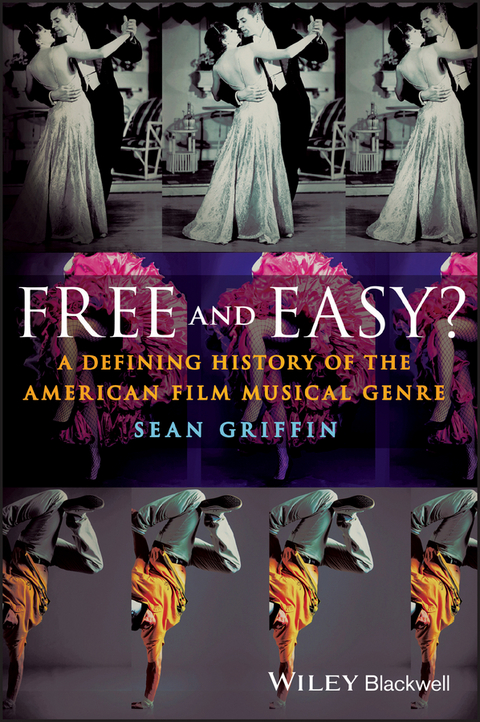
Free and Easy? (eBook)
John Wiley & Sons (Verlag)
978-1-118-32284-0 (ISBN)
A History of the American Musical narrates the evolution of the film musical genre, discussing its influences and how it has come to be defined; the first text on this subject for over two decades, it employs the very latest concepts and research.
- The most up-to-date text on the subject, with uniquely comprehensive coverage and employing the very latest concepts and research
- Surveys centuries of music history from the music and dance of Native Americans to contemporary music performance in streaming media
- Examines the different ways the film musical genre has been defined, what gets counted as a musical, why, and who gets to make that decision
- The text is written in an accessible manner for general cinema and musical theatre buffs, whilst retaining theoretical rigour in research
- Describes the contributions made to the genre by marginalized or subordinated identity groups who have helped invent and shape the musical
Sean Griffin is a Professor of Film and Media Arts at Southern Methodist University. He is the author of Tinker Belles and Evil Queens: The Walt Disney Company from the Inside Out (1999). He is the editor of Hetero: Queering Representations of Straightness (2009) and What Dreams Were Made of: Movie Stars of the 1940s (2011). He co-edited Queer Cinema, The Film Reader (with Harry M. Benshoff, 2005), and co-authored America on Film: Representing Race, Class, Gender and Sexuality at the Movies (Wiley Blackwell , 2009) and Queer Images: A History of Gay and Lesbian Film in America (2006).
A History of the American Musical narrates the evolution of the film musical genre, discussing its influences and how it has come to be defined; the first text on this subject for over two decades, it employs the very latest concepts and research. The most up-to-date text on the subject, with uniquely comprehensive coverage and employing the very latest concepts and research Surveys centuries of music history from the music and dance of Native Americans to contemporary music performance in streaming media Examines the different ways the film musical genre has been defined, what gets counted as a musical, why, and who gets to make that decision The text is written in an accessible manner for general cinema and musical theatre buffs, whilst retaining theoretical rigour in research Describes the contributions made to the genre by marginalized or subordinated identity groups who have helped invent and shape the musical
Sean Griffin is a Professor of Film and Media Arts at Southern Methodist University. He is the author of Tinker Belles and Evil Queens: The Walt Disney Company from the Inside Out (1999). He is the editor of Hetero: Queering Representations of Straightness (2009) and What Dreams Were Made of: Movie Stars of the 1940s (2011). He co-edited Queer Cinema, The Film Reader (with Harry M. Benshoff, 2005), and co-authored America on Film: Representing Race, Class, Gender and Sexuality at the Movies (Wiley Blackwell , 2009) and Queer Images: A History of Gay and Lesbian Film in America (2006).
Title Page 5
Copyright Page 6
Contents 7
Acknowledgments 9
Introduction 11
Chapter 1 Overture: Musical Traditions before Cinema 21
Music and Dance in Early America 22
The Development of American Theatre 25
The Rise of “American” Music 31
American Musical Theatre 34
Notes 39
Chapter 2 You Ain’t Heard Nothin’ Yet: The Sound Revolution 45
Sounding Out the Competition: Technological and Industrial Influence on Filming Musical Performance 46
On with the Show: Theatrical Influence on the Film Musical 51
Beyond the Blue Horizon: Early Film Musical Experiments 59
Other Voices: Minoritized Groups and the Emerging Film Musical Genre 63
Am I Blue? US Volatility in the Late 1920s 67
Notes 70
Chapter 3 Face the Music and Dance: The Depression 77
Blah Blah Blah: The Slump 77
A New Deal in Entertainment: Berkeley to the Rescue 80
Sweet Mysteries of Life: The Production Code 84
Out of the Red and Over the Rainbow: Surviving the Depression 90
Swing High, Swing Low: Blending/Competing Musical Styles 94
Notes 100
Chapter 4 Singing a Song of Freedom: World War II 107
Off to See the World: Musicals Prepare for War 107
All Out for Freedom: Musicals Help Deal with the War 111
Who’s a Yankee Doodle Dandy? American Diversity in the Wartime Musical 118
Notes 129
Chapter 5 There’s Beauty Everywhere: MGM and the Freed Unit 135
Musicals under the Classical Hollywood Studio System 136
Freed in the Classical Hollywood Studio System 139
The Freed Unit Style 142
Notes 153
Chapter 6 Something’s Gotta Give: The Postwar Musical 157
Jumping on the Band Wagon: The Ascendancy of Integration 158
“And then I wrote …”: Enshrining the “American Songbook” 166
It’s Always Fair Weather? Postwar Anxieties 169
Notes 181
Chapter 7 Bustin’ Out All Over: The Rise of the Musical Blockbuster 185
Love Me or Leave Me: The Breakup of the Studio System 185
In My Own Little Corner: The Arrival of Television 188
To Get the Public to Attend a Picture Show: Competing with Television 192
High as an Elephant’s Eye: The Epic Broadway Adaptation 196
Notes 204
Chapter 8 In a Minor Key: The B Musical and Beyond 207
Don’t Fence Me In: B Musicals of the 1930s and 1940s 208
Don’t Let Them Turn Our Love Song Turn Into a Blues: Marginalized Communities and Film Industries 213
Don’t Knock the Rock: Exploitation Musicals in the 1950s 220
Notes 230
Chapter 9 The Sound of Money: Musicals in the 1960s 235
W(h)ither? Rock and Film, 1960–1965 235
Hello, Folly! Blockbuster Musicals, 1965–1970 241
Born to Be Wild: Rock and Film, 1965–1970 251
Notes 255
Chapter 10 Whistling in the Dark: A Genre in Crisis 261
The Conventional Integrated Musical in an Age of Not Believing 262
Phantoms of Paradise: Rock and the Backstager 267
Life as a Cabaret: Deconstructing the Musical 274
Conclusion 283
Notes 283
Chapter 11 Can’t Stop the Music: Musicals and the New Hollywood 289
Stayin’ Alive: The Music Industry and the Film Musical in the Late 1970s 290
Cinematic Boogaloo: The Impact of Music Video 299
Notes 311
Chapter 12 Just Like Scheherezade: Reviving the Musical Film Genre 317
A Whole New World: The New Disney Animated Musical 318
God Help the Outcasts: Musicals in a Multicultural Era 323
Don’t Stop Believin’: The Musical on Television and Beyond 334
Notes 341
Index 345
EULA 379
| Erscheint lt. Verlag | 25.5.2017 |
|---|---|
| Sprache | englisch |
| Themenwelt | Kunst / Musik / Theater ► Film / TV |
| Kunst / Musik / Theater ► Musik ► Klassik / Oper / Musical | |
| Sozialwissenschaften ► Kommunikation / Medien ► Medienwissenschaft | |
| Schlagworte | Alice Faye • American film • American musical traditions • Amerikanische Filmkunst • beach party musicals • Betty Gable • Betty Hutton • Bing Crosby • Carmen Miranda • Chicago • Cultural Studies • deanna durbin • Eleanor Powell • Filmmusical • Frankie Avalon • Frank Sinatra</p> • Fred Astaire • Gene Kelly • Ginger Rogers • Grace Moore • hairspray • Hollywood • Jeanette MacDonald • Judy Garland • Kulturwissenschaften • <p>American musicals • Mama Mia! • MGM • Moulin Rouge! • Musical • musical productions • musical publishing • Musicals • musical traditions • My Fair Lady • Nelson Eddy • Oklahoma! • Rita Hayworth • Shirley Temple • Sonia Henie • The LIttle Mermaid • the musical blockbuster • the Postwar Musical |
| ISBN-10 | 1-118-32284-3 / 1118322843 |
| ISBN-13 | 978-1-118-32284-0 / 9781118322840 |
| Informationen gemäß Produktsicherheitsverordnung (GPSR) | |
| Haben Sie eine Frage zum Produkt? |
 PDF (Adobe DRM)
Kopierschutz: Adobe-DRM
Adobe-DRM ist ein Kopierschutz, der das eBook vor Mißbrauch schützen soll. Dabei wird das eBook bereits beim Download auf Ihre persönliche Adobe-ID autorisiert. Lesen können Sie das eBook dann nur auf den Geräten, welche ebenfalls auf Ihre Adobe-ID registriert sind.
Details zum Adobe-DRM
Dateiformat: PDF (Portable Document Format)
Mit einem festen Seitenlayout eignet sich die PDF besonders für Fachbücher mit Spalten, Tabellen und Abbildungen. Eine PDF kann auf fast allen Geräten angezeigt werden, ist aber für kleine Displays (Smartphone, eReader) nur eingeschränkt geeignet.
Systemvoraussetzungen:
PC/Mac: Mit einem PC oder Mac können Sie dieses eBook lesen. Sie benötigen eine
eReader: Dieses eBook kann mit (fast) allen eBook-Readern gelesen werden. Mit dem amazon-Kindle ist es aber nicht kompatibel.
Smartphone/Tablet: Egal ob Apple oder Android, dieses eBook können Sie lesen. Sie benötigen eine
Geräteliste und zusätzliche Hinweise
Buying eBooks from abroad
For tax law reasons we can sell eBooks just within Germany and Switzerland. Regrettably we cannot fulfill eBook-orders from other countries.
aus dem Bereich