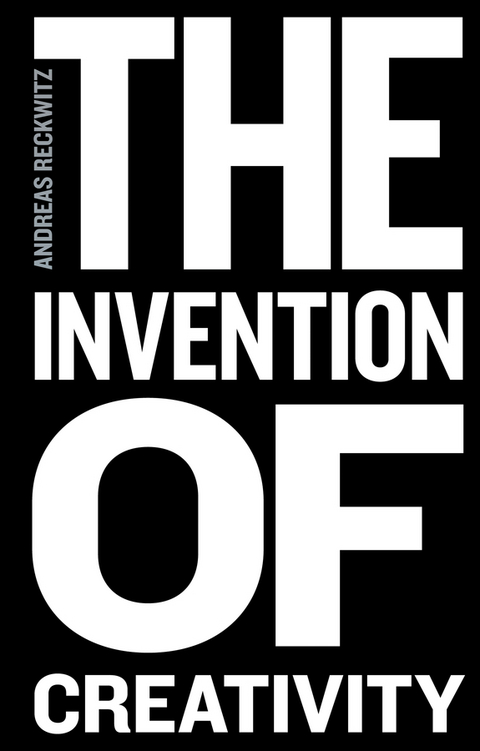
The Invention of Creativity (eBook)
John Wiley & Sons (Verlag)
978-0-7456-9707-9 (ISBN)
Contemporary society has seen an unprecedented rise in both the demand and the desire to be creative, to bring something new into the world. Once the reserve of artistic subcultures, creativity has now become a universal model for culture and an imperative in many parts of society.
In this new book, cultural sociologist Andreas Reckwitz investigates how the ideal of creativity has grown into a major social force, from the art of the avant-garde and postmodernism to the 'creative industries' and the innovation economy, the psychology of creativity and self-growth, the media representation of creative stars, and the urban design of 'creative cities'. Where creativity is often assumed to be a force for good, Reckwitz looks critically at how this imperative has developed from the 1970s to the present day. Though we may well perceive creativity as the realization of some natural and innate potential within us, it has rather to be understood within the structures of a very specific culture of the new in late modern society.
The Invention of Creativity is a bold and refreshing counter to conventional wisdom that shows how our age is defined by radical and restrictive processes of social aestheticization. It will be of great interest to those working in a variety of disciplines, from cultural and social theory to art history and aesthetics.
Andreas Reckwitz is Professor of Cultural Sociology at the European University Viadrina, Frankfurt (Oder).
Contemporary society has seen an unprecedented rise in both the demand and the desire to be creative, to bring something new into the world. Once the reserve of artistic subcultures, creativity has now become a universal model for culture and an imperative in many parts of society.In this new book, cultural sociologist Andreas Reckwitz investigates how the ideal of creativity has grown into a major social force, from the art of the avant-garde and postmodernism to the creative industries and the innovation economy, the psychology of creativity and self-growth, the media representation of creative stars, and the urban design of creative cities . Where creativity is often assumed to be a force for good, Reckwitz looks critically at how this imperative has developed from the 1970s to the present day. Though we may well perceive creativity as the realization of some natural and innate potential within us, it has rather to be understood within the structures of a very specific culture of the new in late modern society. The Invention of Creativity is a bold and refreshing counter to conventional wisdom that shows how our age is defined by radical and restrictive processes of social aestheticization. It will be of great interest to those working in a variety of disciplines, from cultural and social theory to art history and aesthetics.
Andreas Reckwitz is Professor of Cultural Sociology at the European University Viadrina, Frankfurt (Oder).
Contents
Preface to the English edition
Introduction: The Inevitability of Creativity
1. Aestheticisation and the creativity dispositif: The social regime of aesthetic novelty
2. Artistic creation, the genius and the audience: The formation of the modern artistic field
3. Centrifugal art: Dissolving the boundaries of art practices
4. The rise of the aesthetic economy: Permanent innovation, creative industries and the design economy
5. The psychological turn in creativity: From the pathological genius to the normalisation of the self as resource
6. The Genesis of the star system: The mass media construction of expressive individuality
7. Creative cities: Culturalising urban life
8. Society of creativity: Structures, dissonance, alternatives
Notes
Index
"Whether you think you are creative or not, you should read on. In carefully dissecting the social and historical constitution of this concept, Andreas Reckwitz provides a compelling account of how creativity has become a defining feature of contemporary society."
Elizabeth Shove, Lancaster University
"Reckwitz's The Invention of Creativity is not a "creative industries" book. It is instead a sociology that addresses not so much the aestheticization of society as the societalization of the aesthetic - of the pervasion of what Reckwitz, with Foucault, calls the aesthetic dispositif. Neither a dismissal nor a celebration, the book is instead a genealogy of creativity - of how homo economicus has metamorphosed into homo aestheticus."
Scott Lash, Goldsmiths, University of London
"An impressive study."
Die Zeit
"With great intelligence and an argument grounded in scholarship, cultural sociologist Andreas Reckwitz shows just why we perceive creativity as a 'natural' human ability, and one that we feel is absolutely essential in order for us to develop and grow as individuals."
Frankfurter Rundschau
"A fascinating and ambitious book with a provocative thesis."
Times Literary Supplement
Preface to the English Edition
The first German edition of this book appeared in 2012. This English translation provides the occasion to re-evaluate the book within the context of the Anglophone discussion around creativity and society that has been emerging since the beginning of the new millennium. An aspect of this re-evaluation is the question as to what degree the book reflects a specifically German context.
The role of creativity as a cultural blueprint and an economic factor in the formation of late modern society first emerged as an object of inquiry around 2000, particularly in Great Britain, North America and Australia, where it has remained prominent in discussion in sociology as well as in broader intellectual and political discourse. Two of these contexts are of particular note here. First, a mainly academic but also popular discourse has been taken up on the relevance of ‘creativity’ to the economic prosperity of contemporary societies, regions and cities and the emergence of a ‘creative class’ of producers and consumers. This discussion has also carried over into political consulting and urban planning.1 Second, research areas have developed in sociology and cultural studies dealing with the so-called creative industries, which have been spearheading this economic and social transformation. These industries encompass the audio-visual, print and digital media, as well as the arts and crafts, film, design, music, architecture and advertising. The abundant research in this field has been concerned mostly with the detailed analysis of creative labour and the cultural markets, the structural transformation of consumption and the global spread of the creative industries. It has also critically studied the increasingly global phenomenon of the state subsidising of the creative industries.2
The Invention of Creativity takes a step back from these sociological and economic analyses of the creative economy of the present and takes in a more historical and theoretical view of society as a whole. The book regards today's creative industries as the tip of a much bigger iceberg, which conceals below the surface a more fundamental and historically far-reaching transformation of modern Western society. The main claim of the book is the following: late modern society has been fundamentally transformed by the expectation and desire to be creative. What is meant here by creativity is the capacity to generate cultural and aesthetic novelty. Modern society has become geared to the constant production and reception of the culturally new. This applies to the economy, the arts, lifestyle, the self, the media, and urban development. We are witnessing the crystallization of what I have called a creativity dispositif, which is increasingly determining the shape of late modern society.
The term dispositif signals a certain influence coming from Michel Foucault. The book undertakes a genealogical analysis. I reach from the present back into the past, through the twentieth century as far back as the late eighteenth. Creativity is taken not as a given but, rather, as an enigma, as sexuality was for Foucault. How did creativity come to be accepted as a desirable norm? In which heterogeneous complexes of practices and discourses has the dispositif of creativity gradually been developing? The genealogical approach avoids economic reductionism. The economy is certainly one of the main places where the culture of the new develops – a complex I refer to in the book as aesthetic capitalism. Yet the scope of the creativity dispositif extends beyond that of the economy. It also takes in the internal dynamics of media technologies and the human sciences, above all psychology, with its techniques of the self. Since the 1980s, the dispositif has also been propped up by state control in the form of what I have called cultural governmentality, urban planning being among the most conspicuous examples of this. Yet political reductionism must also be avoided. As such, the study undertaken here is not orthodoxly Foucauldian. It is concerned less with revealing the creativity dispositif as a new system of domination than it is with working out the internal dynamics and the internal contradictions of what can be called the society of creativity. For my line of argument, the following point is crucial: in modern culture, the orientation towards creativity began in romanticism in the marginalized niche of the arts. Ever since, it has been spreading to more and more parts of society. Sociology therefore has to take the field of the arts more seriously than it did in the past. The arts do not merely watch from the sidelines; instead, they are a structural blueprint for late modern society as a whole.
In this process, the tension between an anti-institutional desire for creativity and the institutionalized demand for creativity has continued to mount to the present day and has now become acute. For this reason, it is important to take seriously the affective dimension of the creativity dispositif, the importance of aesthetic practices in contemporary society, the existence of what I have termed aesthetic sociality, and the way the dispositif directs audiences’ sensuous, affective attention. These aspects have been left underexposed by the tradition following Foucault. Yet they need to be brought to light if we are to be able to take up a critical stance towards the society of creativity.
But we have still not answered the question ‘Is the book informed by a specifically German perspective or not?’ While it was being written, the question did not occur to me, but it comes up now as the book is presented to an Anglophone readership. I completed part of my studies in Great Britain in the 1990s, and my approach has since then been strongly influenced by the international, Anglophone and also Francophone discussion in social theory and cultural sociology. Moreover, the creativity dispositif embraces a diversity of phenomena that have assumed international dimensions, having become a major force shaping society, whether in London, New York, Copenhagen, Amsterdam, Melbourne or Berlin. This internationalism tends to mute the specifically German accent of the book altogether. Nevertheless, there remains a certain German timbre which likely has three main sources.
First, German sociology is strongly characterized by a fundamental interest in theorizing modernity. This stretches from Max Weber and Georg Simmel to Jürgen Habermas's The Philosophical Discourse of Modernity and Ulrich Beck's work on the society of risk. The theory of modernity is also a key concern of the present book. A characteristic of this tradition is that it equates modernity a priori not with capitalism but rather with what it calls ‘formal rationalization’ and ‘social differentiation’. Underlying the book is a re-engagement with these two concepts: the late modern creativity dispositif pushes modernity's optimization imperative to the limit, while at the same time it is driven by a deeply anti-rational affectivity. Further, the sociality of creativity is manifest in a broad spectrum of heterogeneous, occasionally autonomous social spheres ranging from the arts to economics, human sciences and the mass media. In each case it manifests in different ways, yet always as part of the one overall structure.
Second, the discourse of the aesthetic in philosophy and the humanities, or Geisteswissenschaften, has also influenced the book. Since Kant and Schiller, German philosophy has been intensely concerned with the aesthetic as an autonomous sphere of social practice. More importantly, the interdisciplinary humanities in the German-speaking world since the 1980s have gone outside the narrow confines of these idealist aesthetics to bring to light the social importance of aesthetic practices and their mediality, as well as the way in which they structure perception and feeling, thus recognizing the power of aestheticization in late or postmodernity.3 Noteworthy in this context is also the prominence of German media theory. These newer branches of interdisciplinary German humanities (as distinct from what is generally understood in English as Cultural Studies) have significantly influenced the book's account of the creativity dispositif as a specific manifestation of aestheticization. One effect of this influence has been the reframing of the question of the relation between social modernity and aesthetic modernity.
The third German-language context from which the book originated is more difficult to outline because it is strictly contemporary. Since the mid-2000s, the members of a new generation of German social and cultural theorists have been working independently of one another to produce a series of studies adopting a new approach to the critical examination of late modern society and culture. Just as there has emerged since 2000 a new ‘Berlin school’ in German film, undertaking a uniquely sociological, microscopic inspection of the complexity of contemporary life,4 so too are emerging the contours of a ‘new German critical analysis’ in social and cultural theory, taking a macroscopic view of late modern culture. Ulrich Bröckling's The Entrepreneurial Self, Hartmut Rosa's Social Acceleration and Joseph Vogl's The Specter of Capital can be counted among this movement. I see The Invention of Creativity as also situated within it.5 These books are certainly distinct from one another thematically and methodologically. Yet they share in common an interest in...
| Erscheint lt. Verlag | 30.5.2017 |
|---|---|
| Übersetzer | Steven Black |
| Sprache | englisch |
| Themenwelt | Sozialwissenschaften ► Soziologie ► Allgemeine Soziologie |
| Schlagworte | Aesthetics • Creativity • Cultural Studies • Cultural Studies Special Topics • Gesellschaftstheorie • Innovation • Kultursoziologie • Kulturwissenschaften • Social Theory • Sociology • Sociology of Culture • Soziologie • Spezialthemen Kulturwissenschaften |
| ISBN-10 | 0-7456-9707-0 / 0745697070 |
| ISBN-13 | 978-0-7456-9707-9 / 9780745697079 |
| Informationen gemäß Produktsicherheitsverordnung (GPSR) | |
| Haben Sie eine Frage zum Produkt? |
 EPUB (Adobe DRM)
Kopierschutz: Adobe-DRM
Adobe-DRM ist ein Kopierschutz, der das eBook vor Mißbrauch schützen soll. Dabei wird das eBook bereits beim Download auf Ihre persönliche Adobe-ID autorisiert. Lesen können Sie das eBook dann nur auf den Geräten, welche ebenfalls auf Ihre Adobe-ID registriert sind.
Details zum Adobe-DRM
Dateiformat: EPUB (Electronic Publication)
EPUB ist ein offener Standard für eBooks und eignet sich besonders zur Darstellung von Belletristik und Sachbüchern. Der Fließtext wird dynamisch an die Display- und Schriftgröße angepasst. Auch für mobile Lesegeräte ist EPUB daher gut geeignet.
Systemvoraussetzungen:
PC/Mac: Mit einem PC oder Mac können Sie dieses eBook lesen. Sie benötigen eine
eReader: Dieses eBook kann mit (fast) allen eBook-Readern gelesen werden. Mit dem amazon-Kindle ist es aber nicht kompatibel.
Smartphone/Tablet: Egal ob Apple oder Android, dieses eBook können Sie lesen. Sie benötigen eine
Geräteliste und zusätzliche Hinweise
Buying eBooks from abroad
For tax law reasons we can sell eBooks just within Germany and Switzerland. Regrettably we cannot fulfill eBook-orders from other countries.
aus dem Bereich